|
 |
Purity Tests and Political Reality
Demanding total purity from candidates isn't moral seriousness—it’s a misunderstanding of how power works.
|
| |||||||||||||||


 |
I want to start this by being clear about something that should not be controversial, but often is online: political scientists are not all experts in the same things.
Like most scholars, I have specific areas of focus. Mine are political behavior, political psychology, American government, and the First Amendment. That’s where I live intellectually — where I teach, research, and write most comfortably. And like every political scientist, I have working knowledge of foreign policy — you don’t get through a Ph.D. program without it — but that does not mean international relations is my primary specialty.
Anyone who has spent time in academia knows how this actually works. Departments don’t magically produce interchangeable experts like some sort of intellectual Costco bulk pack. Most of us have lanes. And yes, I’ve taught international relations before — but if I’m being honest, it was usually because the professor who normally taught it got sick, went on sabbatical, or the department was short on instructors that semester and started walking the halls asking, slightly panicked, “Does anyone here technically have a political science degree?” That’s not an indictment of the field. It’s just how universities actually function.
In fact, entire books have been written about how consistently bad the United States is at foreign policy once you zoom out and look past the victory speeches. Stephen Walt’s The Hell of Good Intentions is basically a book-length sigh explaining how American foreign policy elites keep repeating the same mistakes with great confidence and terrible results. With that in mind, I genuinely struggle to think of a single American president who was good at foreign policy in any holistic sense of the word — unless the standard is “made it through the term without accidentally destabilizing an entire region.”
Franklin D. Roosevelt was a towering figure in domestic policy. The New Deal fundamentally reshaped the relationship between Americans and their government, and its legacy still defines modern liberalism. Lyndon B. Johnson may well be the greatest domestic policy president in American history, with the Great Society giving us Medicare, Medicaid, the Civil Rights Act, and the Voting Rights Act — programs and protections that still shape American life today.
But for all of their domestic brilliance, both men were deeply flawed on foreign policy. FDR authorized the internment of Japanese Americans, failed to meaningfully confront the Holocaust as it was unfolding, and made concessions at Yalta that helped pave the way for decades of Cold War authoritarianism in Eastern Europe. LBJ’s escalation of the Vietnam War remains one of the most catastrophic foreign policy failures in American history — a war built on deception, sustained by sunk-cost logic, and devastating in both human and political terms.
And this pattern doesn’t stop there. Ronald Reagan is often credited with “winning” the Cold War, a claim that only works if you squint hard enough and ignore Iran-Contra, the enthusiastic backing of right-wing death squads in Central America, and a foreign policy doctrine that treated human rights as an optional add-on so long as communism was being annoyed somewhere. The mythology is tidy; the body count was not.
George H. W. Bush, who followed Reagan into office, ran a tactically successful Gulf War that is still praised in textbooks. But he left Saddam Hussein in power, entrenched America’s long-term military footprint in the Middle East, and — as a special domestic policy parting gift — gave us Clarence Thomas, which alone should give anyone pause before calling that era a golden age of judgment.
Bill Clinton is remembered as a peace-time president, yet his administration relied heavily on airstrikes, imposed sanctions that devastated civilian populations in Iraq, and failed catastrophically in Rwanda. George W. Bush — don’t even get me started — launched a war under false pretenses that destabilized an entire region, killed hundreds of thousands of civilians, and produced blowback we are still dealing with today.
You could argue Barack Obama had moments of foreign policy success. The operation that killed Osama bin Laden mattered, and the end of Saddam Hussein’s regime mattered. But those successes coexist with an expanded drone war, the collapse of Libya, and the inability to stop mass slaughter in Syria.
Joe Biden does not escape this pattern either. His administration presided over the chaotic withdrawal from Afghanistan — a war he did not start, but one he very much owned on the way out. The images from Kabul were not just a humanitarian failure; they were a foreign-policy and political one, reinforcing global perceptions of American incompetence and undercutting Democratic claims of steady leadership.
More recently, Biden’s decision to continue weapons transfers to Benjamin Netanyahu’s government — even as civilian casualties mounted and international criticism intensified — helped create a political mess that didn’t just stay in the realm of foreign policy. It bled directly into domestic politics, giving critics an opening to smear Kamala Harris and other Democrats as morally compromised, even when they had limited control over the policy itself. Once again, a Democratic administration absorbed the political cost of a foreign policy that neither party has historically handled well.
And now, in real time, we are watching Donald Trump level up the foreign policy disasters with a second, non-consecutive term that makes his first look like an undergraduate foreign-policy thesis turned in five minutes before the deadline. If you thought his first term was erratic — withdrawing from multilateral agreements, antagonizing allies, cozying up to authoritarians, and treating diplomacy like a personal grievance tour — his return has been a kaleidoscope of confusion and contradiction.
In 2025, he has threatened sweeping tariff hikes, including 100 percent tariffs, against countries that do not bend to his will on Ukraine, allies and major trade partners included. The result has been renewed fears of full-blown tariff wars and the very real possibility of pushing countries like India closer to rival powers such as Russia and China. European leaders have openly complained that Trump’s blunt attacks on the European Union and his dismissive treatment of NATO commitments have further fractured transatlantic unity and shaken confidence in U.S. leadership.
On Ukraine itself, Trump has floated so-called peace proposals that would require Kyiv to make major concessions or cede territory — an approach that has drawn sharp criticism from allies and Ukrainian officials alike. His administration’s turn toward punitive trade measures and aggressively transactional diplomacy has reinforced the perception that, under Trump, American foreign policy is driven less by strategy than by leverage and personal impulse. All of this follows a presidency in which Trump openly sought — and did not receive — a Nobel Peace Prize, a pursuit that was widely mocked at the time and looks even more absurd when placed next to the wreckage of his foreign-policy record.
So again, I ask a very basic question: which American president has actually been good at foreign policy? Because from my vantage point, the bar appears to be set somewhere between “didn’t start a catastrophic war” and “managed to leave office without accidentally destabilizing an entire region.”
And when I say good, I actually mean good — not “least bad,” not “better than the other guy,” and not “history will be kind because the alternative was worse.” I mean foreign policy that produces stability rather than blowback, reduces human suffering rather than redistributing it, and doesn’t require a decade of revisionist op-eds to explain why it was actually a success if you squint hard enough.
That question matters because it frames how we should think about the expectations we place on political actors today — especially those who are nowhere near the centers of foreign policy power.
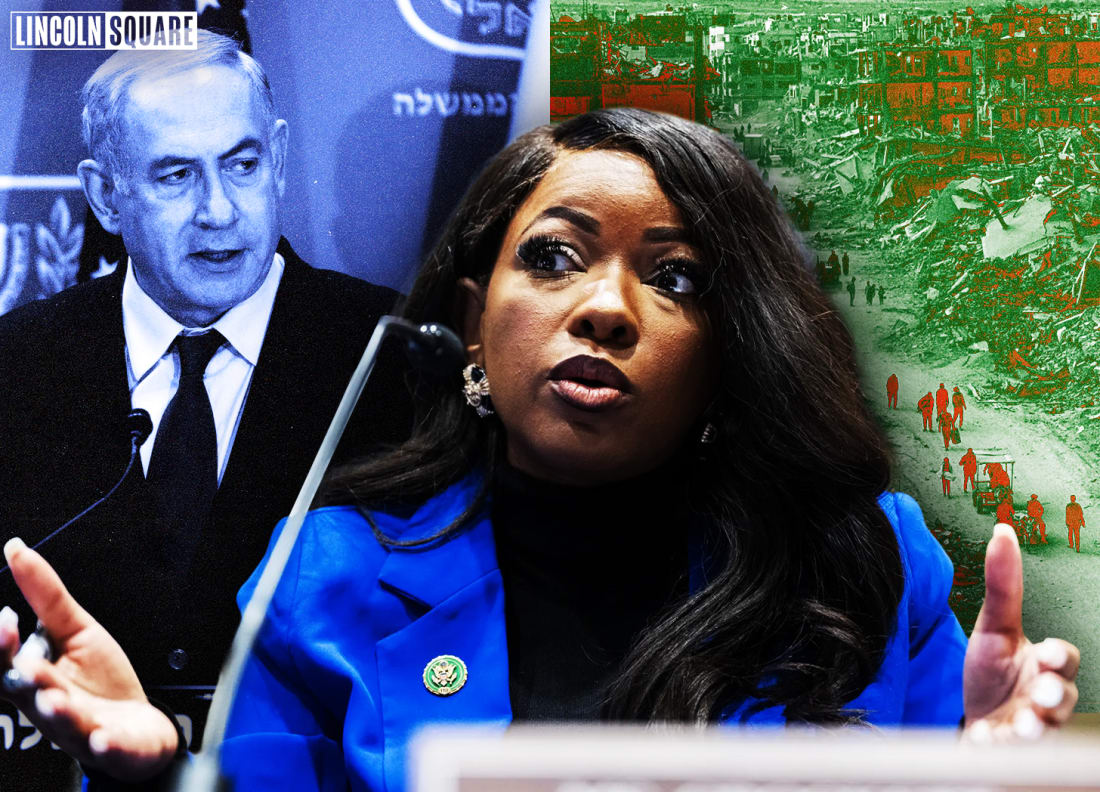
Which brings me to Jasmine Crockett.
If it feels like I’ve written about Crockett a lot lately, that’s because I have. In the last week alone, I’ve probably written about her more than any other Senate candidate — including candidates from my own state of California. I’ve already laid out my views in pieces like How Jasmine Crockett Turned Texas MAGA Inside Out and Why Democrats Keep Learning the Wrong Lessons from Attacks on Jasmine Crockett, and I’m not interested in repeating myself here.
What is worth examining is the sudden scrutiny she has faced over foreign policy — particularly Israel and Palestine.
Over the past week, Crockett has been accused of taking AIPAC money. That claim is false. She has also been criticized for supporting pro-Israel funding, which is true — but that criticism is almost always stripped of the most important context. Those votes were part of broader foreign-aid packages that included substantial humanitarian assistance directed toward civilians in Gaza, the West Bank, Ukraine, Sudan, Yemen, and other conflict zones through food aid, medical supplies, refugee assistance, and emergency relief programs.
In other words, these were not blank-check endorsements of Benjamin Netanyahu’s government, but bundled votes reflecting the messy, imperfect reality of U.S. foreign policy. The media, predictably, has done a poor job explaining this distinction — perhaps because nuance doesn’t travel well online, especially among the “foreign policy is actually very simple” wing of the Cenk Uygur–Ana Kasparian fan club.
So rather than rehashing those details yet again, it’s worth stepping back to explain why this issue becomes so distorted — and why Democrats like Crockett are judged so differently than Republicans on it.

Years ago, when I was still a teaching assistant, I learned this lesson the hard way. I was young, optimistic, and genuinely believed that teaching political science would be mostly about calmly exchanging ideas.
One day, while covering the Middle East around 2009 or 2010, the topic of Palestine came up. A Palestinian student stood up and said, plainly, that Israel was responsible for what had happened to his people. Almost immediately, an Israeli student stood up and responded by asking how many rockets had been fired into Israel, how many bombings his family had lived through.
Voices rose. Chairs moved. At some point I realized this was no longer a discussion — it was about to become a fight. I physically stepped between them. Eventually, cooler heads prevailed, they shook hands, and the class moved on. But the lesson stuck with me.
A few weeks later, I ran into the Palestinian student and told him that I imagined this issue must be incredibly tense for his family. He agreed — and then told me something I’ve never forgotten. His father had been a lifelong Democrat, but when Al Gore selected Joe Lieberman — a Jewish man — as his running mate in 2000, his father voted Republican for the first time in his life.
Not because of policy or ideology, but because of what that choice symbolized to him. That moment crystallized something fundamental about this issue: Israel and Palestine are not debated as abstract foreign policy questions. They are experienced through identity, trauma, memory, and symbolism — which is why nuance is so often the first casualty.
This brings me to the political psychology at work here.
What we are seeing play out with Crockett is a combination of asymmetric moral accountability and expectation–violation theory. Democrats are held to stricter moral standards precisely because they are perceived as persuadable, ethically serious, and capable of growth. Republicans are not judged as harshly because their positions are assumed to be fixed — not forgiven, but written off.
When a Democrat supports an ally, it’s framed as betrayal. When a Republican does the same thing — often with far fewer reservations and far more enthusiasm for leaders like Benjamin Netanyahu — it barely registers. Some of this outrage is genuine, some of it is amplified, and some of it is almost certainly manufactured by bots, bad-faith actors, and engagement-driven media ecosystems. That doesn’t mean the suffering in Palestine isn’t real; it means the outrage is selectively distributed.
Crockett has said something that should be uncontroversial in Political Science 101: the United States supports its allies. That statement is not radical or immoral — it is descriptive. Somehow, that basic acknowledgment has been translated into the claim that Crockett must therefore be an unapologetic cheerleader for Benjamin Netanyahu. That leap is not just absurd; it is intellectually dishonest.
Supporting an alliance is not the same thing as endorsing a leader, excusing atrocities, or abandoning moral judgment. Alliances exist for strategic reasons, often persist despite deeply flawed leadership, and rarely conform to the moral clarity activists wish they had.
Supporting an ally is not the same thing as endorsing every action taken by that ally’s leadership. Strategic alignment is not moral absolution. You can condemn Netanyahu’s atrocities while still understanding why Israel occupies a unique position in U.S. foreign policy. Explaining that reality is not the same as celebrating it.
And to be clear, I am not saying Crockett is a staunch Israel supporter, nor am I saying the United States should be. I am saying there are reasons that relationship exists — and pretending those reasons don’t matter does not make them disappear.
At some point, we also have to confront a more basic question. Crockett is a congresswoman. When she was running in Texas’s 30th District, how often do we honestly think foreign policy came up?
Look at her actual issue priorities. They are overwhelmingly domestic — healthcare, civil rights, economic justice — the things members of Congress are actually expected to deliver for their constituents. Foreign policy rarely decides local congressional races, and it’s not much better at the state level.
People do not enter local or state politics because they are itching to weigh in on geopolitics. They enter to fix problems in their communities. To pretend otherwise is disingenuous.
This matters even more when we talk about Black voters. Polling consistently shows that foreign policy — including Palestine — rarely cracks the top tier of issues driving Black voter behavior in 2025. That doesn’t mean Black voters don’t care; it means they are making rational choices about what most directly affects their lives.
Again, this is not how things should be. It is simply how they are.
And if we are suddenly going to impose foreign policy purity tests on candidates like Jasmine Crockett or Kamala Harris — a woman who has repeatedly been forced to absorb political costs for decisions she did not make — we need to be honest about what we’re doing.
Palestine is not the only place where innocent people are being bombed. It never has been. American foreign policy has been entangled in civilian suffering across regions and decades. Singling out one issue and weaponizing it selectively against Democrats does not create justice — it creates confusion and fragmentation.
So no, I am not shrugging off what is happening in Palestine, nor am I indifferent to innocent people being killed. What I am saying is that moral outrage without institutional realism leads to misplaced accountability — and misplaced accountability does not change foreign policy. It just weakens the coalitions most capable of changing anything at all.
Foreign policy is hard. History proves that. Pretending otherwise may feel righteous, but it doesn’t make it true.
I also want to be clear about something that seems to get lost in all of this: I have no doubt that Jasmine Crockett cares about Palestinians and about human suffering abroad. But she is running for the Texas State Senate, and that distinction matters.
Whoever ultimately holds that seat will not be setting U.S. foreign policy, negotiating ceasefires, or directing arms transfers — they will be legislating on behalf of Texans. And while foreign policy may animate online discourse, campaigns are won by speaking to the lived realities of voters: jobs, healthcare, civil rights, education, infrastructure, and economic stability. Expecting a state-level candidate to center her campaign on issues she will not control is not moral seriousness; it is political unseriousness. Crockett is doing what candidates are supposed to do — running to represent the people who will actually elect her — and confusing that with indifference is not only wrong, it’s a misunderstanding of how democracy works.
I want to start this by being clear about something that should not be controversial, but often is online: political scientists are not all experts in the same things.
Like most scholars, I have specific areas of focus. Mine are political behavior, political psychology, American government, and the First Amendment. That’s where I live intellectually — where I teach, research, and write most comfortably. And like every political scientist, I have working knowledge of foreign policy — you don’t get through a Ph.D. program without it — but that does not mean international relations is my primary specialty.
Anyone who has spent time in academia knows how this actually works. Departments don’t magically produce interchangeable experts like some sort of intellectual Costco bulk pack. Most of us have lanes. And yes, I’ve taught international relations before — but if I’m being honest, it was usually because the professor who normally taught it got sick, went on sabbatical, or the department was short on instructors that semester and started walking the halls asking, slightly panicked, “Does anyone here technically have a political science degree?” That’s not an indictment of the field. It’s just how universities actually function.
In fact, entire books have been written about how consistently bad the United States is at foreign policy once you zoom out and look past the victory speeches. Stephen Walt’s The Hell of Good Intentions is basically a book-length sigh explaining how American foreign policy elites keep repeating the same mistakes with great confidence and terrible results. With that in mind, I genuinely struggle to think of a single American president who was good at foreign policy in any holistic sense of the word — unless the standard is “made it through the term without accidentally destabilizing an entire region.”
Franklin D. Roosevelt was a towering figure in domestic policy. The New Deal fundamentally reshaped the relationship between Americans and their government, and its legacy still defines modern liberalism. Lyndon B. Johnson may well be the greatest domestic policy president in American history, with the Great Society giving us Medicare, Medicaid, the Civil Rights Act, and the Voting Rights Act — programs and protections that still shape American life today.
But for all of their domestic brilliance, both men were deeply flawed on foreign policy. FDR authorized the internment of Japanese Americans, failed to meaningfully confront the Holocaust as it was unfolding, and made concessions at Yalta that helped pave the way for decades of Cold War authoritarianism in Eastern Europe. LBJ’s escalation of the Vietnam War remains one of the most catastrophic foreign policy failures in American history — a war built on deception, sustained by sunk-cost logic, and devastating in both human and political terms.
And this pattern doesn’t stop there. Ronald Reagan is often credited with “winning” the Cold War, a claim that only works if you squint hard enough and ignore Iran-Contra, the enthusiastic backing of right-wing death squads in Central America, and a foreign policy doctrine that treated human rights as an optional add-on so long as communism was being annoyed somewhere. The mythology is tidy; the body count was not.
George H. W. Bush, who followed Reagan into office, ran a tactically successful Gulf War that is still praised in textbooks. But he left Saddam Hussein in power, entrenched America’s long-term military footprint in the Middle East, and — as a special domestic policy parting gift — gave us Clarence Thomas, which alone should give anyone pause before calling that era a golden age of judgment.
Bill Clinton is remembered as a peace-time president, yet his administration relied heavily on airstrikes, imposed sanctions that devastated civilian populations in Iraq, and failed catastrophically in Rwanda. George W. Bush — don’t even get me started — launched a war under false pretenses that destabilized an entire region, killed hundreds of thousands of civilians, and produced blowback we are still dealing with today.
You could argue Barack Obama had moments of foreign policy success. The operation that killed Osama bin Laden mattered, and the end of Saddam Hussein’s regime mattered. But those successes coexist with an expanded drone war, the collapse of Libya, and the inability to stop mass slaughter in Syria.
Joe Biden does not escape this pattern either. His administration presided over the chaotic withdrawal from Afghanistan — a war he did not start, but one he very much owned on the way out. The images from Kabul were not just a humanitarian failure; they were a foreign-policy and political one, reinforcing global perceptions of American incompetence and undercutting Democratic claims of steady leadership.
More recently, Biden’s decision to continue weapons transfers to Benjamin Netanyahu’s government — even as civilian casualties mounted and international criticism intensified — helped create a political mess that didn’t just stay in the realm of foreign policy. It bled directly into domestic politics, giving critics an opening to smear Kamala Harris and other Democrats as morally compromised, even when they had limited control over the policy itself. Once again, a Democratic administration absorbed the political cost of a foreign policy that neither party has historically handled well.
And now, in real time, we are watching Donald Trump level up the foreign policy disasters with a second, non-consecutive term that makes his first look like an undergraduate foreign-policy thesis turned in five minutes before the deadline. If you thought his first term was erratic — withdrawing from multilateral agreements, antagonizing allies, cozying up to authoritarians, and treating diplomacy like a personal grievance tour — his return has been a kaleidoscope of confusion and contradiction.
In 2025, he has threatened sweeping tariff hikes, including 100 percent tariffs, against countries that do not bend to his will on Ukraine, allies and major trade partners included. The result has been renewed fears of full-blown tariff wars and the very real possibility of pushing countries like India closer to rival powers such as Russia and China. European leaders have openly complained that Trump’s blunt attacks on the European Union and his dismissive treatment of NATO commitments have further fractured transatlantic unity and shaken confidence in U.S. leadership.
On Ukraine itself, Trump has floated so-called peace proposals that would require Kyiv to make major concessions or cede territory — an approach that has drawn sharp criticism from allies and Ukrainian officials alike. His administration’s turn toward punitive trade measures and aggressively transactional diplomacy has reinforced the perception that, under Trump, American foreign policy is driven less by strategy than by leverage and personal impulse. All of this follows a presidency in which Trump openly sought — and did not receive — a Nobel Peace Prize, a pursuit that was widely mocked at the time and looks even more absurd when placed next to the wreckage of his foreign-policy record.
So again, I ask a very basic question: which American president has actually been good at foreign policy? Because from my vantage point, the bar appears to be set somewhere between “didn’t start a catastrophic war” and “managed to leave office without accidentally destabilizing an entire region.”
And when I say good, I actually mean good — not “least bad,” not “better than the other guy,” and not “history will be kind because the alternative was worse.” I mean foreign policy that produces stability rather than blowback, reduces human suffering rather than redistributing it, and doesn’t require a decade of revisionist op-eds to explain why it was actually a success if you squint hard enough.
That question matters because it frames how we should think about the expectations we place on political actors today — especially those who are nowhere near the centers of foreign policy power.
Which brings me to Jasmine Crockett.
If it feels like I’ve written about Crockett a lot lately, that’s because I have. In the last week alone, I’ve probably written about her more than any other Senate candidate — including candidates from my own state of California. I’ve already laid out my views in pieces like How Jasmine Crockett Turned Texas MAGA Inside Out and Why Democrats Keep Learning the Wrong Lessons from Attacks on Jasmine Crockett, and I’m not interested in repeating myself here.
What is worth examining is the sudden scrutiny she has faced over foreign policy — particularly Israel and Palestine.
Over the past week, Crockett has been accused of taking AIPAC money. That claim is false. She has also been criticized for supporting pro-Israel funding, which is true — but that criticism is almost always stripped of the most important context. Those votes were part of broader foreign-aid packages that included substantial humanitarian assistance directed toward civilians in Gaza, the West Bank, Ukraine, Sudan, Yemen, and other conflict zones through food aid, medical supplies, refugee assistance, and emergency relief programs.
In other words, these were not blank-check endorsements of Benjamin Netanyahu’s government, but bundled votes reflecting the messy, imperfect reality of U.S. foreign policy. The media, predictably, has done a poor job explaining this distinction — perhaps because nuance doesn’t travel well online, especially among the “foreign policy is actually very simple” wing of the Cenk Uygur–Ana Kasparian fan club.
So rather than rehashing those details yet again, it’s worth stepping back to explain why this issue becomes so distorted — and why Democrats like Crockett are judged so differently than Republicans on it.
Years ago, when I was still a teaching assistant, I learned this lesson the hard way. I was young, optimistic, and genuinely believed that teaching political science would be mostly about calmly exchanging ideas.
One day, while covering the Middle East around 2009 or 2010, the topic of Palestine came up. A Palestinian student stood up and said, plainly, that Israel was responsible for what had happened to his people. Almost immediately, an Israeli student stood up and responded by asking how many rockets had been fired into Israel, how many bombings his family had lived through.
Voices rose. Chairs moved. At some point I realized this was no longer a discussion — it was about to become a fight. I physically stepped between them. Eventually, cooler heads prevailed, they shook hands, and the class moved on. But the lesson stuck with me.
A few weeks later, I ran into the Palestinian student and told him that I imagined this issue must be incredibly tense for his family. He agreed — and then told me something I’ve never forgotten. His father had been a lifelong Democrat, but when Al Gore selected Joe Lieberman — a Jewish man — as his running mate in 2000, his father voted Republican for the first time in his life.
Not because of policy or ideology, but because of what that choice symbolized to him. That moment crystallized something fundamental about this issue: Israel and Palestine are not debated as abstract foreign policy questions. They are experienced through identity, trauma, memory, and symbolism — which is why nuance is so often the first casualty.
This brings me to the political psychology at work here.
What we are seeing play out with Crockett is a combination of asymmetric moral accountability and expectation–violation theory. Democrats are held to stricter moral standards precisely because they are perceived as persuadable, ethically serious, and capable of growth. Republicans are not judged as harshly because their positions are assumed to be fixed — not forgiven, but written off.
When a Democrat supports an ally, it’s framed as betrayal. When a Republican does the same thing — often with far fewer reservations and far more enthusiasm for leaders like Benjamin Netanyahu — it barely registers. Some of this outrage is genuine, some of it is amplified, and some of it is almost certainly manufactured by bots, bad-faith actors, and engagement-driven media ecosystems. That doesn’t mean the suffering in Palestine isn’t real; it means the outrage is selectively distributed.
Crockett has said something that should be uncontroversial in Political Science 101: the United States supports its allies. That statement is not radical or immoral — it is descriptive. Somehow, that basic acknowledgment has been translated into the claim that Crockett must therefore be an unapologetic cheerleader for Benjamin Netanyahu. That leap is not just absurd; it is intellectually dishonest.
Supporting an alliance is not the same thing as endorsing a leader, excusing atrocities, or abandoning moral judgment. Alliances exist for strategic reasons, often persist despite deeply flawed leadership, and rarely conform to the moral clarity activists wish they had.
Supporting an ally is not the same thing as endorsing every action taken by that ally’s leadership. Strategic alignment is not moral absolution. You can condemn Netanyahu’s atrocities while still understanding why Israel occupies a unique position in U.S. foreign policy. Explaining that reality is not the same as celebrating it.
And to be clear, I am not saying Crockett is a staunch Israel supporter, nor am I saying the United States should be. I am saying there are reasons that relationship exists — and pretending those reasons don’t matter does not make them disappear.
At some point, we also have to confront a more basic question. Crockett is a congresswoman. When she was running in Texas’s 30th District, how often do we honestly think foreign policy came up?
Look at her actual issue priorities. They are overwhelmingly domestic — healthcare, civil rights, economic justice — the things members of Congress are actually expected to deliver for their constituents. Foreign policy rarely decides local congressional races, and it’s not much better at the state level.
People do not enter local or state politics because they are itching to weigh in on geopolitics. They enter to fix problems in their communities. To pretend otherwise is disingenuous.
This matters even more when we talk about Black voters. Polling consistently shows that foreign policy — including Palestine — rarely cracks the top tier of issues driving Black voter behavior in 2025. That doesn’t mean Black voters don’t care; it means they are making rational choices about what most directly affects their lives.
Again, this is not how things should be. It is simply how they are.
And if we are suddenly going to impose foreign policy purity tests on candidates like Jasmine Crockett or Kamala Harris — a woman who has repeatedly been forced to absorb political costs for decisions she did not make — we need to be honest about what we’re doing.
Palestine is not the only place where innocent people are being bombed. It never has been. American foreign policy has been entangled in civilian suffering across regions and decades. Singling out one issue and weaponizing it selectively against Democrats does not create justice — it creates confusion and fragmentation.
Kristoffer Ealy is a political science professor who teaches at California State University Fullerton. He writes The Thinking Class Substack is the author of the upcoming book, Political Illiteracy: Learning the Wrong Lessons.
 | A guest post by
|
Not ready to subscribe? Make a one-time donation of $10 or more to support our work amplifying the facts on social media, targeted to voters in red states and districts that we can help flip. Every $10 reaches 1000 Americans. The Truth needs a voice. Your donation will help us amplify it.
| ||||||||||

