|
January 2026
 MPCA honors environmental leader who restored her shoreline while educating her community
Kathy Wagner didn’t just take on a shoreline restoration project at her north-central Minnesota home, she took on a cause. Known for having a hand in many corners of local environmental advocacy, she balances hands-on conservation work with service on community boards and an active presence in her Cass County lakes community. That blend of personal action and public leadership earned her the 2025 Community Conservationist Award, presented by the Minnesota Pollution Control Agency (MPCA) and Minnesota Association of Soil and Water Conservation Districts (MASWCD).
“Kathy’s work shows what’s possible when homeowners recognize their role as caretakers of the land,” said Glenn Skuta, Watershed Division director for the MPCA. “At the MPCA, we often look at water quality on a large scale — entire watersheds and statewide trends. Efforts like hers remind us how much difference one person can make.”
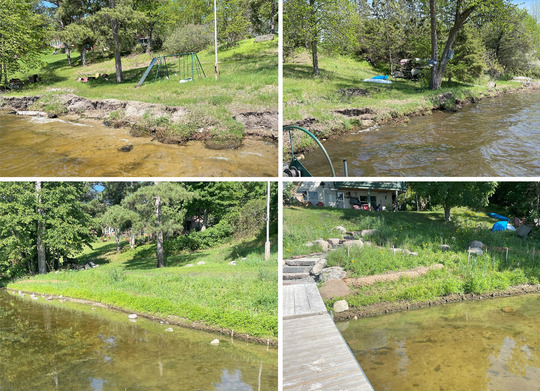 Photos taken before (top) and after restoration work on Kathy Wagner's shoreline property on Wabedo Lake, south of Longville, display improvements that will protect the land from erosion and the lake from sediment. (Courtesy Kathy Wagner)
Wagner’s most personal effort is shoreline restoration on Wabedo Lake, south of Longville, on property that once belonged to her parents’ resort, Wolf Lodge. The resort was the first on the lake, built in 1918, and Wagner’s family purchased the property in 1958. Wagner owns 230 feet of lakeshore and restored 150 feet of it.
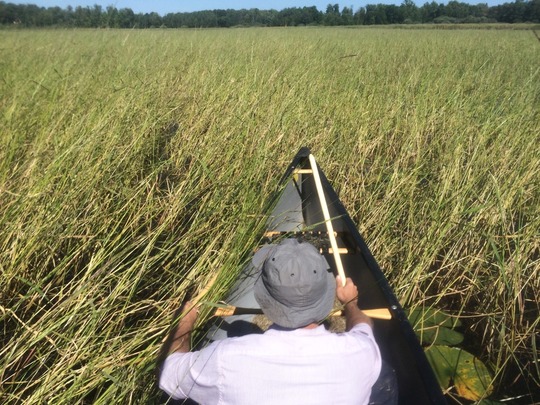 An MPCA scientist harvests wild rice seeds for growth experiments.
MPCA begins analysis of background sulfate levels in Minnesota waters
The Minnesota Pollution Control Agency (MPCA) remains committed to protecting Minnesota’s air, land, water, climate, and wild rice — along with its cultural and historical significance. We use data and science to drive our decisions and policies.
Agency decisions are grounded in science and the law. We are dedicated to working with others to continue to review new science and data as it becomes available. While the impact of sulfate and sulfide on ecosystems is well documented in published science, many have expressed concerns over the age of the sulfate standard, which was adopted in the 1970s. Additionally, data suggests that naturally occurring sulfate levels vary across Minnesota.
In partnership with independent researchers, the MPCA is beginning an evaluation of peer-reviewed science to validate the impacts of sulfate on wild rice. At the same time, the MPCA will work with academic experts to understand and document the variation in naturally occurring sulfate levels across the state.
We anticipate these two analyses will be completed in late 2026 and could inform the MPCA’s approach to implementing the 10 mg/L wild rice sulfate water quality standard. In the interim, potential paths forward for NPDES (water discharge) permits may include a temporary delay in permit development, a permit requirement to monitor for sulfate, or a sulfate limit based on the current water quality standard. These decisions will be made on a case-by-case basis in conversation with permit holders and applicants.
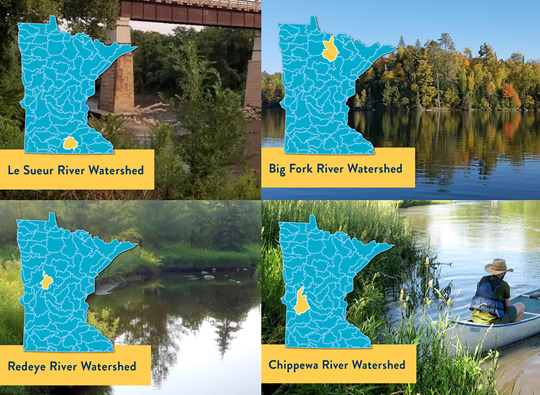
2025 WRAP-up: MPCA scientists aim for cleaner waters with updated research
Water scientists from the Minnesota Pollution Control Agency (MPCA) published four watershed restoration and protection strategy reports — often called WRAPS reports — in 2025, updating the data we need to keep Minnesota’s waters clean and protected. The research includes counting fish and bugs, testing for chemicals and sediment, and recommending steps for improvement.
This year’s reports build on efforts launched more than a decade ago to assess and restore each of the state’s 80 watersheds on a rotating 10-year schedule. Click the link below to read more about the watersheds around the Le Sueur River, Big Fork River, Redeye River, and Chippewa River.
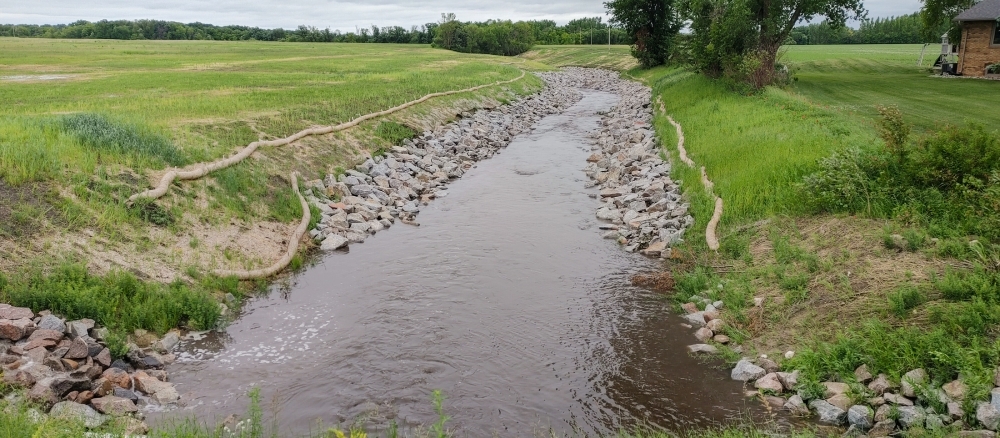
Red Lake River Watershed projects focus restoration where it matters most
In the Red Lake River Watershed, communities are teaming up to protect waters that locals love to play in and anglers love to fish, whether it’s tubing on a hot summer day, paddling a kayak, or chasing trophy smallmouth bass.
Planning, funding, and partnerships lie at the heart of this work. Behind the scenes, a dedicated team from the Pennington, West Polk, and Red Lake soil and water conservation districts; Red Lake Watershed District; the Minnesota Board of Water and Soil Resources; and the Minnesota Pollution Control Agency (MPCA) have led the charge to restore the watershed through science-based interventions.
“The Red Lake Watershed District has been very active on environmental issues. They’re geared toward making sure that water quality is good, not just drainage,” said Denise Oakes, a project manager for the MPCA.

As Minnesota prepares for a cold, snowy winter, MPCA urges smart salting practices
Snow and ice have finally arrived in much of Minnesota, and that brings the winter chore of clearing pavement — sometimes with salt. But when the snow melts or it rains, salt, which contains chloride, runs into storm drains and into nearby lakes, rivers, and groundwater.
The Minnesota Pollution Control Agency (MPCA) urges people to remember smart salting practices. Salt is commonly over-applied, sending too much chloride into our waterways and wreaking havoc for fish and other wildlife. Minnesotans can stay safe while doing their part this winter by minimizing salt use and using other tools to get the job done.
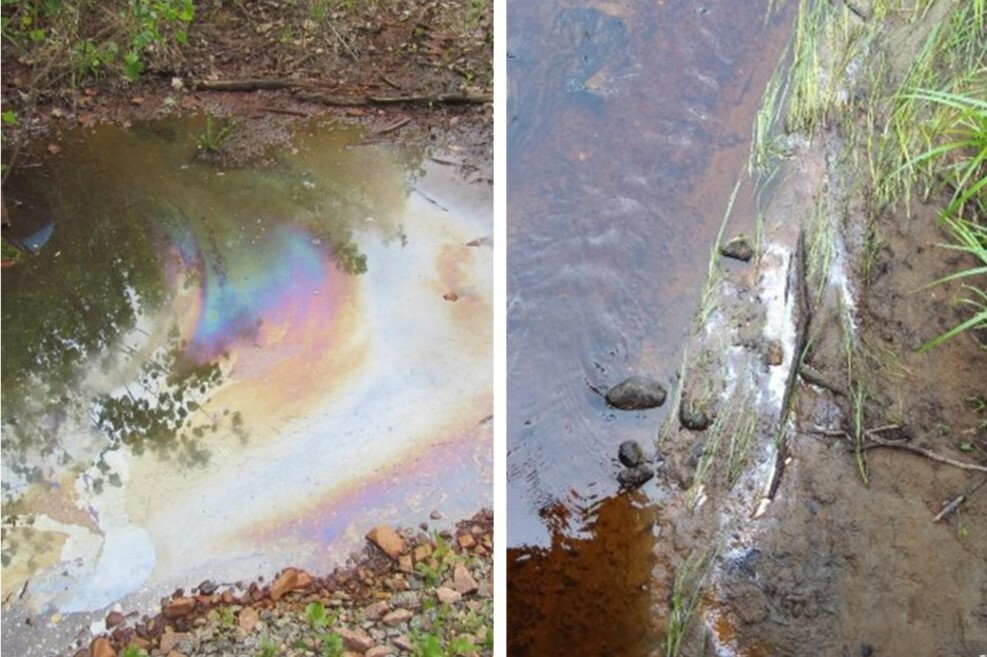 A petroleum sheen on water (left) compared to a natural bacteria sheen (right)
What does that sheen mean?
A colorful film on the water may look like an oil slick, but might be naturally occurring bacteria. One easy way to tell: break the sheen with a stick or rock! If it breaks into pieces, it's likely harmless and natural, as seen above. If it reforms quickly, or if there's a noticeable chemical odor, it may be petroleum-based, as seen below. While it's common to see a temporary sheen near stormwater outfalls, parking lots, or roads after rain, large, persistent sheens or suspected spills should be reported to the Minnesota Duty Officer at 800-422-0798.
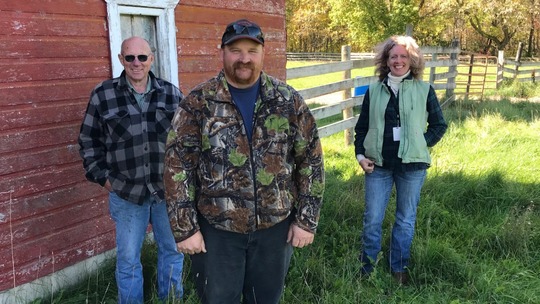 Bob Helle, his son Mike and Todd SWCD Manager Deja Anton
Manure pit closures improve safety, water
A 12-foot-deep manure pit once sat near Bob Helle’s dairy barn. It was one of 200 unused manure pits in Todd County identified in a 2017 inventory funded by a Minnesota Pollution Control Agency (MPCA) grant. By eliminating the risk of a spill or leak, pit closures protect both surface water and drinking water sources.
Since 2020, the Todd Soil & Water Conservation District staff has worked with landowners to voluntarily close nearly 60 unused manure pits, with support from $301,330 in U.S. Environmental Protection Agency grants from the MPCA. Six of those were closed in 2025.
Ag-Urban partnership forum events in January and February
Minnesota’s farmers, producers, local community organizations, watershed staff and others working to improve water quality are encouraged to attend the sixth annual Ag-Urban partnership forum. There are three opportunities to attend. Each event is free, but preregistration is required.
Jan. 7, 2026 – virtual event (9 a.m.-2 p.m.)
Jan. 28, 2026 – Minnesota State University, Moorhead (9 a.m.-2 p.m.)
Feb. 18, 2026 – Minnesota State University, Mankato (9 a.m.-2 p.m.)
Recent news releases
MPCA reports enforcement actions that affect water health across state
The MPCA posts news releases about enforcement actions on its website. Recent headlines include:
- Willmar company fined more than $12,000 for hazardous waste and industrial wastewater violations
- Koochiching County truck stop fined $25,000 for tank violations
- Bemidji septic system tank manufacturer fined $25,000 for potential sealing issue, to offer tank warranty to customers
- BNSF Railway fined $20,000 for stormwater and wastewater permit violations
- Fairmont ethanol plant fined more than $14,000 for four-day ethanol spill
|