
| From | Environment Colorado <[email protected]> |
| Subject | Bees: Teetering toward extinction |
| Date | December 29, 2025 3:16 PM |
Links have been removed from this email. Learn more in the FAQ.
Links have been removed from this email. Learn more in the FAQ.
:
John,
A wiggle to the left... a waggle to the right...
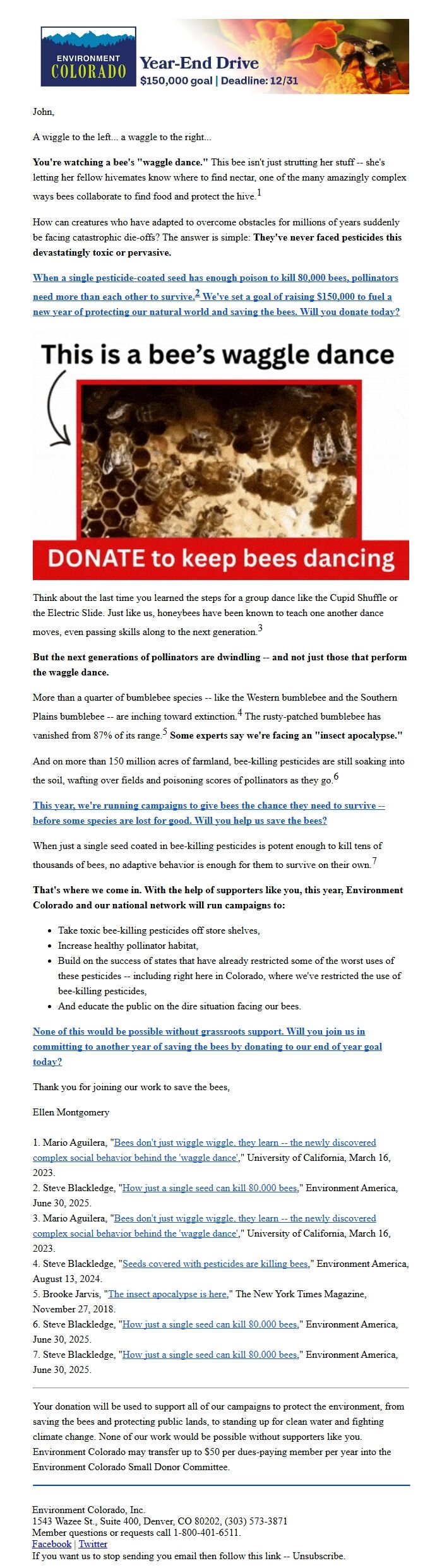
You're watching a bee's "waggle dance." This bee isn't just strutting her stuff -- she's letting her fellow hivemates know where to find nectar, one of the many amazingly complex ways bees collaborate to find food and protect the hive.[1]
How can creatures who have adapted to overcome obstacles for millions of years suddenly be facing catastrophic die-offs? The answer is simple: They've never faced pesticides this devastatingly toxic or pervasive.
When a single pesticide-coated seed has enough poison to kill 80,000 bees, pollinators need more than each other to survive.][2 We've set a goal of raising $150,000 to fuel a new year of protecting our natural world and saving the bees. Will you donate today?
[link removed]
Think about the last time you learned the steps for a group dance like the Cupid Shuffle or the Electric Slide. Just like us, honeybees have been known to teach one another dance moves, even passing skills along to the next generation.[3]
But the next generations of pollinators are dwindling -- and not just those that perform the waggle dance.
More than a quarter of bumblebee species -- like the Western bumblebee and the Southern Plains bumblebee -- are inching toward extinction.[4] The rusty-patched bumblebee has vanished from 87% of its range.[5] Some experts say we're facing an "insect apocalypse."
And on more than 150 million acres of farmland, bee-killing pesticides are still soaking into the soil, wafting over fields and poisoning scores of pollinators as they go.[6]
This year, we're running campaigns to give bees the chance they need to survive -- before some species are lost for good. Will you help us save the bees?
[link removed]
When just a single seed coated in bee-killing pesticides is potent enough to kill tens of thousands of bees, no adaptive behavior is enough for them to survive on their own.[7]
That's where we come in. With the help of supporters like you, this year, Environment Colorado and our national network will run campaigns to:
* Take toxic bee-killing pesticides off store shelves,
* Increase healthy pollinator habitat,
* Build on the success of states that have already restricted some of the worst uses of these pesticides -- including right here in Colorado, where we've restricted the use of bee-killing pesticides,
* And educate the public on the dire situation facing our bees.
None of this would be possible without grassroots support. Will you join us in committing to another year of saving the bees by donating to our end of year goal today?
[link removed]
Thank you for joining our work to save the bees,
Ellen Montgomery
1. Mario Aguilera, "Bees don't just wiggle wiggle, they learn -- the newly discovered complex social behavior behind the 'waggle dance'," University of California, March 16, 2023.
[link removed]
2. Steve Blackledge, "How just a single seed can kill 80,000 bees," Environment America, June 30, 2025.
[link removed]
3. Mario Aguilera, "Bees don't just wiggle wiggle, they learn -- the newly discovered complex social behavior behind the 'waggle dance'," University of California, March 16, 2023.
[link removed]
4. Steve Blackledge, "Seeds covered with pesticides are killing bees," Environment America, August 13, 2024.
[link removed]
5. Brooke Jarvis, "The insect apocalypse is here," The New York Times Magazine, November 27, 2018.
[link removed]
6. Steve Blackledge, "How just a single seed can kill 80,000 bees," Environment America, June 30, 2025.
[link removed]
7. Steve Blackledge, "How just a single seed can kill 80,000 bees," Environment America, June 30, 2025.
[link removed]
-----------------------------------------------------------
Your donation will be used to support all of our campaigns to protect the environment, from saving the bees and protecting public lands, to standing up for clean water and fighting climate change. None of our work would be possible without supporters like you. Environment Colorado may transfer up to $50 per dues-paying member per year into the Environment Colorado Small Donor Committee.
-----------------------------------------------------------
Join us on Facebook: [link removed]
Follow us on Twitter: [link removed]
Environment Colorado, Inc.
1543 Wazee St., Suite 400, Denver, CO 80202, (303) 573-3871
Member questions or requests call 1-800-401-6511.
If you want us to stop sending you email then follow this link: [link removed]
John,
A wiggle to the left... a waggle to the right...
You're watching a bee's "waggle dance." This bee isn't just strutting her stuff -- she's letting her fellow hivemates know where to find nectar, one of the many amazingly complex ways bees collaborate to find food and protect the hive.[1]
How can creatures who have adapted to overcome obstacles for millions of years suddenly be facing catastrophic die-offs? The answer is simple: They've never faced pesticides this devastatingly toxic or pervasive.
When a single pesticide-coated seed has enough poison to kill 80,000 bees, pollinators need more than each other to survive.][2 We've set a goal of raising $150,000 to fuel a new year of protecting our natural world and saving the bees. Will you donate today?
[link removed]
Think about the last time you learned the steps for a group dance like the Cupid Shuffle or the Electric Slide. Just like us, honeybees have been known to teach one another dance moves, even passing skills along to the next generation.[3]
But the next generations of pollinators are dwindling -- and not just those that perform the waggle dance.
More than a quarter of bumblebee species -- like the Western bumblebee and the Southern Plains bumblebee -- are inching toward extinction.[4] The rusty-patched bumblebee has vanished from 87% of its range.[5] Some experts say we're facing an "insect apocalypse."
And on more than 150 million acres of farmland, bee-killing pesticides are still soaking into the soil, wafting over fields and poisoning scores of pollinators as they go.[6]
This year, we're running campaigns to give bees the chance they need to survive -- before some species are lost for good. Will you help us save the bees?
[link removed]
When just a single seed coated in bee-killing pesticides is potent enough to kill tens of thousands of bees, no adaptive behavior is enough for them to survive on their own.[7]
That's where we come in. With the help of supporters like you, this year, Environment Colorado and our national network will run campaigns to:
* Take toxic bee-killing pesticides off store shelves,
* Increase healthy pollinator habitat,
* Build on the success of states that have already restricted some of the worst uses of these pesticides -- including right here in Colorado, where we've restricted the use of bee-killing pesticides,
* And educate the public on the dire situation facing our bees.
None of this would be possible without grassroots support. Will you join us in committing to another year of saving the bees by donating to our end of year goal today?
[link removed]
Thank you for joining our work to save the bees,
Ellen Montgomery
1. Mario Aguilera, "Bees don't just wiggle wiggle, they learn -- the newly discovered complex social behavior behind the 'waggle dance'," University of California, March 16, 2023.
[link removed]
2. Steve Blackledge, "How just a single seed can kill 80,000 bees," Environment America, June 30, 2025.
[link removed]
3. Mario Aguilera, "Bees don't just wiggle wiggle, they learn -- the newly discovered complex social behavior behind the 'waggle dance'," University of California, March 16, 2023.
[link removed]
4. Steve Blackledge, "Seeds covered with pesticides are killing bees," Environment America, August 13, 2024.
[link removed]
5. Brooke Jarvis, "The insect apocalypse is here," The New York Times Magazine, November 27, 2018.
[link removed]
6. Steve Blackledge, "How just a single seed can kill 80,000 bees," Environment America, June 30, 2025.
[link removed]
7. Steve Blackledge, "How just a single seed can kill 80,000 bees," Environment America, June 30, 2025.
[link removed]
-----------------------------------------------------------
Your donation will be used to support all of our campaigns to protect the environment, from saving the bees and protecting public lands, to standing up for clean water and fighting climate change. None of our work would be possible without supporters like you. Environment Colorado may transfer up to $50 per dues-paying member per year into the Environment Colorado Small Donor Committee.
-----------------------------------------------------------
Join us on Facebook: [link removed]
Follow us on Twitter: [link removed]
Environment Colorado, Inc.
1543 Wazee St., Suite 400, Denver, CO 80202, (303) 573-3871
Member questions or requests call 1-800-401-6511.
If you want us to stop sending you email then follow this link: [link removed]
Message Analysis
- Sender: Environment America
- Political Party: n/a
- Country: United States
- State/Locality: n/a
- Office: n/a
-
Email Providers:
- ActionKit