

John,
We've been recycling for decades.1 So why does plastic pollution continue to pile up?
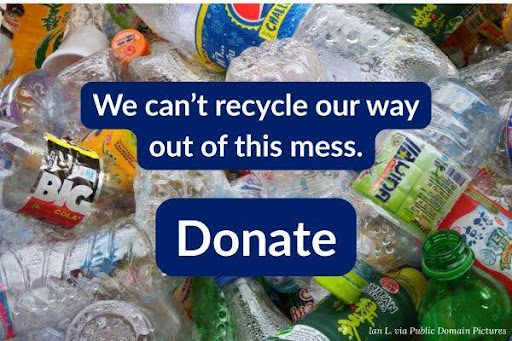
The answer is heartbreakingly simple: Plastic production is far outpacing plastic recycling, in large part because most plastic just isn't made to be recyclable.
If we want to reduce plastic pollution, we must let go of the notion that recycling alone will fix our plastic pollution problem.
Despite that "chasing arrows" symbol, most plastic products won't be recycled into new ones.
That's because less than 10% of all plastic gets recycled.2 The other 90% heads to landfills or incinerators. It also ends up in our oceans, parks and playgrounds.3
And while the plastics industry is now touting so-called "chemical recycling" as the miracle fix to plastic pollution, chemical recycling is nothing more than a dangerous distraction. In fact, it's an energy-intensive and polluting process that produces toxic chemicals and dirty fossil fuels emissions instead of recycled plastic.4
We're calling for real solutions to plastic pollution. Will you join us? Donate today.
Every year, the world makes more than 400 million tons of new plastic.5 If we want clean streets and oceans, we need to be honest: Recycling isn't keeping up. And when many plastics are just too hard or expensive to recycle, it can't keep up. Reduction is the best solution.
We also need to put our proverbial eggs in other baskets. That's why PIRG is working to reduce plastic pollution via a multi-pronged approach. We are:
- urging the Federal Trade Commission to require accurate recycling labels on plastic items, so you know whether that plastic bottle or package is really going to be recycled or not,
- petitioning America's biggest retailers to phase out unnecessary plastic packaging, and
- working to phase out the worst-single use plastics at the state level.
We have a goal to raise $100,000 by midnight on Dec 31. Will you help make meaningful reductions in plastic pollution by donating to End of Year Drive today?
Thank you,
Faye Park
President
1. Olivia B. Waxman, "The History of Recycling in America Is More Complicated Than You May Think," Time Magazine, Nov. 15, 2016.
2. Sandra Laville, "Just 9.5% of plastic made in 2022 used recycled material, study shows," The Guardian, April 10, 2025.
3. "A Whopping 91 Percent of Plastic Isn't Recycled," National Geographic, December 20, 2018.
4. Celeste Meiffren-Swango, James Horrox, Grace Vickers, et al., "'Chemical recycling': What you need to know," PIRG, July 14, 2025.
5. P.G.C. Nayanathara Thathsarani Pilapitiya and Amila Sandaruwan Ratnayake, "The world of plastic waste: A review," Cleaner Materials, last accessed December 1, 2025.
Your donation will power our dedicated staff of organizers, policy experts and attorneys who drive all of our campaigns in the public interest, from banning toxic pesticides and moving us beyond plastic, to saving our antibiotics and being your consumer watchdog, to protecting our environment and our democracy. None of our work would be possible without the support of people just like you.
Join us on Facebook | Follow us on Twitter
U.S. PIRG, Main Office: 1543 Wazee St., Suite 460, Denver, CO 80202, (303) 801-0582
Federal Advocacy Office: 600 Pennsylvania Ave. SE, 4th Fl., Washington, DC 20003, (202) 546-9707
Member Questions or Requests: 1-800-838-6554.

If you want us to stop sending you email then follow this link -- unsubscribe.