
| From | Liberty Fund <[email protected]> |
| Subject | Approaching America’s 250th Anniversary |
| Date | December 26, 2025 2:15 PM |
Links have been removed from this email. Learn more in the FAQ.
Links have been removed from this email. Learn more in the FAQ.
[link removed]
WEEK OF DECEMBER 21, 2025
** This Week on Liberty and the Declaration
------------------------------------------------------------
[link removed]
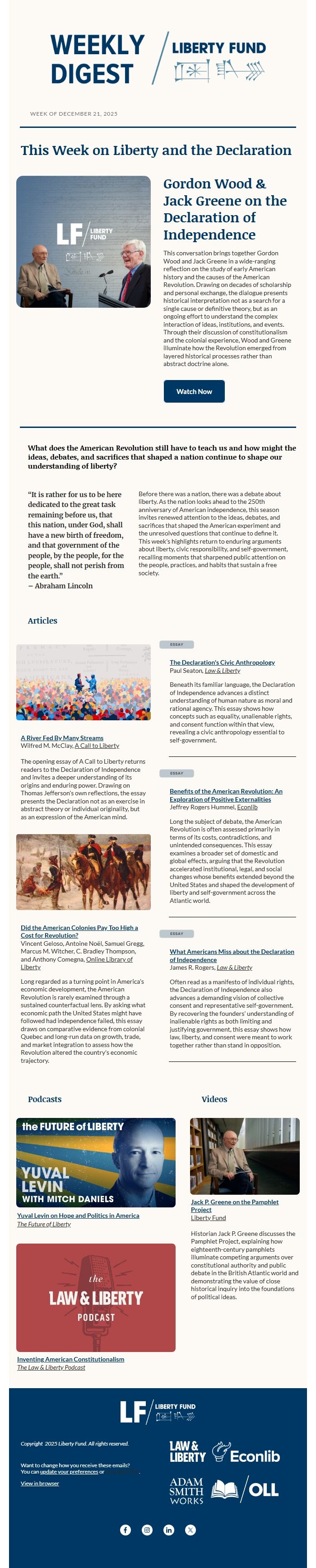
** Gordon Wood & Jack Greene on the Declaration of Independence ([link removed])
------------------------------------------------------------
This conversation brings together Gordon Wood and Jack Greene in a wide-ranging reflection on the study of early American history and the causes of the American Revolution. Drawing on decades of scholarship and personal exchange, the dialogue presents historical interpretation not as a search for a single cause or definitive theory, but as an ongoing effort to understand the complex interaction of ideas, institutions, and events. Through their discussion of constitutionalism and the colonial experience, Wood and Greene illuminate how the Revolution emerged from layered historical processes rather than abstract doctrine alone.
Watch Now ([link removed])
** What does the American Revolution still have to teach us and how might the ideas, debates, and sacrifices that shaped a nation continue to shape our understanding of liberty?
------------------------------------------------------------
** “It is rather for us to be here dedicated to the great task remaining before us, that this nation, under God, shall have a new birth of freedom, and that government of the people, by the people, for the people, shall not perish from the earth.”
------------------------------------------------------------
** – Abraham Lincoln
------------------------------------------------------------
Before there was a nation, there was a debate about liberty. As the nation looks ahead to the 250th anniversary of American independence, this season invites renewed attention to the ideas, debates, and sacrifices that shaped the American experiment and the unresolved questions that continue to define it. This week’s highlights return to enduring arguments about liberty, civic responsibility, and self-government, recalling moments that sharpened public attention on the people, practices, and habits that sustain a free society.
** Articles
------------------------------------------------------------
[link removed]
** A River Fed By Many Streams ([link removed])
------------------------------------------------------------
Wilfred M. McClay, A Call to Liberty ([link removed])
The opening essay of A Call to Liberty returns readers to the Declaration of Independence and invites a deeper understanding of its origins and enduring power. Drawing on Thomas Jefferson’s own reflections, the essay presents the Declaration not as an exercise in abstract theory or individual originality, but as an expression of the American mind.
[link removed]
** Did the American Colonies Pay Too High a Cost for Revolution? ([link removed])
------------------------------------------------------------
Vincent Geloso, Antoine Noël, Samuel Gregg, Marcus M. Witcher, C. Bradley Thompson, and Anthony Comegna, Online Library of Liberty ([link removed])
Long regarded as a turning point in America’s economic development, the American Revolution is rarely examined through a sustained counterfactual lens. By asking what economic path the United States might have followed had independence failed, this essay draws on comparative evidence from colonial Quebec and long-run data on growth, trade, and market integration to assess how the Revolution altered the country’s economic trajectory.
** The Declaration's Civic Anthropology ([link removed])
------------------------------------------------------------
Paul Seaton, Law & Liberty ([link removed])
Beneath its familiar language, the Declaration of Independence advances a distinct understanding of human nature as moral and rational agency. This essay shows how concepts such as equality, unalienable rights, and consent function within that view, revealing a civic anthropology essential to self-government.
** Benefits of the American Revolution: An Exploration of Positive Externalities ([link removed])
------------------------------------------------------------
Jeffrey Rogers Hummel, Econlib ([link removed])
Long the subject of debate, the American Revolution is often assessed primarily in terms of its costs, contradictions, and unintended consequences. This essay examines a broader set of domestic and global effects, arguing that the Revolution accelerated institutional, legal, and social changes whose benefits extended beyond the United States and shaped the development of liberty and self-government across the Atlantic world.
** What Americans Miss about the Declaration of Independence ([link removed])
------------------------------------------------------------
James R. Rogers, Law & Liberty ([link removed])
Often read as a manifesto of individual rights, the Declaration of Independence also advances a demanding vision of collective consent and representative self-government. By recovering the founders’ understanding of inalienable rights as both limiting and justifying government, this essay shows how law, liberty, and consent were meant to work together rather than stand in opposition.
** Podcasts
------------------------------------------------------------
[link removed]
** Yuval Levin on Hope and Politics in America ([link removed])
------------------------------------------------------------
The Future of Liberty ([link removed])
[link removed]
** Inventing American Constitutionalism ([link removed])
------------------------------------------------------------
The Law & Liberty Podcast ([link removed])
** Videos
------------------------------------------------------------
[link removed]
** Jack P. Greene on the Pamphlet Project ([link removed])
------------------------------------------------------------
Liberty Fund ([link removed])
Historian Jack P. Greene discusses the Pamphlet Project, explaining how eighteenth-century pamphlets illuminate competing arguments over constitutional authority and public debate in the British Atlantic world and demonstrating the value of close historical inquiry into the foundations of political ideas.
[link removed]
Copyright 2025 Liberty Fund. All rights reserved.
Want to change how you receive these emails?
You can update your preferences ([link removed]) or unsubscribe ([link removed]) .
View in browser ([link removed])
[link removed] [link removed]
[link removed] [link removed]
[link removed]
[link removed]
[link removed]
[link removed]
WEEK OF DECEMBER 21, 2025
** This Week on Liberty and the Declaration
------------------------------------------------------------
[link removed]
** Gordon Wood & Jack Greene on the Declaration of Independence ([link removed])
------------------------------------------------------------
This conversation brings together Gordon Wood and Jack Greene in a wide-ranging reflection on the study of early American history and the causes of the American Revolution. Drawing on decades of scholarship and personal exchange, the dialogue presents historical interpretation not as a search for a single cause or definitive theory, but as an ongoing effort to understand the complex interaction of ideas, institutions, and events. Through their discussion of constitutionalism and the colonial experience, Wood and Greene illuminate how the Revolution emerged from layered historical processes rather than abstract doctrine alone.
Watch Now ([link removed])
** What does the American Revolution still have to teach us and how might the ideas, debates, and sacrifices that shaped a nation continue to shape our understanding of liberty?
------------------------------------------------------------
** “It is rather for us to be here dedicated to the great task remaining before us, that this nation, under God, shall have a new birth of freedom, and that government of the people, by the people, for the people, shall not perish from the earth.”
------------------------------------------------------------
** – Abraham Lincoln
------------------------------------------------------------
Before there was a nation, there was a debate about liberty. As the nation looks ahead to the 250th anniversary of American independence, this season invites renewed attention to the ideas, debates, and sacrifices that shaped the American experiment and the unresolved questions that continue to define it. This week’s highlights return to enduring arguments about liberty, civic responsibility, and self-government, recalling moments that sharpened public attention on the people, practices, and habits that sustain a free society.
** Articles
------------------------------------------------------------
[link removed]
** A River Fed By Many Streams ([link removed])
------------------------------------------------------------
Wilfred M. McClay, A Call to Liberty ([link removed])
The opening essay of A Call to Liberty returns readers to the Declaration of Independence and invites a deeper understanding of its origins and enduring power. Drawing on Thomas Jefferson’s own reflections, the essay presents the Declaration not as an exercise in abstract theory or individual originality, but as an expression of the American mind.
[link removed]
** Did the American Colonies Pay Too High a Cost for Revolution? ([link removed])
------------------------------------------------------------
Vincent Geloso, Antoine Noël, Samuel Gregg, Marcus M. Witcher, C. Bradley Thompson, and Anthony Comegna, Online Library of Liberty ([link removed])
Long regarded as a turning point in America’s economic development, the American Revolution is rarely examined through a sustained counterfactual lens. By asking what economic path the United States might have followed had independence failed, this essay draws on comparative evidence from colonial Quebec and long-run data on growth, trade, and market integration to assess how the Revolution altered the country’s economic trajectory.
** The Declaration's Civic Anthropology ([link removed])
------------------------------------------------------------
Paul Seaton, Law & Liberty ([link removed])
Beneath its familiar language, the Declaration of Independence advances a distinct understanding of human nature as moral and rational agency. This essay shows how concepts such as equality, unalienable rights, and consent function within that view, revealing a civic anthropology essential to self-government.
** Benefits of the American Revolution: An Exploration of Positive Externalities ([link removed])
------------------------------------------------------------
Jeffrey Rogers Hummel, Econlib ([link removed])
Long the subject of debate, the American Revolution is often assessed primarily in terms of its costs, contradictions, and unintended consequences. This essay examines a broader set of domestic and global effects, arguing that the Revolution accelerated institutional, legal, and social changes whose benefits extended beyond the United States and shaped the development of liberty and self-government across the Atlantic world.
** What Americans Miss about the Declaration of Independence ([link removed])
------------------------------------------------------------
James R. Rogers, Law & Liberty ([link removed])
Often read as a manifesto of individual rights, the Declaration of Independence also advances a demanding vision of collective consent and representative self-government. By recovering the founders’ understanding of inalienable rights as both limiting and justifying government, this essay shows how law, liberty, and consent were meant to work together rather than stand in opposition.
** Podcasts
------------------------------------------------------------
[link removed]
** Yuval Levin on Hope and Politics in America ([link removed])
------------------------------------------------------------
The Future of Liberty ([link removed])
[link removed]
** Inventing American Constitutionalism ([link removed])
------------------------------------------------------------
The Law & Liberty Podcast ([link removed])
** Videos
------------------------------------------------------------
[link removed]
** Jack P. Greene on the Pamphlet Project ([link removed])
------------------------------------------------------------
Liberty Fund ([link removed])
Historian Jack P. Greene discusses the Pamphlet Project, explaining how eighteenth-century pamphlets illuminate competing arguments over constitutional authority and public debate in the British Atlantic world and demonstrating the value of close historical inquiry into the foundations of political ideas.
[link removed]
Copyright 2025 Liberty Fund. All rights reserved.
Want to change how you receive these emails?
You can update your preferences ([link removed]) or unsubscribe ([link removed]) .
View in browser ([link removed])
[link removed] [link removed]
[link removed] [link removed]
[link removed]
[link removed]
[link removed]
[link removed]
Message Analysis
- Sender: Liberty Fund
- Political Party: n/a
- Country: United States
- State/Locality: n/a
- Office: n/a
-
Email Providers:
- MailChimp