
Email
Ending outdated animal tests means better health for people, safer animals
| From | Wayne Pacelle <[email protected]> |
| Subject | Ending outdated animal tests means better health for people, safer animals |
| Date | December 24, 2025 4:44 PM |
Links have been removed from this email. Learn more in the FAQ.
Links have been removed from this email. Learn more in the FAQ.
͏ ͏ ͏ ͏ ͏ ͏ ͏ ͏ ͏ ͏ ͏ ͏ ͏ ͏ ͏ ͏ ͏ ͏ ͏ ͏ ͏ ͏ ͏ ͏ ͏ ͏ ͏ ͏ ͏ ͏ ͏ ͏ ͏ ͏ ͏ ͏ ͏ ͏ ͏ ͏ ͏ ͏ ͏ ͏ ͏ ͏ ͏ ͏ ͏ ͏ ͏ ͏ ͏ ͏ ͏ ͏ ͏ ͏ ͏ ͏ ͏ ͏ ͏ ͏ ͏ ͏ ͏ ͏ ͏ ͏ ͏ ͏ ͏ ͏ ͏ ͏ ͏ ͏ ͏ ͏ ͏ ͏ ͏ ͏ ͏ ͏ ͏ ͏ ͏ ͏ ͏ ͏ ͏ ͏ ͏ ͏ ͏ ͏ ͏ ͏ ͏ ͏ ͏ ͏ ͏ ͏ ͏ ͏ ͏ ͏ ͏ ͏ ͏ ͏ ͏ ͏ ͏If you’d like to unsubscribe, click here. [[link removed]]
[link removed] [[link removed]]
Dear Friend,
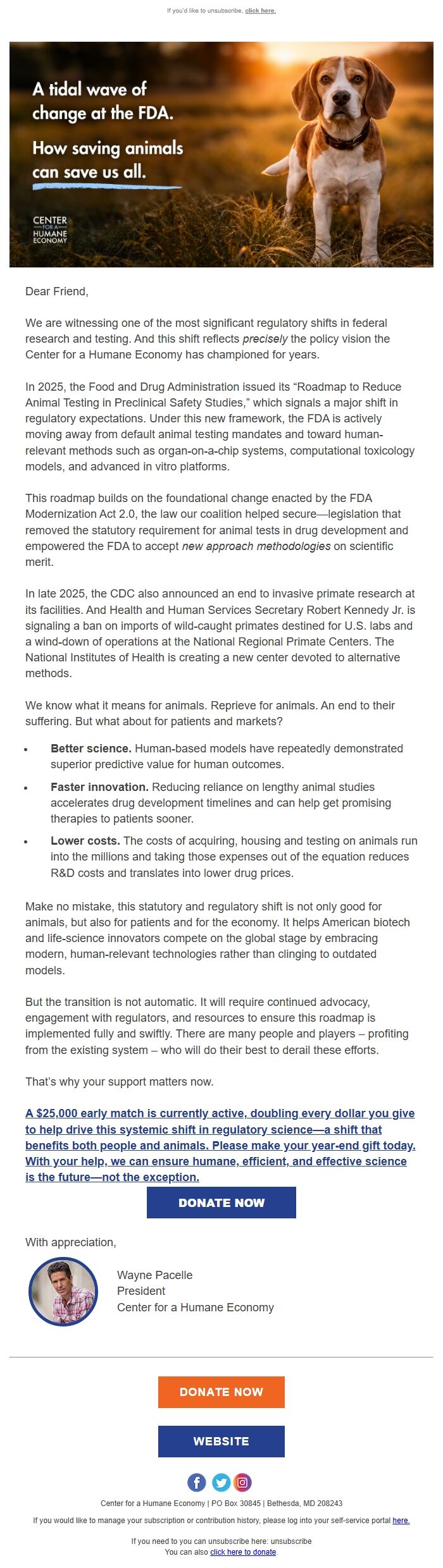
We are witnessing one of the most significant regulatory shifts in federal research and testing. And this shift reflects precisely the policy vision the Center for a Humane Economy has championed for years.
In 2025, the Food and Drug Administration issued its “Roadmap to Reduce Animal Testing in Preclinical Safety Studies,” which signals a major shift in regulatory expectations. Under this new framework, the FDA is actively moving away from default animal testing mandates and toward human-relevant methods such as organ-on-a-chip systems, computational toxicology models, and advanced in vitro platforms.
This roadmap builds on the foundational change enacted by the FDA Modernization Act 2.0, the law our coalition helped secure—legislation that removed the statutory requirement for animal tests in drug development and empowered the FDA to accept new approach methodologies on scientific merit.
In late 2025, the CDC also announced an end to invasive primate research at its facilities. And Health and Human Services Secretary Robert Kennedy Jr. is signaling a ban on imports of wild-caught primates destined for U.S. labs and a wind-down of operations at the National Regional Primate Centers. The National Institutes of Health is creating a new center devoted to alternative methods.
We know what it means for animals. Reprieve for animals. An end to their suffering. But what about for patients and markets?
* Better science. Human-based models have repeatedly demonstrated superior predictive value for human outcomes.
* Faster innovation. Reducing reliance on lengthy animal studies accelerates drug development timelines and can help get promising therapies to patients sooner.
* Lower costs. The costs of acquiring, housing and testing on animals run into the millions and taking those expenses out of the equation reduces R&D costs and translates into lower drug prices.
Make no mistake, this statutory and regulatory shift is not only good for animals, but also for patients and for the economy. It helps American biotech and life-science innovators compete on the global stage by embracing modern, human-relevant technologies rather than clinging to outdated models.
But the transition is not automatic. It will require continued advocacy, engagement with regulators, and resources to ensure this roadmap is implemented fully and swiftly. There are many people and players – profiting from the existing system – who will do their best to derail these efforts.
That’s why your support matters now.
A $25,000 early match is currently active, doubling every dollar you give to help drive this systemic shift in regulatory science—a shift that benefits both people and animals. Please make your year-end gift today. With your help, we can ensure humane, efficient, and effective science is the future—not the exception. [[link removed]]
DONATE NOW [[link removed]]
With appreciation,
Wayne Pacelle [[link removed]] Wayne Pacelle
President
Center for a Humane Economy
[[link removed]] DONATE NOW [[link removed]]
[[link removed]] WEBSITE [[link removed]]
[link removed] [[link removed]] [link removed] [[link removed]] [link removed] [[link removed]]
Center for a Humane Economy | PO Box 30845 | Bethesda, MD 208243
If you would like to manage your subscription or contribution history, please log into your self-service portal here. [[link removed]]
If you need to you can unsubscribe here: unsubscribe: [link removed]
You can also click here to donate [[link removed]] .
[link removed] [[link removed]]
Dear Friend,
We are witnessing one of the most significant regulatory shifts in federal research and testing. And this shift reflects precisely the policy vision the Center for a Humane Economy has championed for years.
In 2025, the Food and Drug Administration issued its “Roadmap to Reduce Animal Testing in Preclinical Safety Studies,” which signals a major shift in regulatory expectations. Under this new framework, the FDA is actively moving away from default animal testing mandates and toward human-relevant methods such as organ-on-a-chip systems, computational toxicology models, and advanced in vitro platforms.
This roadmap builds on the foundational change enacted by the FDA Modernization Act 2.0, the law our coalition helped secure—legislation that removed the statutory requirement for animal tests in drug development and empowered the FDA to accept new approach methodologies on scientific merit.
In late 2025, the CDC also announced an end to invasive primate research at its facilities. And Health and Human Services Secretary Robert Kennedy Jr. is signaling a ban on imports of wild-caught primates destined for U.S. labs and a wind-down of operations at the National Regional Primate Centers. The National Institutes of Health is creating a new center devoted to alternative methods.
We know what it means for animals. Reprieve for animals. An end to their suffering. But what about for patients and markets?
* Better science. Human-based models have repeatedly demonstrated superior predictive value for human outcomes.
* Faster innovation. Reducing reliance on lengthy animal studies accelerates drug development timelines and can help get promising therapies to patients sooner.
* Lower costs. The costs of acquiring, housing and testing on animals run into the millions and taking those expenses out of the equation reduces R&D costs and translates into lower drug prices.
Make no mistake, this statutory and regulatory shift is not only good for animals, but also for patients and for the economy. It helps American biotech and life-science innovators compete on the global stage by embracing modern, human-relevant technologies rather than clinging to outdated models.
But the transition is not automatic. It will require continued advocacy, engagement with regulators, and resources to ensure this roadmap is implemented fully and swiftly. There are many people and players – profiting from the existing system – who will do their best to derail these efforts.
That’s why your support matters now.
A $25,000 early match is currently active, doubling every dollar you give to help drive this systemic shift in regulatory science—a shift that benefits both people and animals. Please make your year-end gift today. With your help, we can ensure humane, efficient, and effective science is the future—not the exception. [[link removed]]
DONATE NOW [[link removed]]
With appreciation,
Wayne Pacelle [[link removed]] Wayne Pacelle
President
Center for a Humane Economy
[[link removed]] DONATE NOW [[link removed]]
[[link removed]] WEBSITE [[link removed]]
[link removed] [[link removed]] [link removed] [[link removed]] [link removed] [[link removed]]
Center for a Humane Economy | PO Box 30845 | Bethesda, MD 208243
If you would like to manage your subscription or contribution history, please log into your self-service portal here. [[link removed]]
If you need to you can unsubscribe here: unsubscribe: [link removed]
You can also click here to donate [[link removed]] .
Message Analysis
- Sender: Center for a Humane Economy
- Political Party: n/a
- Country: United States
- State/Locality: n/a
- Office: n/a
-
Email Providers:
- EveryAction