|
 |
This content is available for free to all subscribers. But you really should consider a paid subscription. This unlocks our afternoon e-mails, our Saturday “What is Jon Reading” e-mail, and analysis on breaking news. Normally a subscription is a modest $7 a month or just $70 for the year.
New UC Labor Study Is Being Used to Justify More Health Care Spending
California officials are pointing to new University of California "research" to argue for extending federal health subsidies — and expanding them further
|

| |||||||||||||||


 |
⏱️ 7 minute read
Sacramento Liberals Are Seeking to Frame the Health Care Debate
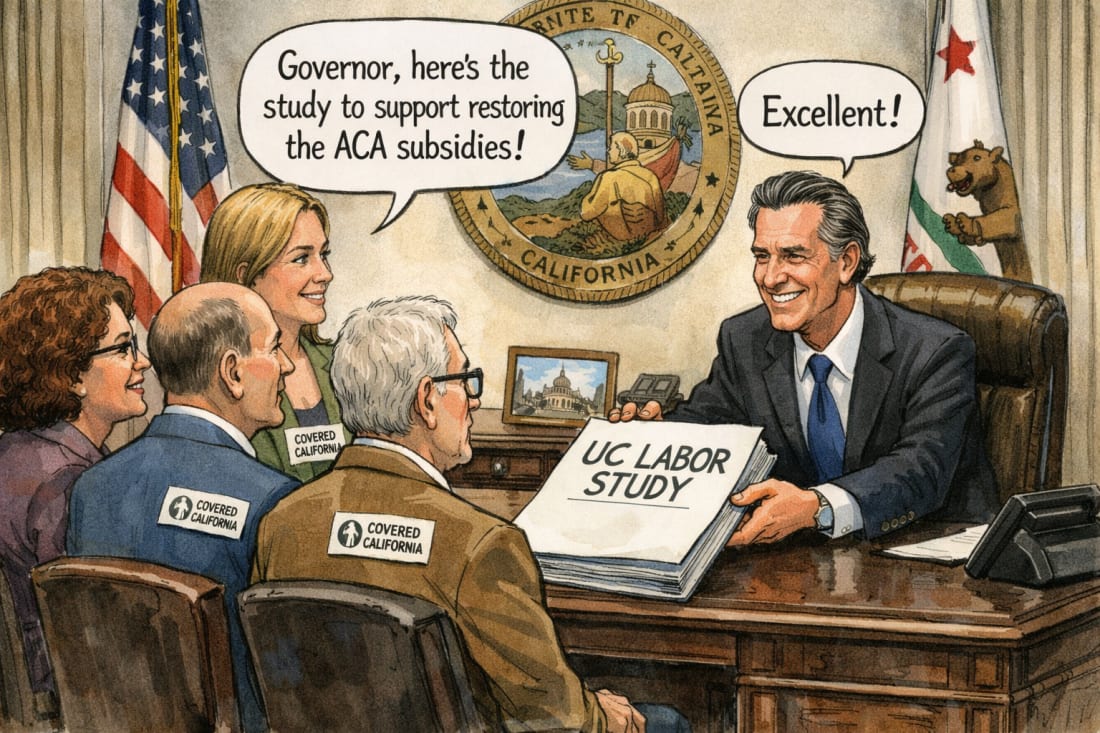
Yesterday’s Sacramento Bee featured a story about a new University of California-backed study that Sacramento officials are already using to make a familiar argument: enhanced federal Obamacare subsidies should be extended and probably expanded to prevent higher insurance premiums. They claim that letting these subsidies expire will increase costs not only for people getting government help, but also for Californians who pay full price for coverage.
This is not happening in isolation. Governor Gavin Newsom has made keeping and expanding Obamacare subsidies a primary goal of his administration, and his office is actively urging Congress to restore the enhanced subsidies that recently expired. When state agencies and UC researchers create studies that assume more government spending is the answer, those reports become part of a larger push to support the governor’s health care agenda in Sacramento and beyond.
Who Is Making This Argument — and Why It Matters
Before taking warnings about premium increases at face value, it’s important to consider who is making these arguments and their perspective. The current analysis comes from the University of California system and is being promoted by Covered California officials. These groups are not neutral. They are publicly funded and part of a state government that has long supported bigger public programs and more centralized control in health care.
This context is important because the study’s conclusion—that more federal subsidies are the only real solution—fits perfectly with that point of view. When research starts with the idea that government expansion is needed and good, the outcome is almost always predictable. This doesn’t mean the data is made up, but it does mean the perspective is narrow and the policy options considered are limited from the start.
Study Comes from Labor and Government Funded Left-Wing Source
The background of the study also warrants closer examination. The UC Berkeley Labor Center is not a neutral research group. It is a pro-labor advocacy center within Berkeley’s Institute for Research on Labor and Employment, and its mission is to support union power and expand government-backed worker programs. It works closely with unions, progressive advocacy groups, and government agencies.
Not surprisingly, the center’s research almost always supports the goals of organized labor, such as more subsidies, higher public spending, and a larger federal role in health care. This matters because both labor groups and government agencies benefit from a system built on subsidies, which increases budgets and bureaucracy while reducing pressure to control costs or enact fundamental reforms.
A Circular Argument Disguised as Economics
At its core, the study advances a simple claim: when subsidies expire, healthier people drop coverage, the insurance pool becomes sicker, and premiums rise. Therefore, subsidies must continue. What goes unexamined is why the system is so fragile to begin with.
Obamacare’s structure is treated as something that can’t be changed. High premiums are taken for granted instead of questioned. The study doesn’t really look at whether required benefits, standardized plans, and limits on cheaper options pushed younger and healthier people out of the market. Instead, the current expensive system is seen as unavoidable, and that idea is then used to argue for more spending. This is more of a policy loop than a proper economic analysis.
Subsidies Don’t Reduce Costs — They Hide Them
Even the Bee article admits that subsidies don’t actually lower health care costs. Hospital prices stay the same, drug costs don’t go down, and provider bills don’t get smaller. The federal government pays a bigger part of the total bill.
Shielding consumers from real prices reduces their awareness of costs and weakens competition. When patients don’t see the actual costs, and insurers know that subsidies will soften premium hikes, there’s less pressure to control spending. Over time, subsidies cease to be a temporary measure and become a permanent support, keeping enrollment steady but locking in high costs.
The Fiscal Context That Rarely Gets Mentioned
All of this is occurring while a larger financial issue is largely ignored. The federal government’s debt is on track to exceed $40 trillion, and borrowing is replacing real reform. This means today’s spending is financed with future money, placing the burden on future taxpayers for programs that current leaders don’t want to rethink.
Right now, Washington seems less like a careful manager and more like a household that has maxed out its credit cards but keeps spending as if there’s no limit. This reality should be part of any honest discussion about expanding long-term federal commitments.
Reduced Choice Wasn’t an Accident
The UC-backed analysis also leaves out consumer choice. Obamacare eliminated many lower-cost, high-deductible, and catastrophic plans through regulations. Standardized plans replaced these with more benefits but much higher premiums.
When younger and healthier people left the market, policymakers didn’t rethink plan design or allow more flexibility. Instead, they chose to add more subsidies. This shows a strong preference for centralized solutions over local adjustments, which is a big part of California’s political culture.
One Size Does Not Fit Fifty States
Health care costs, willingness to pay taxes, and political priorities vary widely across the country. What California voters accept might not work for people in other states. Still, the current debate assumes a single national solution run from Washington and financed through federal borrowing.
This goes against the federalist system the founders envisioned, in which states have the power to balance services and taxes based on local needs. If Californians want larger health programs, that should be debated openly at the state level, along with the taxes needed to fund them. Other states should be able to make their own choices.
Costs Don’t Disappear — They Shift
State officials warn that people without insurance delay care and use emergency rooms, which shifts costs to everyone else. This is a genuine concern, but it’s also a predictable result of a highly regulated and unclear market. These costs spread out, and now the federal government spends more each year on debt interest than on national defense—a number that will only rise as borrowing increases.
So, Does It Matter?
This matters because the subsidies now seen as essential were first introduced as temporary measures during COVID, not as permanent commitments. But once the spending starts, people expect it to continue. What was temporary becomes the new normal, and any attempt to change course is seen as harsh instead of a financial reality.
A system that constantly needs intervention to keep going isn’t stable. It’s fragile, costly, and increasingly out of touch with the people who have to pay for it.
One last point: Governor Gavin Newsom is not just watching this debate. His administration has made keeping and expanding Obamacare subsidies a primary policy goal, and it is actively urging Congress to restore the enhanced subsidies that recently expired. When state agencies and UC researchers create studies that assume more government spending is the answer, those reports become political tools used to support the governor’s larger health care agenda nationally.
Note: I refuse to refer to Obamacare as it’s Democratic authors named it, the “Affordable Care Act” — when that is not at all what it does. I call this Obamacare because then-President Obama forced this big spending policy through on a party-line vote.
You’re currently a free subscriber to So, Does It Matter? California Politics! For the full experience, upgrade your subscription. See how much more you get with an inexpensive, paid subscription, but clicking the button below! Support me in providing hard-hitting, clear-eyed analysis of California politics. I am beholding to no one, and sugar-coat nothing!
| ||||||||||

