Governor Ferguson announces supplemental budget
Governor’s supplemental budget balances without raising taxes on Washingtonians
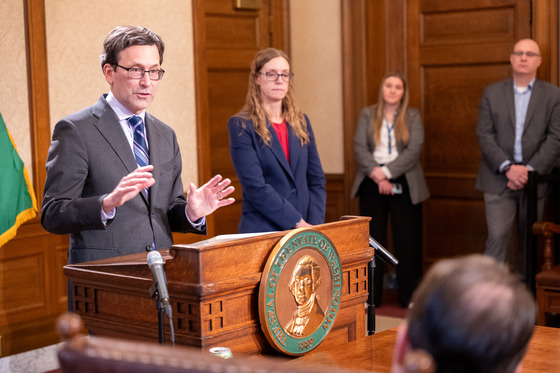 Watch the full press conference here. More photos available here.
OLYMPIA – Today, Governor Bob Ferguson announced his supplemental operating budget proposal. The Governor’s budget does not raise taxes, eliminates tax breaks for corporations, preserves access for reproductive health care and maintains core services, like K-12 education, while making important investments in affordability, including maintaining the Working Families Tax Credit.
The Governor announced his transportation and housing budget priorities late last week.
“Despite a challenging situation, my combined budgets move our state forward in significant ways,” Governor Ferguson said. “We will continue our momentum in modernizing our ferry fleet. We will make historic investments in housing and infrastructure. We can provide hundreds of millions of dollars for tax credits for Washingtonians. We can, and must, responsibly deal with the impacts of the Trump Administration. My budgets provide a path. I look forward to working with legislators in the coming months to keep moving our state forward.”
After plugging a $16 billion budget hole last legislative session, Washington has faced more challenges, including falling revenue, rising costs, and cuts and chaos coming from the Trump Administration. Due to caseload increases and other costs, the state is facing another $1.6 billion dollar shortfall in this supplemental budget.
In addition, state agencies submitted $2 billion in budget requests they described as critically needed. Governor Ferguson’s budget funds $700 million of those requests.
For example:
- $18.4 million to fund health care for Washingtonians who became ineligible for Medicaid overnight when President Trump signed H.R. 1 – the Big Betrayal Bill. These are individuals who are very ill or disabled, many of whom are at risk of losing their housing if they do not have health care coverage;
- $6.6 million to protect our farms and agriculture from pests that destroy crops and impact our economy;
- And $15 million for ongoing support of the University of Washington’s Center for Behavioral Health and Learning, to help those struggling with serious physical and behavioral health problems.
As a result of those $700 million in essential services, that put the problem to solve at $2.3 billion. Here’s how the budget solves for the shortfall:
- Ending two tax exemptions for large corporations to save $89 million a year;
- Using $123 million in unspent money from funds across state government;
- $797 million in reductions to state agencies — including administrative reductions — reducing recent expansions and increases to programs, and delayed implementation of programs;
- Temporarily changing how the state allocates Capital Gains Tax funds, Department of Revenue request legislation on insurance premiums taxes and shifting other non-tax resources for a savings of $300 million;
- Utilizing $1 billion from the Rainy Day Fund.
Trump impacts
Part of the reason for the state’s continued shortfall is the devastating impacts from cynical and chaotic federal policy from the Trump Administration.
For example, as one of the country’s most trade-dependent states, President Trump’s tariffs hit Washington state especially hard. Earlier this year, our state finance office did a detailed analysis of the impacts of these tariffs. They concluded that the tariffs will mean significantly higher costs for Washington families, the loss of tens of thousands of Washington jobs and billions of dollars in lost state revenue.
Washington working families and businesses are already feeling the impacts.
On top of that, H.R. 1 directly impacts our state budget.
This biennium alone, the Big Betrayal Bill will cost our state at least $165 million. That includes $15.9 million to implement new work requirements for SNAP recipients.
Another $20.6 million will go toward IT costs for implementing requirements of H.R. 1.
Starting in October 2026, Washington will be required to increase our fund match for SNAP’s administrative costs from 50% to 75%. We project that will cost $45.7 million.
The Trump Administration also kicked approximately 30,000 refugees, asylees and other immigrants with lawful status off of the Supplemental Nutrition Assistance Program, knows as SNAP.
State law requires that we provide state-level food benefits to anyone who would qualify for SNAP, but do not receive benefits based solely on their lawful immigration status — my budget includes $49 million for these food benefits.
Washington is still protecting access to reproductive health care by backfilling the federal Medicaid funding for Planned Parenthood after the Trump Administration made its draconian cut. That’s an estimated $15 million.
Focus on affordability
While the federal government is going backward on affordability with the adoption of the Big Betrayal Bill, Washington is moving forward.
Governor Ferguson’s budget makes important investments to make Washington more affordable, including:
- $55 million to maintain the Cascade Care premium subsidy program to help lower the cost of Affordable Care Act, also known as Obamacare, health plans for eligible Washingtonians;
- Using $569 million in Climate Commitment Act (CCA) revenues to maintain the Working Families Tax Credit;
- Using $30 million in CCA dollars in Washington Families Clean Energy Credits;
- $30 million in CCA dollars for Washington Families Clean Energy Credits.
Information on Governor Ferguson’s budget announcements
On Dec. 18, Governor Ferguson announced $244 million in housing investments — the largest-ever supplemental budget investment in housing. Read more here. Watch the press conference here.
The following day, Governor Ferguson announced $2.1 billion for transportation infrastructure investments, including preservation and maintenance of our roads and bridges. It is the largest investment of its kind in any enacted budget of the past 20 years. Read more here. Watch the press conference here.
Ferguson also spoke with the Seattle Times about $1 billion in additional investments in Washington’s ferry fleet. Read the story here.
###
|