
Email
Register today for the January 14th NotMiSpecies webinar - "In a stranglehold: Can we prevent invasive mussels from muscling in on native populations?"
| From | MI Dept. of Environment, Great Lakes, and Energy <[email protected]> |
| Subject | Register today for the January 14th NotMiSpecies webinar - "In a stranglehold: Can we prevent invasive mussels from muscling in on native populations?" |
| Date | December 23, 2025 9:02 PM |
Links have been removed from this email. Learn more in the FAQ.
Links have been removed from this email. Learn more in the FAQ.
Monthly webinar series takes an in-depth look at actions taking place to prevent the introduction and spread of invasives.
Share or view as a webpage [ [link removed] ] I Update preferences [ [link removed] ]
NotMiSpecies Web banner [ [link removed] ]
NotMISpecies Webinar Series
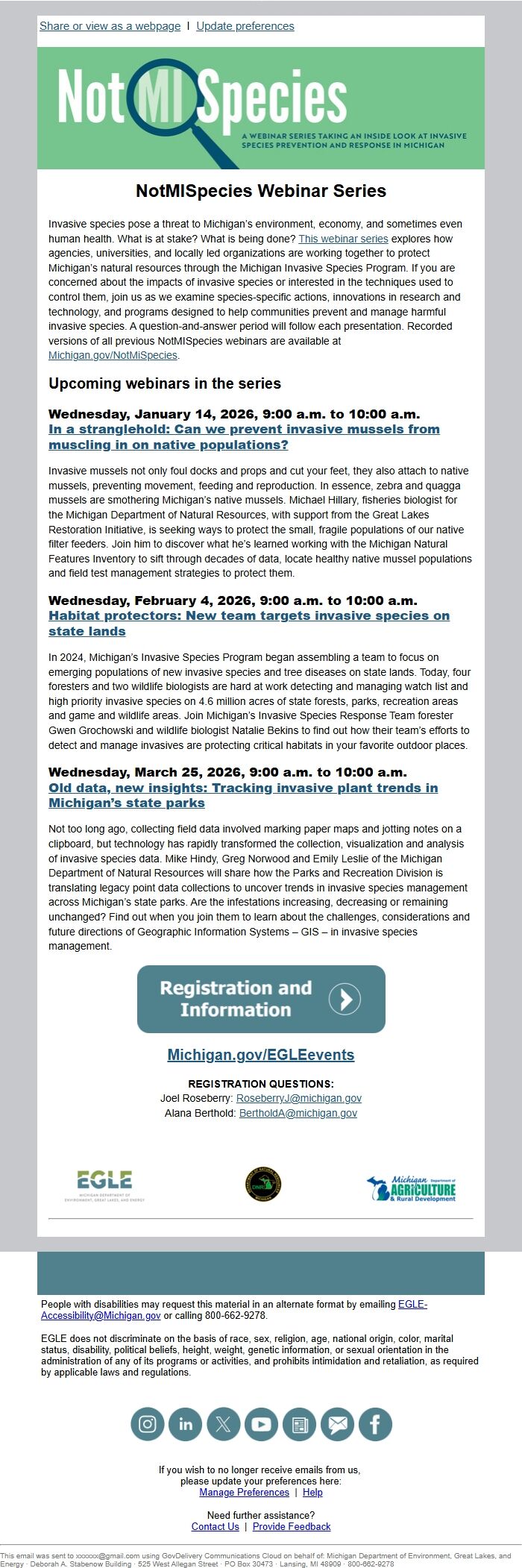
Invasive species pose a threat to Michigan’s environment, economy, and sometimes even human health. What is at stake? What is being done? This webinar series [ [link removed] ] explores how agencies, universities, and locally led organizations are working together to protect Michigan’s natural resources through the Michigan Invasive Species Program. If you are concerned about the impacts of invasive species or interested in the techniques used to control them, join us as we examine species-specific actions, innovations in research and technology, and programs designed to help communities prevent and manage harmful invasive species. A question-and-answer period will follow each presentation. Recorded versions of all previous NotMISpecies webinars are available at Michigan.gov/NotMiSpecies [ [link removed] ].
Upcoming webinars in the series
*Wednesday, January 14, 2026, 9:00 a.m. to 10:00 a.m.
In a stranglehold: Can we prevent invasive mussels from muscling in on native populations? [ [link removed] ]*
Invasive mussels not only foul docks and props and cut your feet, they also attach to native mussels, preventing movement, feeding and reproduction. In essence, zebra and quagga mussels are smothering Michigan’s native mussels. Michael Hillary, fisheries biologist for the Michigan Department of Natural Resources, with support from the Great Lakes Restoration Initiative, is seeking ways to protect the small, fragile populations of our native filter feeders. Join him to discover what he’s learned working with the Michigan Natural Features Inventory to sift through decades of data, locate healthy native mussel populations and field test management strategies to protect them.
*Wednesday, February 4, 2026, 9:00 a.m. to 10:00 a.m.
Habitat protectors: New team targets invasive species on state lands [ [link removed] ]*
In 2024, Michigan’s Invasive Species Program began assembling a team to focus on emerging populations of new invasive species and tree diseases on state lands. Today, four foresters and two wildlife biologists are hard at work detecting and managing watch list and high priority invasive species on 4.6 million acres of state forests, parks, recreation areas and game and wildlife areas. Join Michigan’s Invasive Species Response Team forester Gwen Grochowski and wildlife biologist Natalie Bekins to find out how their team’s efforts to detect and manage invasives are protecting critical habitats in your favorite outdoor places.
*Wednesday, March 25, 2026, 9:00 a.m. to 10:00 a.m.
Old data, new insights: Tracking invasive plant trends in Michigan’s state parks [ [link removed] ]*
Not too long ago, collecting field data involved marking paper maps and jotting notes on a clipboard, but technology has rapidly transformed the collection, visualization and analysis of invasive species data. Mike Hindy, Greg Norwood and Emily Leslie of the Michigan Department of Natural Resources will share how the Parks and Recreation Division is translating legacy point data collections to uncover trends in invasive species management across Michigan’s state parks. Are the infestations increasing, decreasing or remaining unchanged? Find out when you join them to learn about the challenges, considerations and future directions of Geographic Information Systems – GIS – in invasive species management.
Registration button EGLE Blue [ [link removed] ]
Michigan.gov/EGLEevents [ [link removed] ]
*REGISTRATION QUESTIONS:*
Joel Roseberry: [email protected] <[email protected]>
Alana Berthold: [email protected]
AIS agency footer
________________________________________________________________________
People with disabilities may request this material in an alternate format by emailing [email protected] or calling 800-662-9278.
EGLE does not discriminate on the basis of race, sex, religion, age, national origin, color, marital status, disability, political beliefs, height, weight, genetic information, or sexual orientation in the administration of any of its programs or activities, and prohibits intimidation and retaliation, as required by applicable laws and regulations.
Instagram [ [link removed] ] Linkedin [ [link removed] ] X [ [link removed] ] YouTube [ [link removed] ] MiEnvironment [ [link removed] ] GovDelivery [ [link removed] ] Facebook [ [link removed] ]
If you wish to no longer receive emails from us,
please update your preferences here:
Manage Preferences [ [link removed] ] | Help [ [link removed] ]
Need further assistance?
Contact Us <[email protected]> | Provide Feedback <[email protected]>
________________________________________________________________________
This email was sent to [email protected] using GovDelivery Communications Cloud on behalf of: Michigan Department of Environment, Great Lakes, and Energy · Deborah A. Stabenow Building · 525 West Allegan Street · PO Box 30473 · Lansing, MI 48909 · 800-662-9278
body .abe-column-block { min-height: 5px; } table.gd_combo_table img {margin-left:10px; margin-right:10px;} table.gd_combo_table div.govd_image_display img, table.gd_combo_table td.gd_combo_image_cell img {margin-left:0px; margin-right:0px;} table.govd_hr {min-width: 100%;} p, li, h1, h2, h3 { overflow-wrap: normal; word-wrap: normal; word-break: keep-all; -moz-hyphens: none; -ms-hyphens: none; -webkit-hyphens: none; hyphens: none; mso-hyphenate: none; }
Share or view as a webpage [ [link removed] ] I Update preferences [ [link removed] ]
NotMiSpecies Web banner [ [link removed] ]
NotMISpecies Webinar Series
Invasive species pose a threat to Michigan’s environment, economy, and sometimes even human health. What is at stake? What is being done? This webinar series [ [link removed] ] explores how agencies, universities, and locally led organizations are working together to protect Michigan’s natural resources through the Michigan Invasive Species Program. If you are concerned about the impacts of invasive species or interested in the techniques used to control them, join us as we examine species-specific actions, innovations in research and technology, and programs designed to help communities prevent and manage harmful invasive species. A question-and-answer period will follow each presentation. Recorded versions of all previous NotMISpecies webinars are available at Michigan.gov/NotMiSpecies [ [link removed] ].
Upcoming webinars in the series
*Wednesday, January 14, 2026, 9:00 a.m. to 10:00 a.m.
In a stranglehold: Can we prevent invasive mussels from muscling in on native populations? [ [link removed] ]*
Invasive mussels not only foul docks and props and cut your feet, they also attach to native mussels, preventing movement, feeding and reproduction. In essence, zebra and quagga mussels are smothering Michigan’s native mussels. Michael Hillary, fisheries biologist for the Michigan Department of Natural Resources, with support from the Great Lakes Restoration Initiative, is seeking ways to protect the small, fragile populations of our native filter feeders. Join him to discover what he’s learned working with the Michigan Natural Features Inventory to sift through decades of data, locate healthy native mussel populations and field test management strategies to protect them.
*Wednesday, February 4, 2026, 9:00 a.m. to 10:00 a.m.
Habitat protectors: New team targets invasive species on state lands [ [link removed] ]*
In 2024, Michigan’s Invasive Species Program began assembling a team to focus on emerging populations of new invasive species and tree diseases on state lands. Today, four foresters and two wildlife biologists are hard at work detecting and managing watch list and high priority invasive species on 4.6 million acres of state forests, parks, recreation areas and game and wildlife areas. Join Michigan’s Invasive Species Response Team forester Gwen Grochowski and wildlife biologist Natalie Bekins to find out how their team’s efforts to detect and manage invasives are protecting critical habitats in your favorite outdoor places.
*Wednesday, March 25, 2026, 9:00 a.m. to 10:00 a.m.
Old data, new insights: Tracking invasive plant trends in Michigan’s state parks [ [link removed] ]*
Not too long ago, collecting field data involved marking paper maps and jotting notes on a clipboard, but technology has rapidly transformed the collection, visualization and analysis of invasive species data. Mike Hindy, Greg Norwood and Emily Leslie of the Michigan Department of Natural Resources will share how the Parks and Recreation Division is translating legacy point data collections to uncover trends in invasive species management across Michigan’s state parks. Are the infestations increasing, decreasing or remaining unchanged? Find out when you join them to learn about the challenges, considerations and future directions of Geographic Information Systems – GIS – in invasive species management.
Registration button EGLE Blue [ [link removed] ]
Michigan.gov/EGLEevents [ [link removed] ]
*REGISTRATION QUESTIONS:*
Joel Roseberry: [email protected] <[email protected]>
Alana Berthold: [email protected]
AIS agency footer
________________________________________________________________________
People with disabilities may request this material in an alternate format by emailing [email protected] or calling 800-662-9278.
EGLE does not discriminate on the basis of race, sex, religion, age, national origin, color, marital status, disability, political beliefs, height, weight, genetic information, or sexual orientation in the administration of any of its programs or activities, and prohibits intimidation and retaliation, as required by applicable laws and regulations.
Instagram [ [link removed] ] Linkedin [ [link removed] ] X [ [link removed] ] YouTube [ [link removed] ] MiEnvironment [ [link removed] ] GovDelivery [ [link removed] ] Facebook [ [link removed] ]
If you wish to no longer receive emails from us,
please update your preferences here:
Manage Preferences [ [link removed] ] | Help [ [link removed] ]
Need further assistance?
Contact Us <[email protected]> | Provide Feedback <[email protected]>
________________________________________________________________________
This email was sent to [email protected] using GovDelivery Communications Cloud on behalf of: Michigan Department of Environment, Great Lakes, and Energy · Deborah A. Stabenow Building · 525 West Allegan Street · PO Box 30473 · Lansing, MI 48909 · 800-662-9278
body .abe-column-block { min-height: 5px; } table.gd_combo_table img {margin-left:10px; margin-right:10px;} table.gd_combo_table div.govd_image_display img, table.gd_combo_table td.gd_combo_image_cell img {margin-left:0px; margin-right:0px;} table.govd_hr {min-width: 100%;} p, li, h1, h2, h3 { overflow-wrap: normal; word-wrap: normal; word-break: keep-all; -moz-hyphens: none; -ms-hyphens: none; -webkit-hyphens: none; hyphens: none; mso-hyphenate: none; }
Message Analysis
- Sender: Michigan Department of Environment, Great Lakes, and Energy
- Political Party: n/a
- Country: n/a
- State/Locality: n/a
- Office: n/a
-
Email Providers:
- govDelivery