
Dec. 23, 2025
Permission to republish original opeds and cartoons granted.
Great Again: GDP Averaging Over 4 Percent Last Two Quarters With 2026 Right Around The Corner
|
|
|
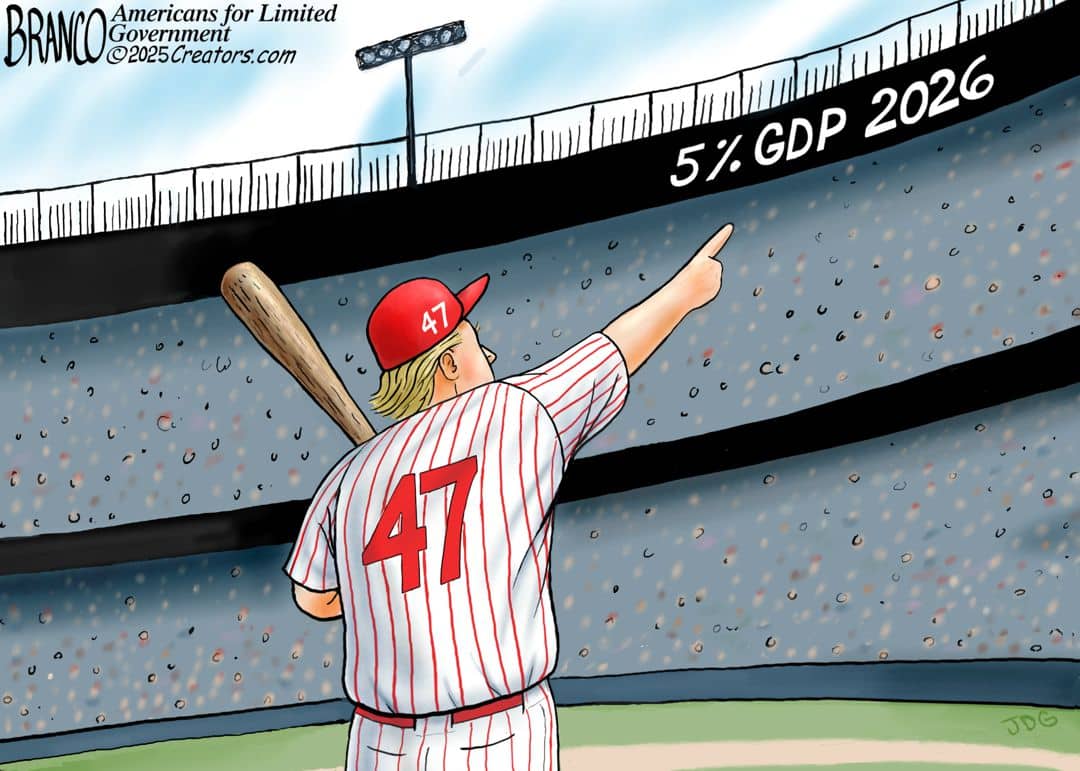
The U.S. economy is growing well above expectations on an inflation-adjusted basis, blowing the barn doors off the hinges, at 4.3 percent annualized in the third quarter, the highest since 2023, according to the latest Gross Domestic Product (GDP) numbers from the Bureau of Economic Analysis. President Donald Trump praised the economy’s performance, by far the best news economically all year long, stating in a post on Truth Social, “Q3 GDP came in at 4.3%, BLOWING PAST expectations of 3.2%. 60 of 61 Bloomberg Economists got it WRONG, but ‘TRUMP,’ and some other Geniuses, got it right. The SUCCESS is due to Good Government, and TARIFFS. Consumer spending is STRONG, Net Exports are WAY UP, Imports and Trade Deficits are WAY DOWN, and there is NO INFLATION! Because of my Tax Bill (THE GREAT BIG BEAUTIFUL BILL) and TARIFFS, INVESTMENT IS SETTING RECORDS. The Trump Economic Golden Age is FULL steam ahead — ‘You haven’t seen anything yet!’ Thank you for your attention to this matter. MAKE AMERICA GREAT AGAIN!” That follows 3.8 percent growth in the second quarter, for average growth of almost 4.1 percent the last two quarters as President Trump’s trade policies have taken effect. And the best is yet to come. With 2026 right around the corner, as the most important provisions of the One Big Beautiful Bill Act go into effect, come what may — the unemployment level has been climbing 2.1 million since January 2023, and there’s still the fourth quarter to report — we can already begin to see that the potential growth of the U.S. economy is much greater than anyone thinks, except, of course, for President Trump, who is aspirationally committed to knocking it out of the park in the years to come. Whatever the numbers are, he's swinging for the fences.
|
Republican’s Main Adversary in 2026 Is Economic Perception — Not A Unified Democratic Party
|
|
|
While conservatives were dealt a heavy blow in November, losing to their Democrat challengers in the Virginia and New Jersey governor races as Democrats pushed voter turnout to near-presidential election levels, there are warning signals that Democrats are the party headed into a civil war in 2026. Democrats are significantly more critical of their own party than Republicans are of the GOP, and optimism about the Democrat Party has rapidly eroded since President Donald Trump’s first term. Republicans are running in a precarious position next year as members of the incumbent party presiding over an economy that is still recovering. Inflation slowed to 2.7 percent growth the past 12 months, down from 3 percent in September according to U.S. Bureau of Labor Statistics data. Average weekly earnings in the private sector are up 3.5 percent over the past year as well. However, there is still a delay among voters in recognizing the economic recovery, with the latest Economist-YouGov survey showing only 23 percent of Americans say the economy is good or excellent, 34 percent say it is fair, and the greatest number (39 percent) say the economy is poor. While perceptions of the economy need to catch up to the data, Republicans are much more unified and optimistic about the future of their party than Democrats are of theirs.
|
Great Again: GDP Averaging Over 4 Percent Last Two Quarters With 2026 Right Around The Corner
By Robert Romano
The U.S. economy is growing well above expectations on an inflation-adjusted basis, blowing the barn doors off the hinges, at 4.3 percent annualized in the third quarter, the highest since 2023, according to the latest Gross Domestic Product (GDP) numbers from the Bureau of Economic Analysis.
President Donald Trump praised the economy’s performance, by far the best news economically all year long, stating in a post on Truth Social, “Q3 GDP came in at 4.3%, BLOWING PAST expectations of 3.2%. 60 of 61 Bloomberg Economists got it WRONG, but ‘TRUMP,’ and some other Geniuses, got it right. The SUCCESS is due to Good Government, and TARIFFS. Consumer spending is STRONG, Net Exports are WAY UP, Imports and Trade Deficits are WAY DOWN, and there is NO INFLATION! Because of my Tax Bill (THE GREAT BIG BEAUTIFUL BILL) and TARIFFS, INVESTMENT IS SETTING RECORDS. The Trump Economic Golden Age is FULL steam ahead — ‘You haven’t seen anything yet!’ Thank you for your attention to this matter. MAKE AMERICA GREAT AGAIN!”
That follows 3.8 percent growth in the second quarter, for average growth of almost 4.1 percent the last two quarters as President Trump’s trade policies have taken effect.
And the best is yet to come.
Unfortunately, not that it matters in the great scheme of things, when you factor the -0.6 percent growth in the first quarter as the Biden economy was collapsing, the average growth rate for 2025 drops to 2.5 percent for the last three quarters, setting up a daunting task for average annual growth to hit 3 percent.
Besides 2021 when the economy was recovering from the unusual Covid recession of 2020 — average annual real GDP growth those two years was -2.1 percent and 6.15 percent — the U.S. economy has not grown at 3 percent or higher since 2005. Since 2001, the economy has only averaged 2.14 percent. That compares to 3.6 percent average annual growth from 1947 to 2000.
Sadly, despite the bounceback in the last two quarters, 2025 will not be any different. Using the Bureau’s formula for average annual growth, which it describes as “a variant of the compound interest formula” and averages each quarter’s real, inflation-adjusted GDP for the entire year compared to the prior year’s average for four quarters, the economy is very unlikely to hit 3 percent this year with that bad first quarter.
The quarterly real GDP rate published is the compound growth rate annualized, whereas the annual growth is just the simple growth rate of the average real GDP.
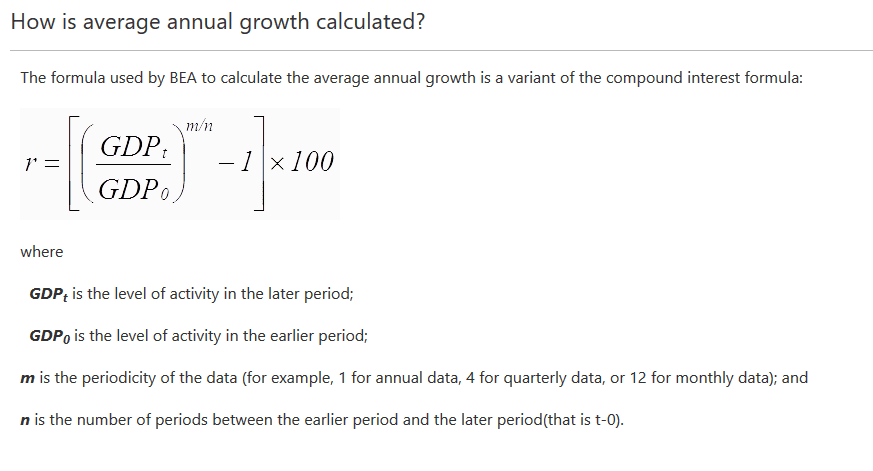
In order to hit 3 percent in 2025, the average real, inflation-adjusted GDP — different from nominal GDP of $31.09 trillion — for the year will need to be about $24.06 trillion. To get there from the real GDP’s current dollar value of $23.78 trillion and bring up the average annual growth upwards to 3 percent, reported annualized GDP for the fourth quarter would need to come in at an astronomical 15.38 percent! Yikes.
But that’s okay. The economy is clearly on the right track. Keep in mind the reported 4.3 percent growth, the best since 2023, is after inflation. That’s super healthy and shows the country is definitely getting wealthier. Whereas, nominal growth of the GDP in the last quarter was 8.2 percent.
Consider it an early Christmas present.
With 2026 right around the corner, as the most important provisions of the One Big Beautiful Bill Act go into effect, come what may — the unemployment level has been climbing 2.1 million since January 2023, and there’s still the fourth quarter to report — we can already begin to see that the potential growth of the U.S. economy is much greater than anyone thinks, except, of course, for President Trump, who is aspirationally committed to knocking it out of the park in the years to come. Whatever the numbers are, he's swinging for the fences.
Thank you, Mr. President, and to all, have a Merry Christmas and a Happy New Year.
Robert Romano is the Executive Director of Americans for Limited Government Foundation.
To view online: https://dailytorch.com/2025/12/great-again-gdp-averaging-over-4-percent-last-two-quarters-with-2026-right-around-the-corner/
Republican’s Main Adversary in 2026 Is Economic Perception — Not A Unified Democratic Party
By Manzanita Miller
While conservatives were dealt a heavy blow in November, losing to their Democrat challengers in the Virginia and New Jersey governor races as Democrats pushed voter turnout to near-presidential election levels, there are warning signals that Democrats are the party headed into a civil war in 2026. Democrats are significantly more critical of their own party than Republicans are of the GOP, and optimism about the Democrat Party has rapidly eroded since President Donald Trump’s first term.
Republicans are running in a precarious position next year as members of the incumbent party presiding over an economy that is still recovering. Inflation slowed to 2.7 percent growth the past 12 months, down from 3 percent in September according to U.S. Bureau of Labor Statistics data. Average weekly earnings in the private sector are up 3.5 percent over the past year as well.
However, there is still a delay among voters in recognizing the economic recovery, with the latest Economist-YouGov survey showing only 23 percent of Americans say the economy is good or excellent, 34 percent say it is fair, and the greatest number (39 percent) say the economy is poor.
While perceptions of the economy need to catch up to the data, Republicans are much more unified and optimistic about the future of their party than Democrats are of theirs. Pew Research Center data reveals that Democrats, but not Republicans, are particularly irate with their party ahead of the 2026 midterm cycle, while Republicans are more unified and hopeful about the GOP.
The survey of 3,445 Americans released Oct. 30 by the Pew Research Center shows 75 percent of Americans overall are frustrated with the Democratic Party, while two-thirds (64 percent) are frustrated with the GOP. While 36 percent of Americans say they are hopeful about the GOP, just 28 percent say they are hopeful about the Democratic Party. Twenty-seven percent of Americans are proud of the GOP while a mere 16 percent say the same about the Democratic Party.
The real issue is that Democrats have a much higher rate of negative attitudes towards their own party than Republicans do. According to the survey, over two-thirds of Democrats (67 percent) say they are frustrated with their own party, while well under half of Republicans (40 percent) say they are frustrated with the GOP.
Conversely, a full 69 percent of Republicans say they are hopeful about the Republican Party, while just half of Democrats say the same thing about the Democratic Party. Fifty-two percent of Republicans say they are proud of the GOP, while just 29 percent of Democrats say the same for the Democratic Party.
Pew’s data indicates frustration with the Democratic Party and a decline in optimism about the party’s future have been building for years, with negative sentiment spiking significantly since 2019.
While over two-thirds (67 percent) of Democrats are frustrated with their own party now, that is up close to thirty percentage points compared to 2019, when only 41 percent of Democrats were frustrated with their own party. While only half of Democrats are hopeful about the Democratic Party today, that number is down fifteen points from 2019, when 65 percent were hopeful. Pride in the Democrat Party has dropped over twenty-two percentage points in the past six years, from 51 percent to 29 percent.
What is notable about this precipitous decline in optimism and rise in frustration among Democrats is that objectively, Democrats should be feeling unified about “stropping the Trump Administration at any cost,” as they were in 2019 under President Trump’s first term. In 2018, Democrats became unified against the Trump Administration and took the House in a “blue wave” picking up 41 seats but were stalled in the Senate as Republicans picked up two seats. But we are now seeing the opposite.
As Democrats have fought, stalled, and put up every fathomable roadblock against President Trump to halt his second term agenda, Democrat Party pride has gone down and frustration is peaking. Democrats’ enduring nine-year strategy of fighting against everything President Trump and the America First movement stand for has not yielded a more unified or optimistic base, it has produced the opposite.
One wing of the Democrat Party is no doubt “frustrated” that Congressional Democrats have, in their eyes, failed to adequately stop the Trump Administration’s second-term agenda. It is this progressive wing of the Democratic Party that is calling for a complete overhaul of the party, a sort of “Democrat Tea Party” as the New York Time’s Nate Cohn recently mused about. But the moderate, economy-motivated wing of the Democratic Party is exhausted with the progressive agenda and wants to see moderate Democrats back on the ticket. The problem is, the party is going to have a challenging time getting moderates to support radicals in the primaries, and vice versa in the general election.
Despite delayed perceptions about the economic recovery in 2025, Democrats are only ahead of Republicans by a modest 3.7 percentage points in the latest generic congressional ballot data as the year closes, and optimism in the party is at a record low. The Democrat party is underwater by an alarming 23.7 percentage points as the year closes, with a 56.2 percent unfavorable rating to a 32.5 favorable rating. The GOP is underwater too, but by 14.3 points.
Republicans cannot afford to rest on their laurels next year and continuing to address inflation and job growth are critical to hold on to as many seats as they can. But the fact that Democrats’ popularity is still so incredibly low despite negative perceptions about the economy should be a warning sign to progressives as well.
The GOP has an uphill battle next year, but its challenge is less a well-positioned Democrat Party and more continuing to bring down cost-of-living, stoke the engines of job creation, and allow public perception to catch up. Republicans will be fighting inflation and stagnant job growth in 2026, not a robust, coherent, or unified Democrat Party.
Manzanita Miller is the senior political analyst at Americans for Limited Government Foundation.
To view online: https://dailytorch.com/2025/12/republicans-main-adversary-in-2026-is-economic-perception-not-a-unified-democratic-party/