
Email
Nurdles: What are they, and how did so many end up here?
| From | U.S. PIRG <[email protected]> |
| Subject | Nurdles: What are they, and how did so many end up here? |
| Date | December 23, 2025 4:36 PM |
Links have been removed from this email. Learn more in the FAQ.
Links have been removed from this email. Learn more in the FAQ.
:
John,
In just a few minutes in May, volunteers around the world found nearly 50,000 plastic pellets in the environment.[1]
And that barely even scratched the surface.
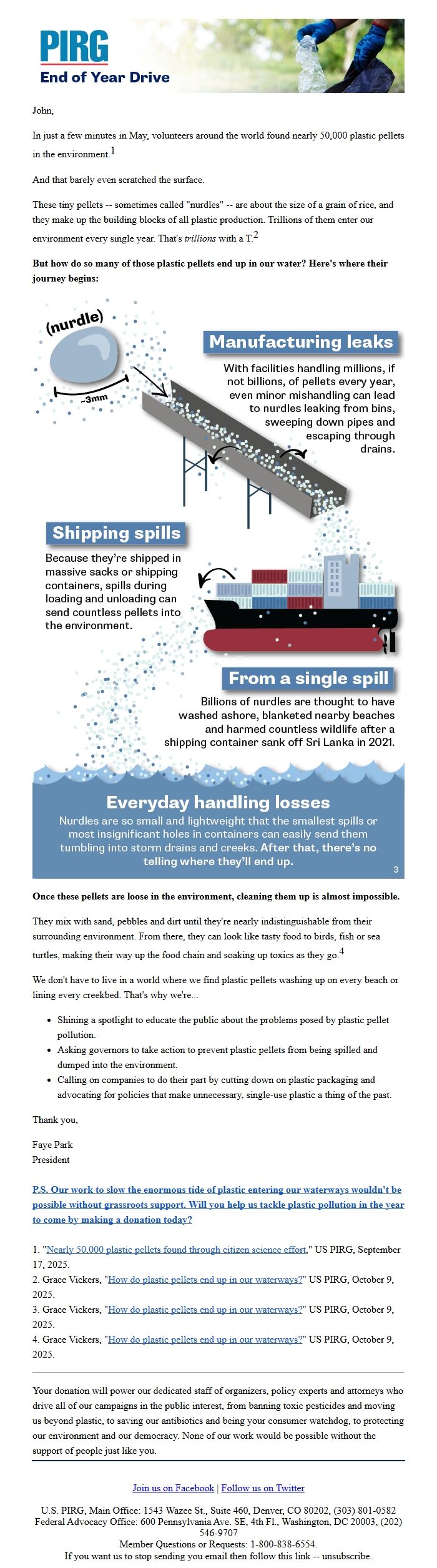
These tiny pellets -- sometimes called "nurdles" -- are about the size of a grain of rice, and they make up the building blocks of all plastic production. Trillions of them enter our environment every single year. That's trillions with a T.[2]
But how do so many of those plastic pellets end up in our water? Here's where their journey begins:
Once these pellets are loose in the environment, cleaning them up is almost impossible.
They mix with sand, pebbles and dirt until they're nearly indistinguishable from their surrounding environment. From there, they can look like tasty food to birds, fish or sea turtles, making their way up the food chain and soaking up toxics as they go.[4]
We don't have to live in a world where we find plastic pellets washing up on every beach or lining every creekbed. That's why we're...
* Shining a spotlight to educate the public about the problems posed by plastic pellet pollution.
* Asking governors to take action to prevent plastic pellets from being spilled and dumped into the environment.
* Calling on companies to do their part by cutting down on plastic packaging and advocating for policies that make unnecessary, single-use plastic a thing of the past.
Thank you,
Faye Park
President
P.S. Our work to slow the enormous tide of plastic entering our waterways wouldn't be possible without grassroots support. Will you help us tackle plastic pollution in the year to come by making a donation today?
[link removed]
1. "Nearly 50,000 plastic pellets found through citizen science effort," US PIRG, September 17, 2025.
[link removed]
2. Grace Vickers, "How do plastic pellets end up in our waterways?" US PIRG, October 9, 2025.
[link removed]
3. Grace Vickers, "How do plastic pellets end up in our waterways?" US PIRG, October 9, 2025.
[link removed]
4. Grace Vickers, "How do plastic pellets end up in our waterways?" US PIRG, October 9, 2025.
[link removed]
-----------------------------------------------------------
Your donation will power our dedicated staff of organizers, policy experts and attorneys who drive all of our campaigns in the public interest, from banning toxic pesticides and moving us beyond plastic, to saving our antibiotics and being your consumer watchdog, to protecting our environment and our democracy. None of our work would be possible without the support of people just like you.
-----------------------------------------------------------
Join us on Facebook: [link removed]
Follow us on Twitter: [link removed]
U.S. PIRG
Main Office: 1543 Wazee St., Suite 460, Denver, CO 80202, (303) 801-0582
Federal Advocacy Office: 600 Pennsylvania Ave. SE, 4th Fl., Washington, DC 20003, (202) 546-9707
Member Questions or Requests: 1-800-838-6554
If you want us to stop sending you email then follow this link -- [link removed]
John,
In just a few minutes in May, volunteers around the world found nearly 50,000 plastic pellets in the environment.[1]
And that barely even scratched the surface.
These tiny pellets -- sometimes called "nurdles" -- are about the size of a grain of rice, and they make up the building blocks of all plastic production. Trillions of them enter our environment every single year. That's trillions with a T.[2]
But how do so many of those plastic pellets end up in our water? Here's where their journey begins:
Once these pellets are loose in the environment, cleaning them up is almost impossible.
They mix with sand, pebbles and dirt until they're nearly indistinguishable from their surrounding environment. From there, they can look like tasty food to birds, fish or sea turtles, making their way up the food chain and soaking up toxics as they go.[4]
We don't have to live in a world where we find plastic pellets washing up on every beach or lining every creekbed. That's why we're...
* Shining a spotlight to educate the public about the problems posed by plastic pellet pollution.
* Asking governors to take action to prevent plastic pellets from being spilled and dumped into the environment.
* Calling on companies to do their part by cutting down on plastic packaging and advocating for policies that make unnecessary, single-use plastic a thing of the past.
Thank you,
Faye Park
President
P.S. Our work to slow the enormous tide of plastic entering our waterways wouldn't be possible without grassroots support. Will you help us tackle plastic pollution in the year to come by making a donation today?
[link removed]
1. "Nearly 50,000 plastic pellets found through citizen science effort," US PIRG, September 17, 2025.
[link removed]
2. Grace Vickers, "How do plastic pellets end up in our waterways?" US PIRG, October 9, 2025.
[link removed]
3. Grace Vickers, "How do plastic pellets end up in our waterways?" US PIRG, October 9, 2025.
[link removed]
4. Grace Vickers, "How do plastic pellets end up in our waterways?" US PIRG, October 9, 2025.
[link removed]
-----------------------------------------------------------
Your donation will power our dedicated staff of organizers, policy experts and attorneys who drive all of our campaigns in the public interest, from banning toxic pesticides and moving us beyond plastic, to saving our antibiotics and being your consumer watchdog, to protecting our environment and our democracy. None of our work would be possible without the support of people just like you.
-----------------------------------------------------------
Join us on Facebook: [link removed]
Follow us on Twitter: [link removed]
U.S. PIRG
Main Office: 1543 Wazee St., Suite 460, Denver, CO 80202, (303) 801-0582
Federal Advocacy Office: 600 Pennsylvania Ave. SE, 4th Fl., Washington, DC 20003, (202) 546-9707
Member Questions or Requests: 1-800-838-6554
If you want us to stop sending you email then follow this link -- [link removed]
Message Analysis
- Sender: n/a
- Political Party: n/a
- Country: n/a
- State/Locality: n/a
- Office: n/a
-
Email Providers:
- ActionKit