|
 |



By Gary Null, PhD, Special to The MAHA Report
“Honesty is not a virtue we perform — it is the light we uncover.” — Gary Null
When we talk about “living with complete honesty,” most people imagine confessing they ate the last slice of vegan cheesecake or admitting they never really liked their cousin’s new husband. But the kind of honesty I’m talking about — the kind that liberates a human being — is far more uncomfortable. It asks us to turn toward the truths we’ve spent our lives artfully avoiding.
You see, every generation inherits a set of beautiful illusions wrapped in ribbon and handed down like family heirlooms. We’re told they represent wisdom. Tradition. Progress.
 |
But if you crack open the box and look closely, you discover something else: a glittering collection of cultural lies so old they’ve become sacred.
And we fall for them.
All of us.
Because the human mind, bless its hopeful little heart, desperately wants to believe the world is being run by adults who know what they’re doing.
The Lie That Starts the Journey
Let me give you just one example — a small, simple lie that has shaped millions of young lives.
A teenager sits in a guidance counselor’s office. The bulletin board behind the counselor is plastered with smiling graduates in caps and gowns, each holding a symbolic diploma and a future filled with opportunities. The counselor looks at the teenager and says something like:
“A good education is the foundation of a secure life. Pick a major, take on the loans, and you’ll be prepared for the world ahead.”
But here’s the problem…
The world ahead has changed, and the curriculum hasn’t.
No university brochure tells the truth: that AI and automation are already erasing entire career paths, that thousands of jobs these students borrow $80,000 to train for won’t exist by the time they graduate, that the four-year degree — once a bridge to opportunity — has become, for many, a very expensive detour.
No dean stands up at orientation and says:
“Half of this curriculum was outdated before you were born. But do enjoy the campus tour.”
Instead, institutions keep selling an educational model designed for the 1950s — rigid, standardized, and obedient to a world that no longer exists.
The truth? It’s a form of dishonesty so deep it blends into the wallpaper.
And when young people feel the rug pulled out from under them, what happens? They blame themselves.
Not the system.
Not the lie.
Not the false promise wrapped in a $120,000 price tag.
Cultural Narratives: The Lies That Shape a Generation
But the deception doesn’t end in the classroom. Oh no — that’s just the warm-up act.
Every day, cultural and political machines broadcast narratives that divide, inflame, and hypnotize. They tell us who we are supposed to fear, who we’re allowed to love, which tribe we belong to, and whose suffering we should ignore.
Critical race theory, wokeism, identity politics, tribalism — depending on whom you listen to, these ideas are either the salvation of democracy or its funeral pyre. But here’s the real issue: none of these institutions — academic, political, or media — are asking the deeper questions.
They’re not asking:
What heals a society?
What brings people together rather than tearing them apart?
What does it mean to be a human being before being a category?
And who benefits when we’re too busy arguing to notice the strings being pulled behind the curtain?
The tragedy is not that these narratives exist.
The tragedy is that millions accept them without examination — believing that what flashes across the screen must be true simply because it glows.
But honesty — raw, unglamorous, unedited honesty — requires that we pause long enough to ask:
“Whose voice is this?
Who profits when I believe it?
And what part of me goes quiet when I do?”
A Path Toward Real Honesty
Living with complete honesty does not begin with exposing the world’s lies.
It begins with exposing our willingness to believe them.
It begins with acknowledging that human beings are storytellers — and sometimes, the story we love most is the one that spares us from changing our lives.
But change is coming whether we choose it or not.
AI is rewriting the labor market.
Technology is shaping identity. Institutions are losing legitimacy.
And young people are waking up with sharper questions than any generation before them.
The only way forward is to meet these changes with clarity, humility, and truth — not the rehearsed truths of the past, but the living truth that arises from a mind unafraid to look directly at reality.
The 10th Person: A Story from the Institute
Let me share a story that taught me one of the most important lessons of my life — the value of questioning what everyone else accepts.
I was young then. Twenty-one. The youngest junior scientist ever taken into the Institute for Applied Biology — a place founded by brilliant refugees from the Pasteur Institute in Paris. These were not ordinary scientists. These were the kind of minds that light up a room simply by thinking in it.
I didn’t feel particularly bright beside them. But I was curious. And sometimes curiosity is enough.
One month, I presented my research at a staff meeting. I had discovered that fasting a group of laboratory rats increased their lifespan by twenty-seven percent. I was excited — not because I expected applause, but because I had stumbled onto something meaningful.
The response?
“It can’t be right.”
“What does fasting have to do with anything?”
“Nonsense.”
You have to understand — these were people who smoked cigarettes during lab meetings, who drank heavily, who gave no thought to diet or lifestyle. The idea that something as simple as fasting might influence longevity offended their entire worldview.
Nine of them dismissed the research outright.
But the director of science, who had been listening silently, leaned forward and said:
“If nine people agree on something, the tenth person has an obligation to say, ‘Let’s see if we’re wrong.’”
That sentence changed my life.
I went back to the lab. I repeated the experiment. I tried to disprove myself. I invited others to challenge my findings. But we all arrived at the same conclusion: fasting worked.
By the next monthly meeting, three of the original skeptics admitted they had been hasty. They had read new studies. They had reconsidered. And they now agreed that my findings had merit.
Years later, another scientist received public credit for this idea — and the Institute never even submitted my paper for publication. That happened many times: 165 successful experiments withheld. But results aren’t diminished by silence. A truth is still a truth, even when hidden in a drawer.
 |
And the lesson stayed with me:
The majority is often wrong. Truth is often whispered, not shouted. And someone must be the tenth person.
The Weight of Truth and the Silence That Often Follows It
I spent thirty-six years in that institute. Thirty-six years watching discoveries emerge from quiet rooms, from late-night experiments, from persistence rather than prestige. And during all those years, one lesson became painfully clear:
Having the truth does not guarantee anyone will hear it.
Having the truth does not guarantee anyone will believe it.
And having the truth certainly does not guarantee you will be rewarded for it.
People assume that truth naturally rises to the top, that it floats like cream above the noise. It doesn’t. Truth often sinks—slowly, stubbornly—because it doesn’t come wrapped in money, or in political advantage, or in the approval of powerful institutions.
There are thousands of us—independent investigators, researchers, journalists, thinkers—who have spent our lives looking for the truth, not for applause.
We were never paid by agencies. We weren’t carried by major papers or major networks.
We didn’t have a lobby. We didn’t have an institution behind us smoothing the edges of our findings. We had only the work.
And historically, we were right. On every major issue we tackled, the truth was on our side. I tell people: don’t take my word for it. Go to the website. Read every article. Watch the documentaries. Look for a single retraction—one forced correction. You won’t find it. Not one.
 |
Think of it:
War on Health.
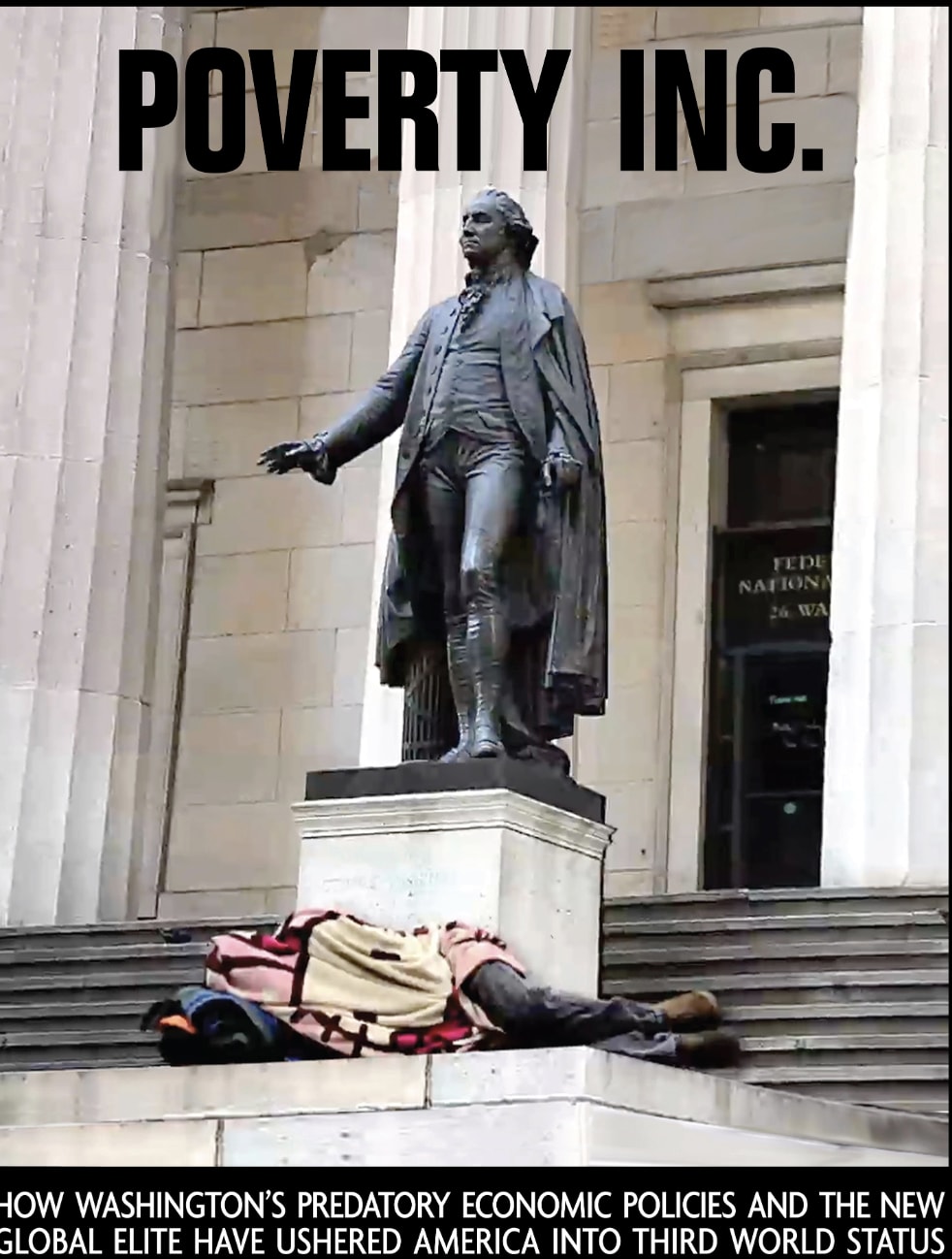
Poverty, Inc.
Last Call for Tomorrow.
Brother, Can You Spare a Dime?
Over a hundred award-winning documentaries.
Just months ago, we filled the great Ethical Culture Center in New York for the latest film. Packed house. Not because people were told to come, but because truth calls to those who still have ears for it.
Now—turn the question around.
Go to the government agencies. The National Academy of Sciences. The U.S. Public Health Service. The FDA. The CDC.
Look at the same topics, the same crises, the same issues. Look at how many times they were wrong—dead wrong—yet were rewarded anyway. Promotions, grants, expanded authority. When their policies failed, they were given more power, not less. When their predictions collapsed, no one demanded accountability. When evidence contradicted them, they simply rewrote the narrative and moved on.
This is the paradox of our time:
Those who brought forward truth were excluded.
Those who distorted truth were elevated.
And so we must ask a very human question:
Why?
Why reward those who misled us?
Why silence those who tried to protect us?
Why create a world where truth is punished and deception is profitable?
The answer is not philosophical—it is structural.
Institutions reward loyalty, not accuracy. They protect their own authority, not the public’s wellbeing. And truth—real truth—has no lobby behind it.
Truth is not profitable. Truth does not flatter the powerful. Truth does not bend easily. And so it is ignored, sidelined, excluded.
But that exclusion is precisely why independent voices matter.
That exclusion is why we must become custodians of our own discernment.
Because if we hand that responsibility to institutions that have repeatedly deceived us, we cannot pretend to be surprised when they continue to do so.
Rewriting the Script: From Limitation to Inner Freedom
At some point in this journey, we must sit with one simple truth: Most of our suffering comes not from the world, but from the script we inherited about who we’re allowed to be.
Somewhere along the way, perhaps as a child or young adult, someone told you:
“You’re not enough.”
“You’re not smart enough.”
“You don’t have what it takes.”
“You always mess things up.”
And without realizing it, we picked up those lines and rehearsed them every day, as if they were part of a play we hadn’t auditioned for. So here is one of the most liberating tools I’ve ever discovered:
Rewrite the script
Take a limiting belief — just one — and flip it.
If the voice says, “You’re not enough,” ask, “Says who?”
Not enough for what?
Not enough according to whose standards?
Reverse it and speak the truth aloud:
“I am inherently worthy.”
“I can learn the skills.”
“I can map the tools.”
“I can grow into mastery.”
And I’ll do it ethically, with compassion, with integrity, with the steady character that comes when you’ve finally decided to live your own life rather than the one others designed for you.
We must get the “you’re stupid,” “you can’t do anything right” voices out of our minds — all the residue from people who were themselves wounded, frightened, overworked, or underloved.
You’re not stupid.
You may be tired.
You may be uninspired.
You may be conditioned into believing small things about yourself.
But you are not stupid — even if you temporarily believed you were.
Conscious Consumption: Feeding the Mind Instead of Manipulating It
Once you’ve begun rewriting your script, you must protect the inner environment where the new beliefs grow.
 |
That means conscious consumption.
Limit exposure to manipulative media. Stop scrolling through platforms designed to hijack your emotions. Choose books, music, films, conversations — anything — that uplifts you, expands you, strengthens you.
And stop letting critics tell you what matters. How many times have you gone to a movie that received rave reviews only to walk out thinking, “My God… this is terrible.” You weren’t wrong. You were simply not manipulated.
Marketing will praise anything if enough money is behind it. So trust your own experience.
Trust your own taste. Trust your own sense of truth.
Gary Null, PhD, is an internationally renowned expert on health and nutrition. He has authored more than 70 best-selling books and directed over 100 critically acclaimed, feature-length documentary films focused on natural health, self-empowerment, and environmental awareness. He hosts The Gary Null Show weekdays from noon–1 p.m. EST on PRN.Live. Learn more at garynull.com.
Thank you for subscribing to The MAHA Report
You can follow us at: TheMAHA_Report on X
You can also follow us at: MAHA Action on Facebook
Make America Healthy Again™ and MAHA™ are trademarks owned by MAHA TM LLC
| ||||||||||

