|
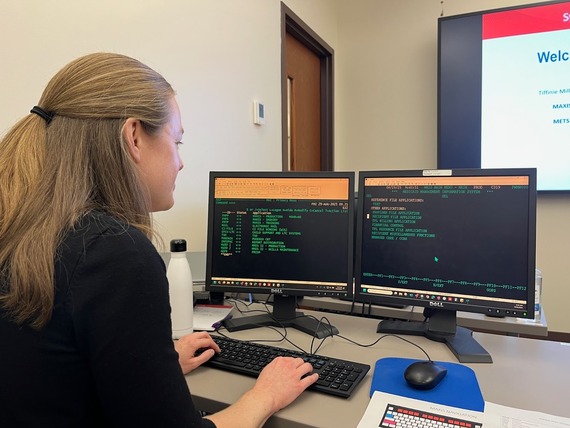
County caseworkers spend most of their time entering data when they’d much rather be helping their clients. Most county caseworkers burn out and quit their jobs before they’ve even completed their two-year training program. If you’re wondering why your County property taxes are increasing, the inefficiencies of this process are a big reason why, and with Congress now requiring Medicaid members to verify their work status and income multiple times each year, it's about to get much worse!
Because enrollment and eligibility processing for various DHS programs are split between MAXIS and a second system called METS, DHS has always had trouble keeping its consolidated client list straight. This, in turn, makes it easy for fraudulent businesses to make up clients or register real clients in programs without the client’s knowledge or permission, a weakness that is at the heart of many of the worst fraud schemes.
Because provider, client enrollment, and claims data from MAXIS, METS and MMIS, (the mainframe/COBOL system used to pay claims) are incompletely integrated in the 25 year-old DHS “data warehouse” that is used for analysis, it is difficult for analysts to make the correlations across client identifiers, providers, service address, and claims that are necessary to identify patterns of fraud that seem obvious in hindsight.
It’s not going to be possible to correct these shortcomings overnight, but if one good thing comes out of the Fraud Committee’s work, it should be an executable plan to correct these shortcomings and legislative funding to see it through to completion.
The plan will require a two stage process: First, stanch the bleeding from the current obsolete systems and then come back and build a new system from scratch, the right way on modern, flexible platforms (Note: At any given time, DHS has a three to five year backlog of MAXIS programming changes that are needed to reflect changes in law and policy and, as a result, the State is frequently penalized by the feds for errors in program administration).
To stanch the bleeding, Minnesota IT Services (MNIT) has already identified a couple of bolt-on enhancements to the current systems that would have an immediate impact. First, MNIT has determined that there are ways to enable the electronic ingestion of timely and accurate data into MAXIS from authoritative data sources like the DEED UI database, MNBenefits and the “Federal Data Services Hub”. This would eliminate most manual keying of data and dramatically improve the timeliness and accuracy of the data being entered into MAXIS. In connection with the adoption of this technology, DHS and MNIT need to rebuild the data highway connecting state systems (called an Enterprise Service Bus – we IT geeks are horrible at naming things!) so that DEED (and other agencies) can more easily transmit data among themselves.
In addition, Hennepin County employees have identified a user-friendly graphical user interface for MAXIS that would make county caseworkers more productive for their remaining manual work.
Next, MNIT has already implemented a “single sign-on” application called LoginMN where Minnesota residents will be able to create a single, verified, online identity for themselves that can be used to sign into any state system (There is already a federal version called Login.gov that is used to log in to programs like Social Security, Medicare, IRS and TSAPreCheck). LoginMN is now being implemented in connection with the State’s new Paid Family & Medical Leave program (PFML) (see below). Once proven as part of the PFML implementation, the required use of LoginMN by both providers and clients for these DHS programs should be a priority. With one verified name and address record for all program participants (both providers and clients) it would be next to impossible for fraudulent providers to invent clients or enroll clients in programs without their permission (only the clients, themselves, would be able to log in and enroll).
Having a reliable online identity and consistent address information for each provider and each client would also make it much easier to identify correlations across programs, providers, clients, and addresses for fraud pattern detection in the DHS data warehouse.
DHS leadership understands the need to adopt LoginMN, but the electronic interface for MAXIS must be in place before it can be implemented.
These two system enhancements alone would enable a dramatic reduction in fraud in these programs.
Once the hemorrhaging has been stanched, DHS can proceed with its existing long term plan to replace its obsolete systems and processes. It’s called the Medicaid Enterprise Systems (MES) project. It's ambitious, it’s refreshing, it’s well-grounded, and you can learn about it here.
In my next bulletin, I’ll discuss my thoughts about how the Inspector General function should be organized in state government.
Property Damage Insurance
Between the 2025 and 2026 sessions, I’m serving on four interim study committees and chairing the one that is studying the rapidly rising cost of property insurance. In 2017 and again in 2022, Minnesota had three severe wind and hail storms that each generated over a billion dollars in property damage claims. Clearly, climate change is resulting in more frequent and severe weather events. Minnesota property and casualty insurers have suffered a cumulative net loss on their property insurance policies over the last decade. As a result, our homeowner’s insurance rates have gone up significantly. The impact has been especially severe for the owners of condominiums and apartment complexes, some of whom have had difficulty finding any insurance at all.
Our task force has identified several factors that are aggravating these trends and we’ve been studying possible ways to reduce home damage, mitigate insurance costs, and improve insurance availability. In 2023, the legislature approved a program that would offer insurance rate discounts to homeowners who strengthen their roofs to “Fortified” standards to better withstand wind and hail damage. The task force is poised to recommend that the state adopt related Minnesota-appropriate building code standards for new homes and provide financial incentives for retrofitting existing homes to such a standard so that we can move forward to implement this program. Pilot programs in Alabama and Oklahoma are demonstrating the cost-effectiveness of this approach.
To address the unavailability of insurance for homeowners associations and older affordable housing complexes, we’re poised to recommend that the State’s FAIR plan, our insurer of last resort for homes, expand their back-up insurance program to cover these types of multi-family housing as well.
The task force is also considering improvements to consumer protections and mediation processes governing the evaluation and processing of property damage claims, and is about to start considering the possible impact of tort claims on insurance rates.
The task force will complete its work and issue its recommendations in a report that will be delivered to the Legislature before we reconvene in February.
Note: There are signs that the market is stabilizing and some homeowners associations are actually seeing reductions in their insurance quotes for the coming year.
Paid Family Medical Leave to Launch on January 1, 2026
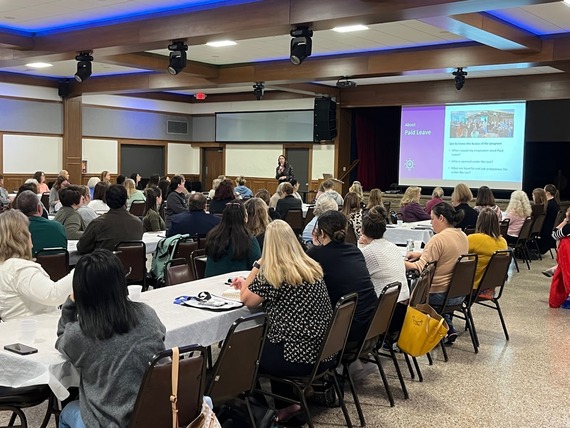
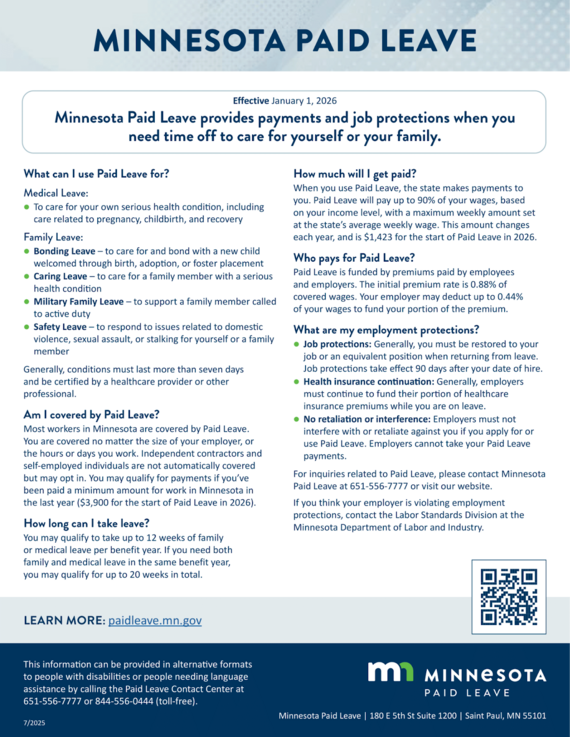
The U.S. is the only developed country in the world that doesn’t guarantee some form of paid leave, forcing most workers to make impossible choices between a paycheck and caring for a new child, an aging parent, or their own serious health condition. But in Minnesota, that’s about to change with the launch of Paid Leave on January 1, 2026. As we prepare for Paid Leave to take effect, I want to share a bit about the basics of the new law, how it impacts you, and how to use it when it goes live.
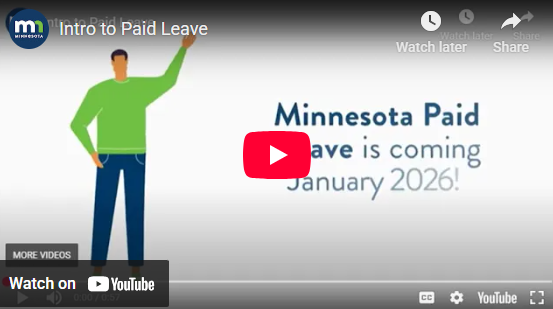
Paid Leave – which DFLers in the Legislature and Governor Walz passed in 2023 – provides partial wage replacement for up to 12 weeks of paid medical leave for your own serious health condition, including pregnancy and recovery. It also provides up to 12 weeks of paid family leave to care for a new child, a seriously ill loved one, or for certain military or safety-related events. If using both medical and family leave, workers can use up to a total of 20 weeks annually. A short video explaining the basics of how it works is available here:
|