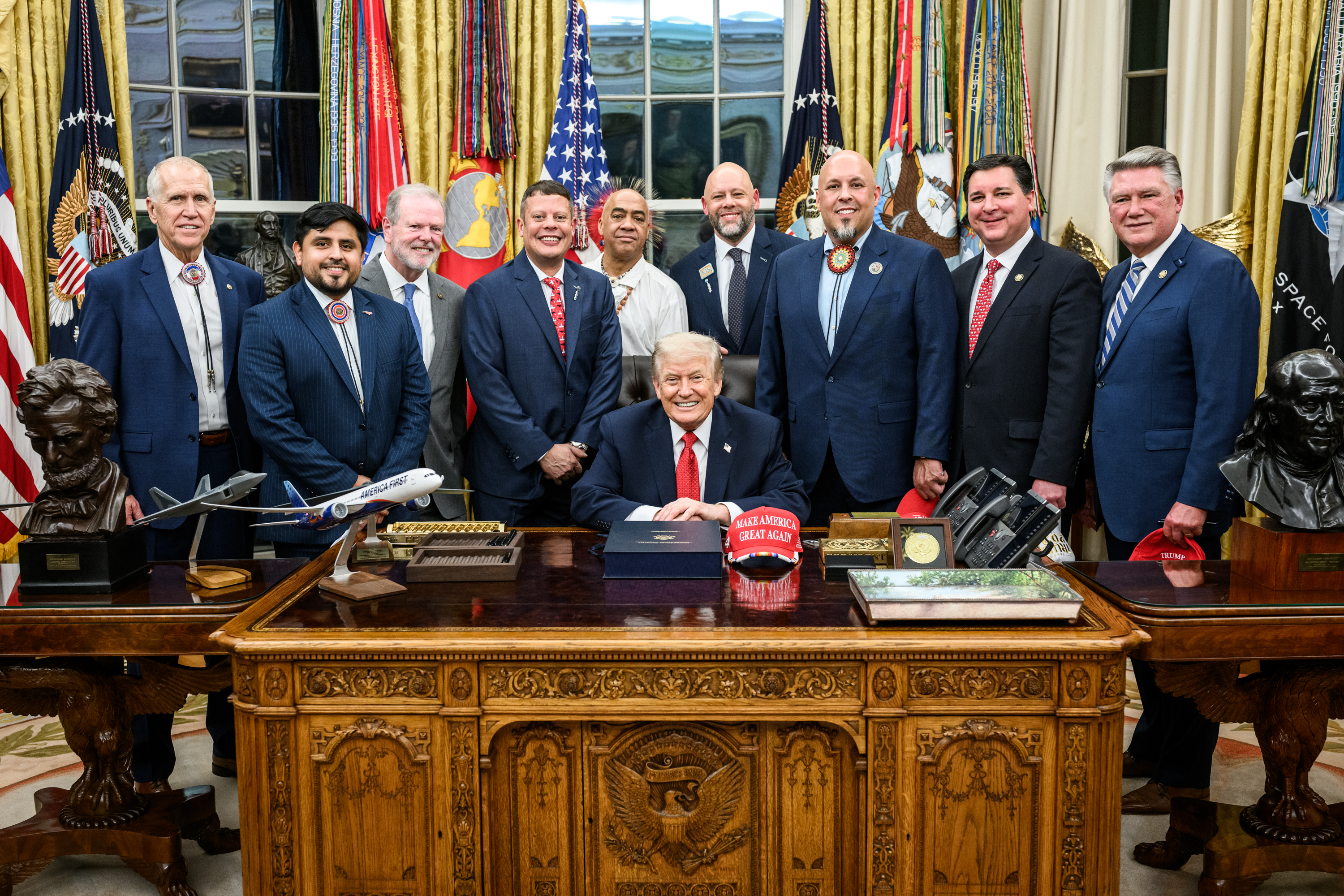
This past week, the U.S. House of Representatives wrapped up an historic year delivering major legislative victories for the American people, much of which will not be felt directly for another four to nine months. Among the many accomplishments is the passage of my bill, the Lumbee Fairness Act, which was just signed into law by President Donald J. Trump.
While Robeson County has not always been in the 7th Congressional District, in the previous Congress, I had the honor of representing all of Robeson County. This Congress, due to redistricting, I now only represent a portion of the county. In both the 118th and 119th Congresses I’ve been honored to lead the effort in the House to get the Lumbees the federal recognition they deserve. This is a truly historic accomplishment, and one in which I am proud to have played a part.
On the Floor this past week, the House passed the Lower Health Care Premiums for All Americans Act, taking initiative to address the disastrous effects of Obamacare, which has resulted in less access to good quality care while increasing the cost of health insurance. Additionally, I lead a bipartisan letter with more than one hundred of my House colleagues advocating for relief for specialty crop producers as a part of recent USDA efforts. Additional details are below.
If you received this newsletter from a friend, and you would like to continue receiving these updates, you can subscribe here or connect with me on Twitter, Facebook, and Instagram.
|
I am honored to share truly historic news! After years of determination and support, the Lumbee Tribe of North Carolina has finally received full federal recognition.
This past week, Congress passed the Fiscal Year 2026 National Defense Authorization Act, which included the Lumbee Fairness Act granting the Lumbee Tribe full federal recognition. With President Donald J. Trump’s signature, this long-overdue achievement is now law, ending generations of denied recognition.
This amazing achievement would not have been possible without Lumbee Tribal Chairman John Lowery’s leadership and the hard work of generations of Lumbee. Their voice has been heard, and their perseverance and faith in God has brought us to this historic moment.
I also want to commend and thank our current Senators Thom Tillis and Ted Budd as well as former Senators Elizabeth Dole and Richard Burr. Each of them have been staunch supporters of this effort, and Senator Tillis’ efforts have been nothing short of stellar. A number of my House colleagues in the NC Delegation have been strong advocates as well, including Mark Harris who now represents most of Robeson County.
This victory, decades in the making, is a moment of celebration for a community that has never wavered in its resolve. I am proud to stand with the Lumbee Tribe and with all who worked tirelessly to make this a reality.
|
This past Wednesday, I took to the House Floor following Senate passage to celebrate this historic moment, watch the floor remarks here.
|
This past week, House Republicans took action on a major issue that needs to be addressed: the rising cost of healthcare. Republicans are working to advance reforms to lower premiums, expand choice, and restore transparency across our healthcare system.
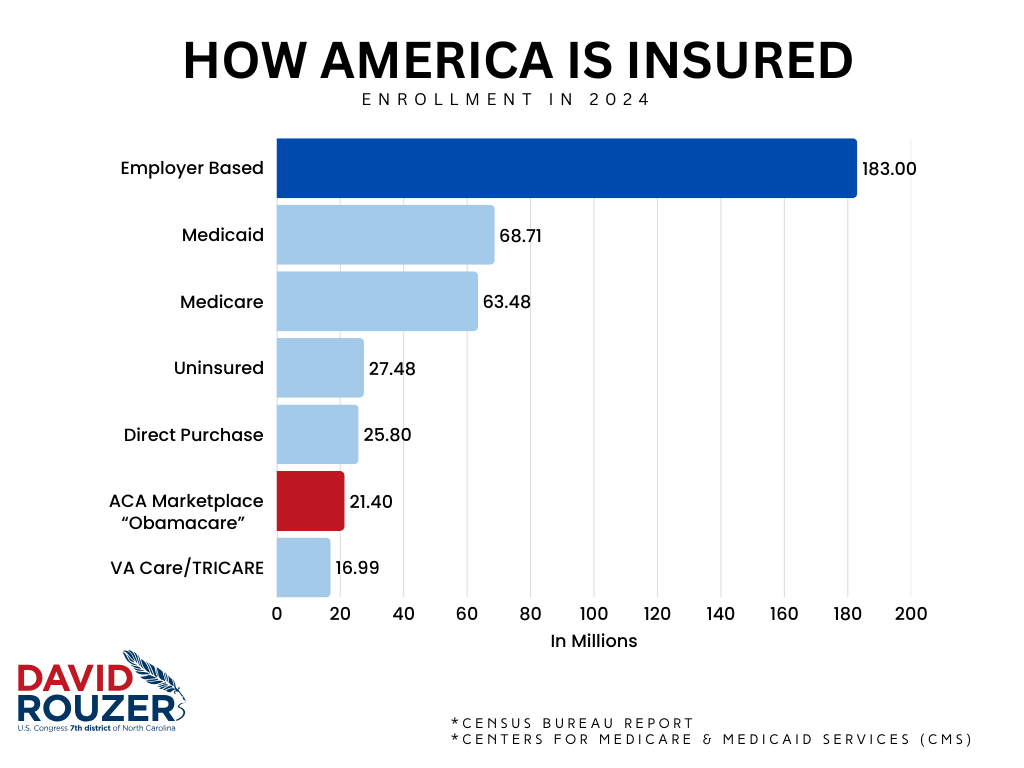
Meanwhile, Democrats remain solely focused on continuing expanded pandemic-era “Unaffordable” Care Act subsidies while ignoring the hundreds of millions of Americans and employers who have seen health care costs rise. As you can see in the chart above, in 2024 less than seven percent of the American population purchased their insurance through the Affordable Care Act (ACA) Marketplace, while more than fiftypercent of Americans received health care through their employer. Yet, Democrats have offered no solutions for these Americans.
Instead, Democrats continue to push the extension of COVID-era policies they themselves decided should expire at the end of 2025 when they wrote the law, which was passed when they had a majority in the House and Senate and President Biden in the White House. These subsidies benefit only a small share of the population, while masking the failures of a system that has driven health care costs higher for everyone. In doing so, Democrats have chosen to protect insurance companies’ bottom lines and further incentivize insurers to raise prices for working families and employers.
Additionally, rampant fraud in the ACA exchanges has led to insurance companies collecting payments for automatically enrolled individuals who never filed claims, padding insurer profits while taxpayers foot the bill. A December 3, 2025, Government Accountability Office (GAO) report highlighted the fraud:
- GAO was able to get approved coverage by the Obamacare Marketplace for 18 of 20 fake applications in 2024 and 2025.
- For some, the Obamacare Marketplace requested identification documents, however when GAO did not provide the documents, they were still approved for coverage.
- The Obamacare Marketplace failed to match applicants’ Social Security Numbers to tax filings to determine the amount of premium tax credit for which enrollees were eligible.
- In 2023, GAO found more than $21 billion in Advance Premium Tax Credit (APTC) claims where identity and incomes had not been reconciled.
- GAO found significant duplication of coverage: In 2023 and 2024 over 97,000 SSNs received more than a year's coverage in a single plan year.
- Insurers were “secretly” enrolling individuals or changing coverage: In 2024, at least 160,000 applications had unauthorized changes by agents or brokers.
To address this fraud and waste as well as drive health care costs down, House Republicans, with my support, passed H.R. 6703, the Lower Health Care Premiums for All Americans Act, this past week. This legislation uses common sense reforms to help put citizens and their employers back in control to help drive down costs. Through targeted expansions of Association Health Plans and CHOICE Arrangements, the bill allows small businesses, sole proprietors, and self-employed workers to save money on health insurance by allowing individuals and industries to join together to purchase insurance at group rates. More than half of Americans receive health insurance through their employer, yet small businesses have been boxed out of affordable options by the Unaffordable Care Act. Republicans are working to fix this.
The legislation also appropriates funding for Cost-Sharing Reductions, which will lower premiums and other costs by more than eleven percent for lower-income individuals purchasing through the ACA marketplace. Health insurers are required by the Affordable Care Act to provide CSRs, but a Congressional appropriation is required. By appropriating funding for CSRs, insurers would no longer be able to offset losses with a practice known as “silver loading”, which is when insurers increase premiums on silver plans to bait purchasers to choose more expensive plans that appear cheaper due to federal credits, recouping losses from federally-required CSRs. Removing this practice will bring premiums down for certain individuals, with federal support better directed towards low-income enrollees who need the help, saving taxpayers more than $35 billion.
Additionally, it addresses one of the largest drivers of prescription drug costs by requiring greater transparency from pharmacy benefit managers (PBMs). Under this provision, PBMs would have to provide employers with clear, detailed reporting on prescription drug spending, including rebates, pricing, and formulary decisions. Informing employers allows them to negotiate better prices for their workers.
Instead of endless subsidies which cost taxpayers billions, enrich insurers, and systematically fail the people they are supposed to help, Republicans are advancing simple, structural reforms that will drive costs lower, expand access, and increase competition. |
This past week, I led a bipartisan letter with the Co-Chairs of the Specialty Crops Caucus urging the House and Senate Agriculture Committees to secure immediate, equitable relief for specialty crop producers. Specialty crops (fruits, vegetables, tree nuts, greenhouse, nursery, and floriculture) generate more than $75 billion annually and make up about one third of farm gate value, yet growers continue to face rising costs and market disruptions without proportional support.
The letter responds to USDA’s new Farmer Bridge Assistance (FBA) Program, which directs $11 billion to row crops but only $1 billion to specialty crops and other commodities, with little clarity on how or when payments will be made. Producers are struggling as production costs outpace crop prices, and USDA has not provided details on eligibility or payment formulas.
In the letter, we urged the House and Senate Committees on Agriculture to work with USDA to ensure specialty crop funding is delivered quickly, fairly, and in a way that reflects the sector’s unique needs. We emphasized the importance of building on proven models so growers can remain competitive, support rural economies, and continue providing safe, affordable food nationwide.
The full text of the letter can be found here.
|
For this week’s good news story, I’m proud to highlight the Fayetteville Public Works Commission’s recent achievements at the 2025 NC One Water Awards. Fayetteville PWC was honored with the Water Distribution Center of the Year: Overall Winner and the Wastewater Collections System of the Year: Large System awards, recognizing their exceptional maintenance, service, and professionalism in providing reliable water services to more than 225,000 residents.
These awards highlight the strong infrastructure and new improvements that have led to greater efficiency. Read more here. |
"Let us raise a standard to which the wise and honest can repair; the rest is in the hands of God." - George Washington |
|