Cora Weiss was a woman who changed my life at the impressionable age of 19. I was a sophomore at conservative Dartmouth College, interested in the world beyond the United States but ignorant of how to become a part of that world.
I was studying Chinese at that moment when Nixon and Mao had opened a door to closer U.S.-Chinese relations and my Chinese teacher suggested I take advantage of Dartmouth’s “semester-off” grants to do an internship in Washington. I later learned that he wrote to Cora and asked where a young, “confused” Dartmouth student might go to get a glimpse of how to work for a better world.
Cora reached out to the Indochina Resource Center, a small but vital organization in Washington, D.C. that was fighting to end the Vietnam War, and they agreed to host me in the spring of 1975. There, I met some of the most committed and effective activists from Vietnam, Laos, and the United States who were teaching the Washington establishment and the country about the atrocities that the United States was committing in the countries of Indochina.
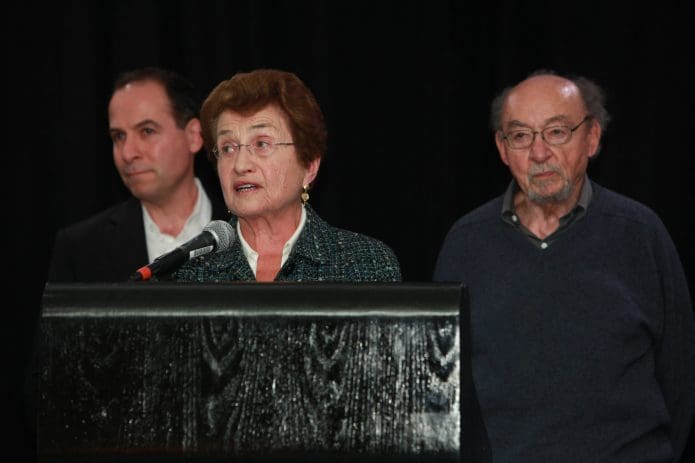 Cora Weiss speaks at a memorial event for the late Saul Landau in 2013. Her son Danny (left) and husband Peter (right) listen on. (Photo by Rick Reinhard for IPS)
During my work at the Center, I “met” Cora as her voice boomed over the speaker phone and she reported on a recent trip to Vietnam. Cora was a pillar of so much of the anti-war organizing in this period: trips to return POWs, humanizing the Vietnamese people for Americans, conveying the impact of the war on women and children.
My timing was impeccable as the war ended during my internship. My going away present was a May 1975 poster advertising a massive peace celebration Cora co-organized (with Don Luce) in New York City’s Central Park. Forty years later, when I had become her friend, I asked if she needed a copy of the poster and it turned out she’d been looking for one for years. I was able to make an impeccable copy for her, while the original still hangs in my family home.
In 1983, the Institute for Policy Studies hired me to lead its global economy work — and I was delighted to find that Cora and her brilliant international lawyer husband, Peter, were close allies of IPS. They showed great interest in the work I had done after graduate school at the United Nations in Geneva, and they were there to offer support and ideas for the next four decades.
Cora was a champion of the United Nations and its mission to advance peace and women’s rights. She insisted that we at IPS name our programs in positive terms to inspire people with “what we’re for”: peace, disarmament, internationalism, women’s rights, the common good.
She always wanted to hear about and meet the women we were bringing into IPS, and loved to talk to me about their work: Isabel Letelier, Barbara Ehrenreich, Sarah Anderson, Phyllis Bennis, Karen Dolan, Emira Woods, Lindsay Koshgarian, Kathleen Gaspard, Christine Ahn, and others.
When I needed help, I called. In 1996, IPS and the International Forum on Globalization were seeking a venue for a huge teach-in on globalization in New York, and Cora delivered the glorious Riverside Church, where she ran their program on disarmament. I joined a United Nations advisory committee and Cora introduced me to her friend, Helen Clark, the former Prime Minister of New Zealand who ran the UN Development Program.
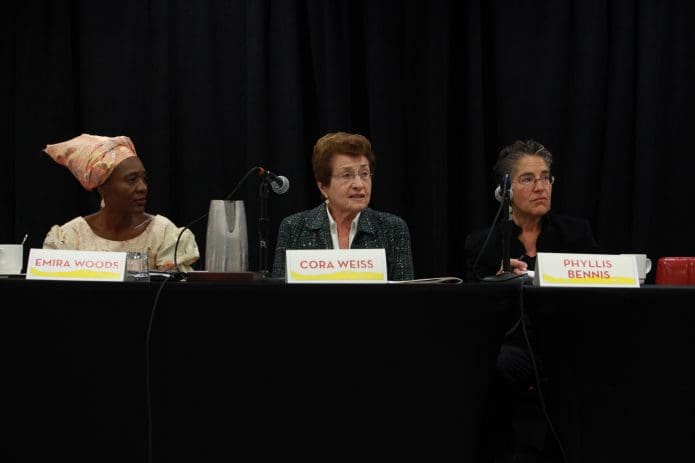 Cora Weiss (center) speaks on a panel at IPS’s 50th anniversary celebration with Emira Woods (left) and Phyllis Bennis (right). (Photo by Rick Reinhard for IPS)
As a philanthropist, she invested not only in many of the key peace and women’s rights groups, but in dynamic and brilliant people she believed in. In the midst of all of her other duties as a peace and women’s rights leader, Cora ran the Samuel Rubin Foundation (now directed by her daughter, Judy), a foundation set up by her father who had created the perfume company Fabergé and sold it to set up the foundation.
For decades, that foundation generously supported IPS and its international arm, the Transnational Institute (now an independent but still allied organization). She and Peter not only supported the institutions they felt would deliver peace and human rights and women’s rights, they were there for leaders when they needed help. As a trustee of Hampshire College, Cora helped key leaders get teaching jobs. She paid for the college education of the children of victims of political assassination. She gave special grants to IPS to help build retirement funds for some of its original leaders who couldn’t imagine they would ever “retire.”
And she was audacious in her creations. In 1999, she organized The Hague Appeal for Peace, bringing Bishop Desmond Tutu of South Africa and 10,000 people to the Netherlands to educate for peace.
One of my favorite Cora moments was in 2009. I told Cora that I had been invited to attend a White House speech by President Barack Obama on the economy. Cora had met Obama on the campaign trail and had told him about the role that she and IPS Trustee Harry Belafonte had played in organizing funds for the program that brought Barack Obama’s father to study in this country. In 2009, a new book (Airlift to America) had just been published on this program, and Cora wanted to inscribe a copy and have me deliver it to President Obama.
I arrived at the White House for the speech and was told that we had to wait an hour and could explore parts of the White House because the world had just been told that Obama would win the Nobel Peace Prize. I figured that I would never actually meet the president so I wandered into the White House library and put the book on a shelf next to some important 18th century tomes. I then told a confused and disbelieving White House aide where I had left a gift for the president from Cora Weiss.
Cora and Peter were incredibly proud of their three children, and loved to talk about them. Cora loved to organize birthday parties for Peter where people were challenged to talk about their dreams to make the impossible possible. She loved meeting women who would, like her, push the boundaries of the possible.
And she inspired me to help IPS build an ambitious program to mentor new leaders of the movements that will lead us out of this time of crisis, now called the Henry A. Wallace Fellowship Program.
Cora’s bold, inspiring legacy will live on for generations to come.
John Cavanagh directed IPS’s Global Economy Project from 1983-1999, directed IPS from 1991 to 2021, and is now Senior Advisor at IPS.
IPS is a progressive organization dedicated to building a more equitable, ecologically sustainable, and peaceful society. In partnership with dynamic social movements, we turn transformative policy ideas into action.


