
| From | Hudson Institute Weekend Reads <[email protected]> |
| Subject | China’s Stealth War Has Already Begun |
| Date | December 20, 2025 2:00 PM |
Links have been removed from this email. Learn more in the FAQ.
Links have been removed from this email. Learn more in the FAQ.
No images? Click here [link removed]
Weekend Reads
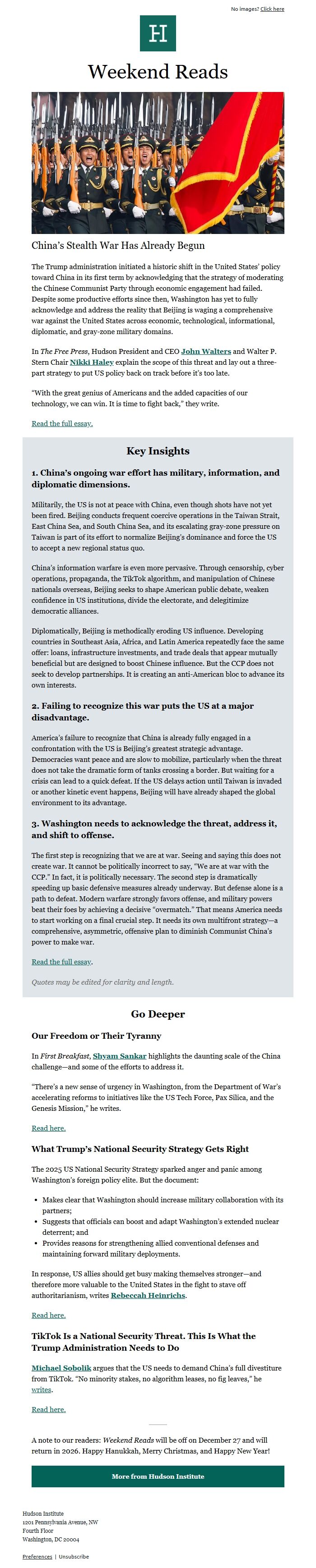
China’s Stealth War Has Already Begun [[link removed]]
The Trump administration initiated a historic shift in the United States’ policy toward China in its first term by acknowledging that the strategy of moderating the Chinese Communist Party through economic engagement had failed. Despite some productive efforts since then, Washington has yet to fully acknowledge and address the reality that Beijing is waging a comprehensive war against the United States across economic, technological, informational, diplomatic, and gray-zone military domains.
In The Free Press, Hudson President and CEO John Walters [[link removed]] and Walter P. Stern Chair Nikki Haley [[link removed]] explain the scope of this threat and lay out a three-part strategy to put US policy back on track before it’s too late.
“With the great genius of Americans and the added capacities of our technology, we can win. It is time to fight back,” they write.
Read the full essay. [[link removed]]
Key Insights
1. China’s ongoing war effort has military, information, and diplomatic dimensions.
Militarily, the US is not at peace with China, even though shots have not yet been fired. Beijing conducts frequent coercive operations in the Taiwan Strait, East China Sea, and South China Sea, and its escalating gray-zone pressure on Taiwan is part of its effort to normalize Beijing’s dominance and force the US to accept a new regional status quo.
China’s information warfare is even more pervasive. Through censorship, cyber operations, propaganda, the TikTok algorithm, and manipulation of Chinese nationals overseas, Beijing seeks to shape American public debate, weaken confidence in US institutions, divide the electorate, and delegitimize democratic alliances.
Diplomatically, Beijing is methodically eroding US influence. Developing countries in Southeast Asia, Africa, and Latin America repeatedly face the same offer: loans, infrastructure investments, and trade deals that appear mutually beneficial but are designed to boost Chinese influence. But the CCP does not seek to develop partnerships. It is creating an anti-American bloc to advance its own interests.
2. Failing to recognize this war puts the US at a major disadvantage.
America’s failure to recognize that China is already fully engaged in a confrontation with the US is Beijing’s greatest strategic advantage. Democracies want peace and are slow to mobilize, particularly when the threat does not take the dramatic form of tanks crossing a border. But waiting for a crisis can lead to a quick defeat. If the US delays action until Taiwan is invaded or another kinetic event happens, Beijing will have already shaped the global environment to its advantage.
3. Washington needs to acknowledge the threat, address it, and shift to offense.
The first step is recognizing that we are at war. Seeing and saying this does not create war. It cannot be politically incorrect to say, “We are at war with the CCP.” In fact, it is politically necessary. The second step is dramatically speeding up basic defensive measures already underway. But defense alone is a path to defeat. Modern warfare strongly favors offense, and military powers beat their foes by achieving a decisive “overmatch.” That means America needs to start working on a final crucial step. It needs its own multifront strategy—a comprehensive, asymmetric, offensive plan to diminish Communist China’s power to make war.
Read the full essay [[link removed]].
Quotes may be edited for clarity and length.
Go Deeper
Our Freedom or Their Tyranny [[link removed]]
In First Breakfast, Shyam Sankar [[link removed]] highlights the daunting scale of the China challenge—and some of the efforts to address it.
“There’s a new sense of urgency in Washington, from the Department of War’s accelerating reforms to initiatives like the US Tech Force, Pax Silica, and the Genesis Mission,” he writes.
Read here. [[link removed]]
What Trump’s National Security Strategy Gets Right [[link removed]]
The 2025 US National Security Strategy sparked anger and panic among Washington’s foreign policy elite. But the document:
Makes clear that Washington should increase military collaboration with its partners;Suggests that officials can boost and adapt Washington’s extended nuclear deterrent; andProvides reasons for strengthening allied conventional defenses and maintaining forward military deployments.
In response, US allies should get busy making themselves stronger—and therefore more valuable to the United States in the fight to stave off authoritarianism, writes Rebeccah Heinrichs [[link removed]].
Read here. [[link removed]]
TikTok Is a National Security Threat. This Is What the Trump Administration Needs to Do [[link removed]]
Michael Sobolik [[link removed]] argues that the US needs to demand China’s full divestiture from TikTok. “No minority stakes, no algorithm leases, no fig leaves,” he writes [[link removed]].
Read here [[link removed]] . [[link removed]]
A note to our readers: Weekend Reads will be off on December 27 and will return in 2026. Happy Hanukkah, Merry Christmas, and Happy New Year!
More from Hudson Institute [[link removed]]
Hudson Institute
1201 Pennsylvania Avenue, NW
Fourth Floor
Washington, DC 20004
Preferences [link removed] | Unsubscribe [link removed]
Weekend Reads
China’s Stealth War Has Already Begun [[link removed]]
The Trump administration initiated a historic shift in the United States’ policy toward China in its first term by acknowledging that the strategy of moderating the Chinese Communist Party through economic engagement had failed. Despite some productive efforts since then, Washington has yet to fully acknowledge and address the reality that Beijing is waging a comprehensive war against the United States across economic, technological, informational, diplomatic, and gray-zone military domains.
In The Free Press, Hudson President and CEO John Walters [[link removed]] and Walter P. Stern Chair Nikki Haley [[link removed]] explain the scope of this threat and lay out a three-part strategy to put US policy back on track before it’s too late.
“With the great genius of Americans and the added capacities of our technology, we can win. It is time to fight back,” they write.
Read the full essay. [[link removed]]
Key Insights
1. China’s ongoing war effort has military, information, and diplomatic dimensions.
Militarily, the US is not at peace with China, even though shots have not yet been fired. Beijing conducts frequent coercive operations in the Taiwan Strait, East China Sea, and South China Sea, and its escalating gray-zone pressure on Taiwan is part of its effort to normalize Beijing’s dominance and force the US to accept a new regional status quo.
China’s information warfare is even more pervasive. Through censorship, cyber operations, propaganda, the TikTok algorithm, and manipulation of Chinese nationals overseas, Beijing seeks to shape American public debate, weaken confidence in US institutions, divide the electorate, and delegitimize democratic alliances.
Diplomatically, Beijing is methodically eroding US influence. Developing countries in Southeast Asia, Africa, and Latin America repeatedly face the same offer: loans, infrastructure investments, and trade deals that appear mutually beneficial but are designed to boost Chinese influence. But the CCP does not seek to develop partnerships. It is creating an anti-American bloc to advance its own interests.
2. Failing to recognize this war puts the US at a major disadvantage.
America’s failure to recognize that China is already fully engaged in a confrontation with the US is Beijing’s greatest strategic advantage. Democracies want peace and are slow to mobilize, particularly when the threat does not take the dramatic form of tanks crossing a border. But waiting for a crisis can lead to a quick defeat. If the US delays action until Taiwan is invaded or another kinetic event happens, Beijing will have already shaped the global environment to its advantage.
3. Washington needs to acknowledge the threat, address it, and shift to offense.
The first step is recognizing that we are at war. Seeing and saying this does not create war. It cannot be politically incorrect to say, “We are at war with the CCP.” In fact, it is politically necessary. The second step is dramatically speeding up basic defensive measures already underway. But defense alone is a path to defeat. Modern warfare strongly favors offense, and military powers beat their foes by achieving a decisive “overmatch.” That means America needs to start working on a final crucial step. It needs its own multifront strategy—a comprehensive, asymmetric, offensive plan to diminish Communist China’s power to make war.
Read the full essay [[link removed]].
Quotes may be edited for clarity and length.
Go Deeper
Our Freedom or Their Tyranny [[link removed]]
In First Breakfast, Shyam Sankar [[link removed]] highlights the daunting scale of the China challenge—and some of the efforts to address it.
“There’s a new sense of urgency in Washington, from the Department of War’s accelerating reforms to initiatives like the US Tech Force, Pax Silica, and the Genesis Mission,” he writes.
Read here. [[link removed]]
What Trump’s National Security Strategy Gets Right [[link removed]]
The 2025 US National Security Strategy sparked anger and panic among Washington’s foreign policy elite. But the document:
Makes clear that Washington should increase military collaboration with its partners;Suggests that officials can boost and adapt Washington’s extended nuclear deterrent; andProvides reasons for strengthening allied conventional defenses and maintaining forward military deployments.
In response, US allies should get busy making themselves stronger—and therefore more valuable to the United States in the fight to stave off authoritarianism, writes Rebeccah Heinrichs [[link removed]].
Read here. [[link removed]]
TikTok Is a National Security Threat. This Is What the Trump Administration Needs to Do [[link removed]]
Michael Sobolik [[link removed]] argues that the US needs to demand China’s full divestiture from TikTok. “No minority stakes, no algorithm leases, no fig leaves,” he writes [[link removed]].
Read here [[link removed]] . [[link removed]]
A note to our readers: Weekend Reads will be off on December 27 and will return in 2026. Happy Hanukkah, Merry Christmas, and Happy New Year!
More from Hudson Institute [[link removed]]
Hudson Institute
1201 Pennsylvania Avenue, NW
Fourth Floor
Washington, DC 20004
Preferences [link removed] | Unsubscribe [link removed]
Message Analysis
- Sender: Hudson Institute
- Political Party: n/a
- Country: United States
- State/Locality: n/a
- Office: n/a
-
Email Providers:
- Campaign Monitor