
| From | Editors, Earth Island Journal <[email protected]> |
| Subject | After the Fire |
| Date | December 20, 2025 12:05 AM |
Links have been removed from this email. Learn more in the FAQ.
Links have been removed from this email. Learn more in the FAQ.
Rethinking the future of France’s historic Corbières wine region.
Is this email difficult to read? View in your web browser. ([link removed])
News of the world environment
NEWSLETTER | DECEMBER 19, 2025
([link removed])
([link removed])
([link removed])
After the Fire
ON A COLD, clear morning last October, 57-year-old Sophie Guiraudon led me along a dusty track that snaked up a hillside toward an old stone sheepfold. On either side of the path, we were surrounded by seemingly endless rows of charred vines, which stood in stark contrast to the beige and bone-white hues of the cracked earth from which they grew. Or rather, had grown. As she surveyed what was left of her 25-acre estate, Guiraudon spoke of the wild beauty she had once found in the rough terrain of this rocky plateau, set above the medieval village of Lagrasse in the heart of southwestern France’s historic Corbières wine region. “But when I come back here now, this landscape unsettles me,” she said. “It upsets me physically.”
About two months earlier, on August 5, a wildfire had broken out just a couple hundred meters from where we stood. Within 48 hours, it grew into a conflagration that consumed 40,000 acres in the department of Aude (an administrative unit similar to a county that the Corbières region is part of). That’s an area more than one-and-a-half times the size of Paris. The fire would go on to become the biggest blaze recorded in France in almost 80 years. It would take 23 days, more than 2,000 firefighters, and the French Civil Security Agency’s entire national air fleet to put it out.
Guiraudon lost almost everything. More than 90 percent of the vines she had tended for 25 years to produce refined organic wines were gone within the space of an hour. The fire destroyed more than just decades of hard work. Guiraudon’s children grew up playing among these vines, helping their mother pick grapes at harvest time. “It was as if all my memories of this place had been taken from me,” she said.
Guiraudon had been in the process of selling her estate when the fire hit. More than three years of punishing drought and oppressive summer heatwaves had taken a steep toll on the vineyard. In 2024, her total production had more than halved, dropping from about 6,500 to 8,000 gallons to just over 3,000. “I had the feeling that things were only going to get worse, so I said to myself, At least you’re going to get a head start,” she said.
But the fire denied her the chance to go out on her own terms.
Guiraudon’s story is not only emblematic of the wider impact of the fire, which burned a total of more than 2,200 acres of vines in the Corbières, it also exemplifies the increasingly existential threat to an industry that has long been this region’s lifeblood, and the uncertain future of the region itself.
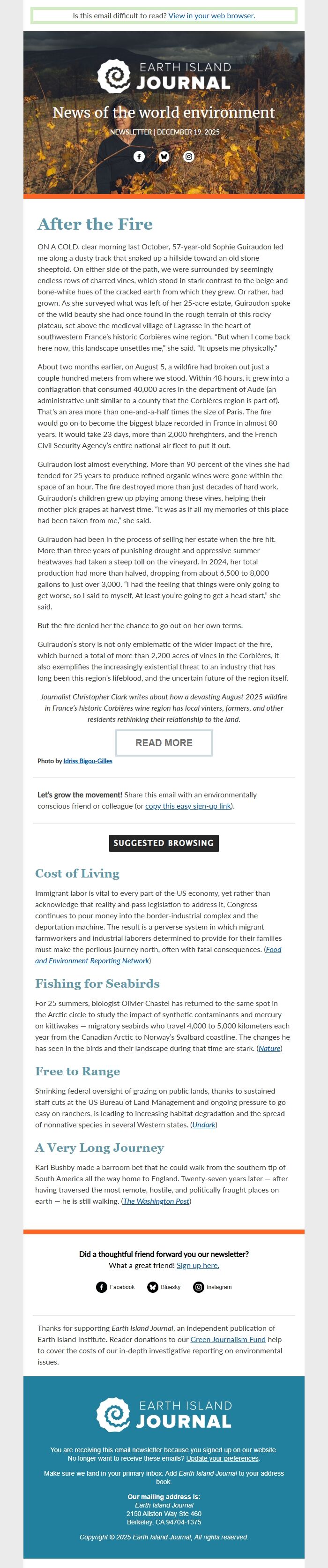
Journalist Christopher Clark writes about how a devasting August 2025 wildfire in France’s historic Corbières wine region has local vinters, farmers, and other residents rethinking their relationship to the land.
READ MORE ([link removed])
Photo by Idriss Bigou-Gilles ([link removed])
Let’s grow the movement! Share this email with an environmentally conscious friend or colleague (or copy this easy sign-up link ([link removed])).
SUGGESTED BROWSING ()
Cost of Living ([link removed])
Immigrant labor is vital to every part of the US economy, yet rather than acknowledge that reality and pass legislation to address it, Congress continues to pour money into the border-industrial complex and the deportation machine. The result is a perverse system in which migrant farmworkers and industrial laborers determined to provide for their families must make the perilous journey north, often with fatal consequences. (Food and Environment Reporting Network ([link removed]))
Fishing for Seabirds ([link removed])
For 25 summers, biologist Olivier Chastel has returned to the same spot in the Arctic circle to study the impact of synthetic contaminants and mercury on kittiwakes — migratory seabirds who travel 4,000 to 5,000 kilometers each year from the Canadian Arctic to Norway’s Svalbard coastline. The changes he has seen in the birds and their landscape during that time are stark. (Nature ([link removed]))
Free to Range ([link removed])
Shrinking federal oversight of grazing on public lands, thanks to sustained staff cuts at the US Bureau of Land Management and ongoing pressure to go easy on ranchers, is leading to increasing habitat degradation and the spread of nonnative species in several Western states. (Undark ([link removed]))
A Very Long Journey ([link removed])
Karl Bushby made a barroom bet that he could walk from the southern tip of South America all the way home to England. Twenty-seven years later — after having traversed the most remote, hostile, and politically fraught places on earth — he is still walking. (The Washington Post ([link removed]))
Did a thoughtful friend forward you our newsletter?
What a great friend! Sign up here. ([link removed])
([link removed])
Facebook ([link removed])
([link removed])
Bluesky ([link removed])
([link removed])
Instagram ([link removed])
Thanks for supporting Earth Island Journal, an independent publication of Earth Island Institute. Reader donations to our Green Journalism Fund ([link removed]) help to cover the costs of our in-depth investigative reporting on environmental issues.
([link removed])
You are receiving this email newsletter because you signed up on our website.
No longer want to receive these emails? Update your preferences ([link removed]).
Make sure we land in your primary inbox: Add Earth Island Journal to your address book.
Our mailing address is:
Earth Island Journal
2150 Allston Way Ste 460
Berkeley, CA 94704-1375
Copyright © 2025 Earth Island Journal, All rights reserved.
Is this email difficult to read? View in your web browser. ([link removed])
News of the world environment
NEWSLETTER | DECEMBER 19, 2025
([link removed])
([link removed])
([link removed])
After the Fire
ON A COLD, clear morning last October, 57-year-old Sophie Guiraudon led me along a dusty track that snaked up a hillside toward an old stone sheepfold. On either side of the path, we were surrounded by seemingly endless rows of charred vines, which stood in stark contrast to the beige and bone-white hues of the cracked earth from which they grew. Or rather, had grown. As she surveyed what was left of her 25-acre estate, Guiraudon spoke of the wild beauty she had once found in the rough terrain of this rocky plateau, set above the medieval village of Lagrasse in the heart of southwestern France’s historic Corbières wine region. “But when I come back here now, this landscape unsettles me,” she said. “It upsets me physically.”
About two months earlier, on August 5, a wildfire had broken out just a couple hundred meters from where we stood. Within 48 hours, it grew into a conflagration that consumed 40,000 acres in the department of Aude (an administrative unit similar to a county that the Corbières region is part of). That’s an area more than one-and-a-half times the size of Paris. The fire would go on to become the biggest blaze recorded in France in almost 80 years. It would take 23 days, more than 2,000 firefighters, and the French Civil Security Agency’s entire national air fleet to put it out.
Guiraudon lost almost everything. More than 90 percent of the vines she had tended for 25 years to produce refined organic wines were gone within the space of an hour. The fire destroyed more than just decades of hard work. Guiraudon’s children grew up playing among these vines, helping their mother pick grapes at harvest time. “It was as if all my memories of this place had been taken from me,” she said.
Guiraudon had been in the process of selling her estate when the fire hit. More than three years of punishing drought and oppressive summer heatwaves had taken a steep toll on the vineyard. In 2024, her total production had more than halved, dropping from about 6,500 to 8,000 gallons to just over 3,000. “I had the feeling that things were only going to get worse, so I said to myself, At least you’re going to get a head start,” she said.
But the fire denied her the chance to go out on her own terms.
Guiraudon’s story is not only emblematic of the wider impact of the fire, which burned a total of more than 2,200 acres of vines in the Corbières, it also exemplifies the increasingly existential threat to an industry that has long been this region’s lifeblood, and the uncertain future of the region itself.
Journalist Christopher Clark writes about how a devasting August 2025 wildfire in France’s historic Corbières wine region has local vinters, farmers, and other residents rethinking their relationship to the land.
READ MORE ([link removed])
Photo by Idriss Bigou-Gilles ([link removed])
Let’s grow the movement! Share this email with an environmentally conscious friend or colleague (or copy this easy sign-up link ([link removed])).
SUGGESTED BROWSING ()
Cost of Living ([link removed])
Immigrant labor is vital to every part of the US economy, yet rather than acknowledge that reality and pass legislation to address it, Congress continues to pour money into the border-industrial complex and the deportation machine. The result is a perverse system in which migrant farmworkers and industrial laborers determined to provide for their families must make the perilous journey north, often with fatal consequences. (Food and Environment Reporting Network ([link removed]))
Fishing for Seabirds ([link removed])
For 25 summers, biologist Olivier Chastel has returned to the same spot in the Arctic circle to study the impact of synthetic contaminants and mercury on kittiwakes — migratory seabirds who travel 4,000 to 5,000 kilometers each year from the Canadian Arctic to Norway’s Svalbard coastline. The changes he has seen in the birds and their landscape during that time are stark. (Nature ([link removed]))
Free to Range ([link removed])
Shrinking federal oversight of grazing on public lands, thanks to sustained staff cuts at the US Bureau of Land Management and ongoing pressure to go easy on ranchers, is leading to increasing habitat degradation and the spread of nonnative species in several Western states. (Undark ([link removed]))
A Very Long Journey ([link removed])
Karl Bushby made a barroom bet that he could walk from the southern tip of South America all the way home to England. Twenty-seven years later — after having traversed the most remote, hostile, and politically fraught places on earth — he is still walking. (The Washington Post ([link removed]))
Did a thoughtful friend forward you our newsletter?
What a great friend! Sign up here. ([link removed])
([link removed])
Facebook ([link removed])
([link removed])
Bluesky ([link removed])
([link removed])
Instagram ([link removed])
Thanks for supporting Earth Island Journal, an independent publication of Earth Island Institute. Reader donations to our Green Journalism Fund ([link removed]) help to cover the costs of our in-depth investigative reporting on environmental issues.
([link removed])
You are receiving this email newsletter because you signed up on our website.
No longer want to receive these emails? Update your preferences ([link removed]).
Make sure we land in your primary inbox: Add Earth Island Journal to your address book.
Our mailing address is:
Earth Island Journal
2150 Allston Way Ste 460
Berkeley, CA 94704-1375
Copyright © 2025 Earth Island Journal, All rights reserved.
Message Analysis
- Sender: Earth Island
- Political Party: n/a
- Country: United States
- State/Locality: n/a
- Office: n/a