Dear Neighbor,
Following a weekend of heartbreaking, staggering loss, I returned to Washington this week, my thoughts with all those mourning the tremendous losses at home and across the world. On Saturday, two Brown University students were killed, and nine more seriously injured, during a mass shooting during the second day of finals. On Sunday 15 people were killed and 40 more were seriously injured in an antisemitic attack at a Hanukkah celebration near Bondi Beach, Australia, a deliberate act of hatred against Jewish families celebrating their faith. Later Sunday, we learned that beloved Rob and Michele Reiner were murdered in an act of family violence. We must stand continue working with urgency to protect our communities and prevent this kind of violence from happening again. |
Congress was in session for its last week of the year, and it was a busy one. And people were talking about many different things happening in the administration, including President Trump’s disgraceful, narcissistic comments about the murders of the Reiners. Amid so much senseless killing–for reasons we know and reasons we do not–we look to others in our communities and country for comfort, peace, and purpose. Those who have died and all those who mourn deserve that from those we elect as our leaders.
On Wednesday night, President Trump continued to demonstrate his lack of empathy and isolation in an oval office address that demonstrated an utter failure to understand Americans’ concerns about the economy and rising costs. Although many people, including me, expected the President to address growing concerns regarding the administration’s military strikes against Venezuela, he instead focused on his declining approval ratings. (Among other things, President Trump announced that the administration is raiding the $2.9 billion in congressionally allocated funds intended to subsidize housing allowances for service members to give a “Warrior Dividend” payment of $1,776 for 1.45 million military service members before Christmas.)
People in Washinton were also talking about the executive order the President signed last week that blocks states from regulating artificial intelligence (AI), even if a state has already passed a law regulating it. This latest effort follows multiple attempts by Congressional Republicans to override state laws to prevent harm to citizens from AI systems. As an enforcement mechanism, this Executive Order allows the federal government to withhold federal funding for broadband and other projects unless states comply with these demands. Once again, we are witnessing an overreach of executive authority without any benefit to Americans. President Trump should not restrict states’ ability to protect their residents when the Congress fails to do so, as it has. The dismantling of state AI laws without a serious federal strategy only creates confusion and risk for Americans. It is critical that Congress pass a federal regulatory framework that harnesses the potential of AI and protects the rights and privacy of all Americans.
Also this week, the DOJ must release the Epstein files by today, December 19. In November, Congress passed the bipartisan Epstein Files Transparency Act, H.Res. 581, to force the Trump administration to release all files related to the sex-trafficking investigation into Jeffrey Epstein at the Department of Justice (DOJ). At the time of writing, these files have not been released despite an overwhelming desire from the American people to release the files and a statutory deadline to do so. President Trump has—and has had—the power to release the Epstein files at any time. And Democrats on the House Oversight Committee have continued to make available to the public materials that it has received from Epstein’s estate demonstrating the importance of the full release of the files. (You can learn more here.) I will not stop working to provide transparency, accountability, and justice for the survivors.
(And, for all those worried that President Trump had the Kennedy Center Board rename the Kennedy Center after him this week, neither he nor the Board has the authority to do that. It was named by an act of Congress and it takes an act of Congress to change it.) |
The House schedule was full this week. Lots of votes to cover below!
With health insurance premiums set to go up at the end of the year unless Congress acts, this week, the House considered the disingenuously named Lower Health Care Premiums for All Americans Act (H.R. 6703). In response to political pressure from the very real crisis before us, House Republicans rushed a bill to the floor without input from House Democrats and without going through the Energy & Commerce Committee as it should, or going through any actual legislative process. The explanation of why the policies in this bill will not work is long, but in short, this bill is a glaring failure to engage in real, meaningful policy. And it does not lower health care premiums. In fact, the experts tell us that this bill will do nothing to lower health care costs. It promotes junk insurance plans that rip people off. And it allows tax credits to expire, which will cause health insurance premiums to more than double for many Americans. During the debate on the House floor, I got one minute to speak about why I was opposed to the bill. You can watch my remarks below. |
As I mentioned at the very end, House Republicans did include in the bill a provision to prevent those with ACA insurance plans from getting reproductive health care. This is not what people are asking for. This rushed, unvetted, and unserious health care bill is a failure in process and in substance. For all of these reasons, I voted against this bill, which passed the House by a party-line vote of 216-211.
The House also considered another important bill for people in our district, in particular, on an issue I have worked on for years, the bipartisan Standardizing Permitting and Expediting Economic Development (SPEED) Act (H.R. 4776), a bill to reform the federal permitting process. If you’re a long-time subscriber to these updates, you know how important permitting reform is to many of the energy engineers and experts who live and work in Houston. Uncertainty and instability are holding back important work that we need to do in the United States to modernize and build energy infrastructure of all kinds—from traditional to renewable—and to provide reliable, affordable energy for people in Texas and across the country. This bill would help provide project developers with greater certainty by shortening timelines, eliminating duplicative processes, and focusing federal permitting agencies’ analysis on the direct impact of a project. Supporters of the bill include local groups like the Greater Houston Partnership and a broad coalition of the energy industry that includes renewable and oil and gas professionals. This bill was considered in the House Natural Resources Committee and reflects important bipartisan work and compromise. Unfortunately, this week members of the House Freedom Caucus insisted on last-minute changes to the bill that undermine a key pillar of the bill and which I do not support. I voted for the bill, however, to keep the process moving and to send something to the Senate that reflects some key priorities of the House. A small group of Democrats, many of them Texans, voted for the bill, and it passed by a vote of 221-196. I will work to ensure the Senate removes the problematic last-minute provisions and make other improvements to the bill that I have been working on before it comes back to the House.
The House also considered two resolutions this week to prevent further military operations in Latin America without congressional approval, H.Con.Res.61 and H.Con.Res.64. Since September, the Trump administration has built up a military presence in the Caribbean and eastern Pacific Ocean, launching a series of military strikes on boats in international waters and killing nearly 100 people the administration claims are smuggling drugs. This week, President Trump ordered a blockade of Venezuela, targeting sanctioned oil tankers. Last week, the United States seized a Venezuelan oil tanker. And President Trump has stated multiple times that the U.S. would start strikes on land soon. Congress—not the President—has the exclusive constitutional authority to declare war. These war powers resolutions reassert Congress’ authority and provide a process by which the President must consult with Congress and seek authorization for the use of armed force, or to terminate the use of force if not authorized by Congress. I voted for and cosponsored both of these war powers resolutions, H.Con.Res.61 and H.Con.Res.64, which failed the House by a vote of 210-216 and 211-213, respectively. Democratic leaders issued a statement following the failure to pass these resolutions: By not reining in President Trump’s abuse of power, Republicans are sending a dangerous signal that any president can unilaterally commit U.S. armed forces to hostilities without Congressional authorization.
Also this week, the House considered the Kayla Hamilton Act (H.R. 437) a bill that purports to increase protections for unaccompanied migrant children but instead grants the Trump administration broad authority to detain unaccompanied children as young as 12 years old. This bill undermines the long-standing protections for children contained in the bipartisan Trafficking Victims Protection Reauthorization Act and would lead to unaccompanied children spending extended periods of time in government custody with little to no due process on the basis they may be engaged in undefined “gang activity.” I voted against this bill, which passed the House by a vote of 225-201.
The House also considered two bills related to gender-affirming care for minors, which are insults to parents and doctors who have dedicated their lives to caring for children and families. These bills disregard families' fundamental rights and freedoms when it comes to making medical decisions for their children. The first bill, the Protect Children’s Innocence Act (H.R. 3492), is an extreme and partisan bill that could put doctors and parents behind bars for up to 10 years for providing medical care for children. The second bill, the Do No Harm in Medicaid Act (H.R. 498), prohibits federal Medicaid funding to be used to provide gender-affirming care for minors in any state, regardless of state laws relating to care. Members of Congress are not better positioned that patients, parents, and physicians to make personal and complex medical decisions that pose no risk to public health. I voted against both of these bills, which passed the House 216-211 and 215-201, respectively.
This week, the House considered two bills related to the operation of the country’s electricity grids. The Power Plant Reliability Act (H.R. 3632) allows the Federal Energy Regulatory Commission (FERC) to force power plants to stay in operation past their intended lifetime with very little evidence and to directly allocate the cost of keeping power plants online to those of us who pay the bills (“ratepayers”). If this bill were to be signed into law, the cost to consumers could reach nearly $6 billion per year. I voted against this bill, which passed 222-202. The Reliable Power Act (H.R. 3616) gives FERC unprecedented authority to veto regulations from other federal agencies related to energy generation and grid reliability. FERC already has the ability to weigh in other agencies’ regulations to ensure they will not negatively impact grid reliability. I voted against this bill, too, but it passed by a vote of 225-203.
The House considered the Mining Regulatory Clarity Act (H.R. 1366), which allows mining companies to dispose of mining waste on public lands outside of their established mining claim. I voted against this bill, which does not provide strong enough guardrails to ensure that that mining waste is disposed of safely, but it passed 219-198.
The House also considered the Pet and Livestock Protection Act (H.R. 845) to require the Secretary of the Interior to re-issue a rule from the first Trump Administration that removed the gray wolf from the list of protected species under the Endangered Species Act. Whether a species is removed or kept on an endangered species list is best left to experts with a background in wildlife management—the scientists—instead of members of Congress. I voted against this bill, which passed the House by a vote of 211-204.
The House passed twenty other bills without much debate addressing land conservation, fisheries, and federal lands. And the House unanimously passed a resolution honoring the service and sacrifice of United States Army Specialist Sarah Beckstrom and United States Air Force Staff Sergeant Andrew Wolfe, who were shot in Washington D.C. on November 26, 2025 during their National Guard deployment in a targeted assault against United States service members (H. Res. 923). My thoughts remain with their families and loved ones, and everyone affected by this violence, which has no place in our country.
As I said, it was a very busy week. And, as a reminder, you can always find a list of all of the votes I have taken for the district on my website. |
On Tuesday, I attended a classified briefing regarding the United States’ recent activity and military strikes in the Western Hemisphere from Secretary of State Marco Rubio, Secretary of Defense Pete Hegseth, General Dan Caine, Chairman of the Joint Chiefs of Staff, Vice Admiral Thomas G. Allan, Jr., Acting Vice Commandant, U.S. Coast Guard, Brigadier General Eric Widmar, Legal Counsel to the Chairman of the Joint Chiefs of Staff, and Charles Young, Principal Deputy General Counsel, Department of Defense. This briefing to members of Congress came unacceptably late—three months after the initial strikes on Venezuelan boats began in September. I agree with Democratic leaders that Secretary Hegseth should testify in a public hearing before the House Armed Services Committee to explain the policy, strategy, and legality of the military’s operations against drug cartels, provide congressional defense committees with copies of orders related to these military operations, as required by law, and publicly release the video of the September 2nd follow-on strike. And, following this briefing, I voted in favor of the war powers resolutions discussed above. |
This week, I led an effort with Congresswoman Pramila Jayapal, the ranking member on the House Judiciary Committee’s Subcommittee on Immigration, Security, Integrity, and Enforcement, to draft and send a letter to Homeland Security Secretary Kristi Noem and United States Citizenship and Immigration Services (USCIS) Director Joseph Edlow, condemning the Trump administration’s decision to halt green card applications and naturalization ceremonies for people from the 19 countries named in President Trump’s discriminatory travel ban. Recently, USCIS officers pulled people who had passed the citizenship exam and extensive vetting out of line moments before ceremonies to take their oath of citizenship.
This sweeping action is unjustified, discriminatory, and inconsistent with our nation’s founding principles. Democratic Leader Hakeem Jeffries, Democratic Whip Katherine Clark, Democratic Caucus Chair Pete Aguilar, Democratic Caucus Vice Chair Ted Lieu, House Judiciary Committee Ranking Member Jamie Raskin, and 112 of our Democratic colleagues joined us in demanding the Trump administration lift this pause immediately and requesting transparency regarding the decision and its impact on the hundreds of thousands of people attempting to navigate our country’s immigration system.
As we explained in our letter, these naturalization ceremonies are a time of celebration, as soon-to-be U.S. citizens welcome their friends and family to witness their achievement of becoming a U.S. citizen. To deny this monumental achievement to those who have waited years, if not decades, to pledge the Oath of Allegiance, delaying their naturalization through no fault of their own, is a slap in the face to all those who have devoted their time and energy to become U.S. citizens. It is also a waste of USCIS resources, such as employees who adjudicated applications, which includes vetting and screening, throughout the process. You can read our letter by clicking here.
I also joined colleagues in sending a letter to Government Accountability Office (GAO) Comptroller General Gene Dodaro urging the GAO to evaluate the public health, economic, and equity impacts of the Advisory Committee on Immunization Practices' recent decision to change their recommendation that all newborns receive the hepatitis B vaccine and a letter to Secretary of State Marco Rubio requesting information about the Trump administration's actions over U.S. foreign aid, including the State Department's plans to reallocate nearly $2 billion that Congress appropriated for USAID toward vaguely defined initiatives aimed to advance President Trump's "America First" agenda.
And I cosponsored several pieces of legislation on issues important to our community, including: - the Lowering Drug Costs for American Families Act, H.R. 6166, to expand the Medicare drug price negotiation program that in the Inflation Reduction Act to Americans with private insurance and to also extend the annual $2,000 out-of-pocket cap on prescription drugs to individuals with private insurance. This bill also increase the amount of drugs selected for negotiation each year from 20 to 50;
- the Living Donor Protection Act, H.R. 4583, to prohibit insurance companies from denying life, disability, or long-term care insurance to organ donors or charging them higher premiums based on their organ donor status;
- the Living Donor FMLA Protection Act, H.R. 4582, to amend the Family Medical and Leave Act (FMLA) of 1993 to allow private and federal employees to use FMLA to recover from organ donation surgery;
- the Metastatic Breast Cancer Access to Care Act, H.R. 2048, to eliminate the five-month waiting period for Social Security Disability Insurance benefits and the 24-month waiting period for Medicare coverage for individuals with metastatic breast cancer;
- the Reforming and Enhancing Sustainable Updates to Laboratory Testing Services (RESULTS) Act, H.R. 5269, to reform the Protecting Access to Medicare Act by altering how the data used to set the Medicare Clinical Laboratory Fee Schedule is collected;
- the Creating Opportunities Now for Necessary and Effective Care Technologies (CONNECT) for Health Act, H.R. 4206, to remove permanently the prior geological and location-based restrictions on telehealth under Medicare, giving Medicare patients the ability to access virtual care regardless of their location; and
- a resolution commending state and local governments for championing reproductive rights as human rights, H.Con.Res.65.
|
This week, the Energy & Commerce’s Subcommittee on Oversight & Investigations held a hearing on biosecurity, pandemic threats, and artificial intelligence. The topic of this hearing is important, but we cannot ignore that our country’s pandemic response has been decimated this year. The Trump administration has systematically destroyed the pipeline for biomedical research, terminating 1,229 National Institutes of Health (NIH) research grants totaling nearly $500 million. You can watch my full remarks and the witnesses’ answers to my questions below. |
During the hearing, the Ranking Member of the Energy & Commerce Committee Frank Pallone offered a motion to subpoena Secretary Kennedy to testify before the Committee to answer for these cuts, and other concerns posed by members of this Committee. I supported this effort, but we were outvoted when every Republican member of the Subcommittee voted to block a vote on the subpoena request. |
In Washington, Team TX-07 held more than a dozen meetings with constituents and groups advocating on their behalf, including members of Congregation Emanu El, pictured below. Back home in the district, our team joined community members at events across town. |
This week, we said goodbye to our fall semester interns in our Washington and Houston offices. Every semester, I'm so grateful to our interns for their hard work helping me and the entire TX-07 team serve our neighbors at home in Houston. Many thanks to our fall semester interns, who were outstanding! |
This is the last Washington Wrap Up for 2025. And, as I wrote to you last week, the rules of the House of Representatives limit my ability to send you these emails within 60 days of a congressional election. With a primary election next March, that means that people who have not opted-in to my email list will not get them next January and February (and next September and October).
If you haven’t opted in, this is the last Washington Week wrap up you will get until March. I hope you will take a minute today to opt in here. |
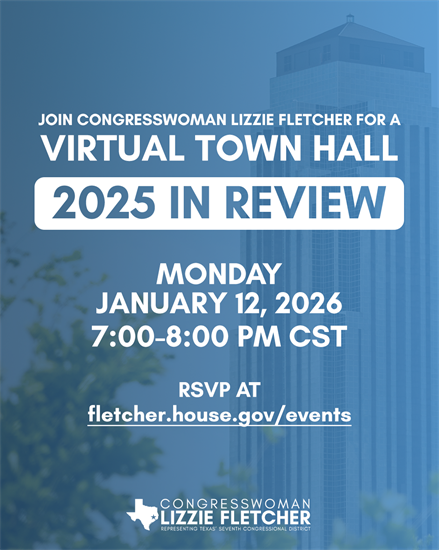
On Monday, January 12 at 7:00 p.m. CST, I will host a virtual town hall from my office in Washington to provide a review of 2025 in Congress and a look ahead to 2026. You can sign up here or by clicking on the graphic below. And you can submit your questions or topics you’d like to hear about while you’re signing up, so I can try to address them in my remarks. |
The House of Representatives has adjourned for the year, and I am looking forward to joining family, friends, and neighbors across the district for holiday celebrations of all kinds. The House will reconvene on Tuesday, January 6, 2026.
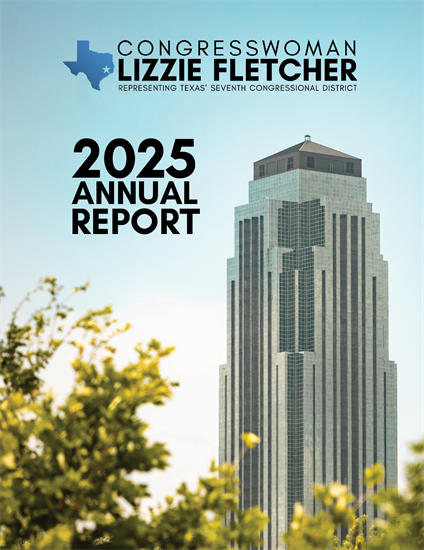
As the year comes to an end, our team is hard at work on this year’s Annual Report, and it will be in your inbox soon! I’ll share thoughts on what is included the report and more in January’s town hall, so I hope you will join in! Here’s a preview: |
Our offices in Washington and Houston will be closed for the holidays from December 24, 2025 through January 1, 2026. We will be checking in, however, so if you need urgent help during this period, please email [email protected]. |
During this season of celebration, I send best wishes to you and your families for the happiest of holidays and a very happy new year, |
|