
| From | Andy Bursky, No Labels <[email protected]> |
| Subject | Averting a health care crisis |
| Date | December 19, 2025 7:18 PM |
Links have been removed from this email. Learn more in the FAQ.
Links have been removed from this email. Learn more in the FAQ.
Beneath the noise, a few House and Senate members are trying to stop premium spikes next year and fix what is wrong in health care.
<<<DO YOU THINK CONGRESS MUST BOTH SHOW COMPASSION TO PREVENT PREMIUM SPIKES, WHILE ALSO TAKING BOLDER ACTION TO REDUCE HEALTH CARE COSTS?>>> ([link removed] )
John,
It can feel impossible to keep up with the noise from Washington, and this week was no different. But if you strip all of that away, the most critical thing that happened this week was a quiet, bipartisan meeting about health insurance premiums.
On Monday night, about 20 senators met behind closed doors to discuss the enhanced Affordable Care Act (ACA) tax credits which are scheduled to expire on December 31. Sen. Susan Collins of Maine, who helped pull the group together, said it was a “very constructive” conversation with senators agreeing they must prevent significant insurance premium increases that would make coverage unaffordable for lower- and middle-income Americans. If Congress does nothing, millions of people will see higher premiums when their plans renew in January.
In an ideal world, we would not be in this position at all. But in 2021, one party chose to pass these costly ACA subsidies on a short-term, party-line basis as part of a COVID-era stimulus package, with no plan in place for what would happen when they expired. That decision created the cliff we are facing now. On top of that, new reporting from the nonpartisan Government Accountability Office has revealed how easy it is for fraudsters to obtain these enhanced subsidies using fake Social Security numbers. So, the status quo is not sustainable either. Reforms are needed.
Here is the plain truth: Nothing will pass before Christmas because leaders in both parties are still busy posturing instead of problem solving. They have effectively pushed this fight into January. The enhanced subsidies will expire on December 31, premiums will reset, and only then will the political pressure really hit, when families start asking their congressman why their monthly bill just jumped. When that happens, we will need an answer that is both compassionate toward those affected and responsible for the country: a short-term extension that prevents sudden premium spikes, paired with reforms that begin to address the tremendous costs and abuse in our health care system.
The good news is that several members of Congress are already doing that hard work, like:
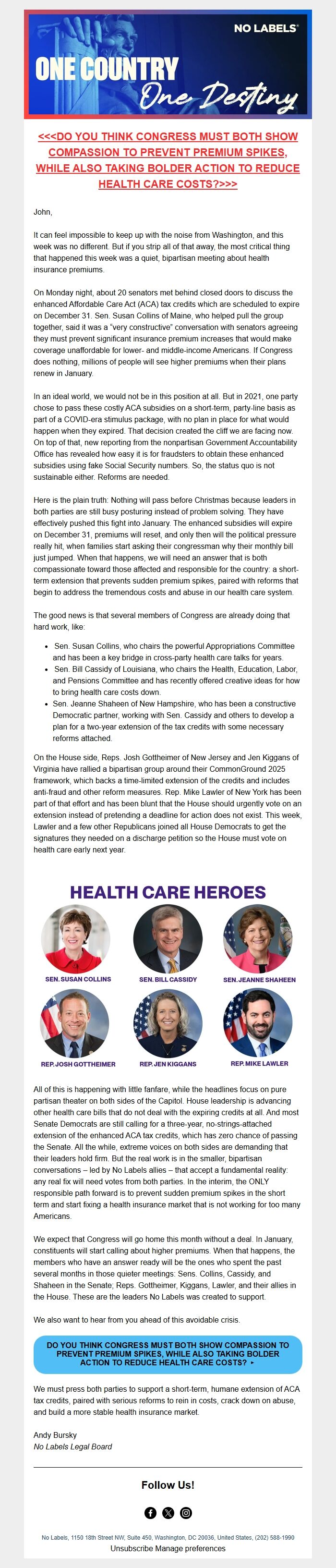
- Sen. Susan Collins, who chairs the powerful Appropriations Committee and has been a key bridge in cross-party health care talks for years.
- Sen. Bill Cassidy of Louisiana, who chairs the Health, Education, Labor, and Pensions Committee and has recently offered creative ideas for how to bring health care costs down.
- Sen. Jeanne Shaheen of New Hampshire, who has been a constructive Democratic partner, working with Sen. Cassidy and others to develop a plan for a two-year extension of the tax credits with some necessary reforms attached.
On the House side, Reps. Josh Gottheimer of New Jersey and Jen Kiggans of Virginia have rallied a bipartisan group around their CommonGround 2025 framework, which backs a time-limited extension of the credits and includes anti-fraud and other reform measures. Rep. Mike Lawler of New York has been part of that effort and has been blunt that the House should urgently vote on an extension instead of pretending a deadline for action does not exist. This week, Lawler and a few other Republicans joined all House Democrats to get the signatures they needed on a discharge petition so the House must vote on health care early next year.
All of this is happening with little fanfare, while the headlines focus on pure partisan theater on both sides of the Capitol. House leadership is advancing other health care bills that do not deal with the expiring credits at all. And most Senate Democrats are still calling for a three-year, no-strings-attached extension of the enhanced ACA tax credits, which has zero chance of passing the Senate. All the while, extreme voices on both sides are demanding that their leaders hold firm. But the real work is in the smaller, bipartisan conversations – led by No Labels allies – that accept a fundamental reality: any real fix will need votes from both parties. In the interim, the ONLY responsible path forward is to prevent sudden premium spikes in the short term and start fixing a health insurance market that is not working for too many Americans.
We expect that Congress will go home this month without a deal. In January, constituents will start calling about higher premiums. When that happens, the members who have an answer ready will be the ones who spent the past several months in those quieter meetings: Sens. Collins, Cassidy, and Shaheen in the Senate; Reps. Gottheimer, Kiggans, Lawler, and their allies in the House. These are the leaders No Labels was created to support.
We also want to hear from you ahead of this avoidable crisis.
DO YOU THINK CONGRESS MUST BOTH SHOW COMPASSION TO PREVENT PREMIUM SPIKES, WHILE ALSO TAKING BOLDER ACTION TO REDUCE HEALTH CARE COSTS? ▸
([link removed] )
We must press both parties to support a short-term, humane extension of ACA tax credits, paired with serious reforms to rein in costs, crack down on abuse, and build a more stable health insurance market.
Andy Bursky
No Labels Legal Board
Follow Us!
Facebook ([link removed] )
X ([link removed] )
Instagram ([link removed] )
No Labels, 1150 18th Street NW, Suite 450, Washington, DC 20036, United States, (202) 588-1990
Unsubscribe ([link removed] )
Manage preferences ([link removed] )
<<<DO YOU THINK CONGRESS MUST BOTH SHOW COMPASSION TO PREVENT PREMIUM SPIKES, WHILE ALSO TAKING BOLDER ACTION TO REDUCE HEALTH CARE COSTS?>>> ([link removed] )
John,
It can feel impossible to keep up with the noise from Washington, and this week was no different. But if you strip all of that away, the most critical thing that happened this week was a quiet, bipartisan meeting about health insurance premiums.
On Monday night, about 20 senators met behind closed doors to discuss the enhanced Affordable Care Act (ACA) tax credits which are scheduled to expire on December 31. Sen. Susan Collins of Maine, who helped pull the group together, said it was a “very constructive” conversation with senators agreeing they must prevent significant insurance premium increases that would make coverage unaffordable for lower- and middle-income Americans. If Congress does nothing, millions of people will see higher premiums when their plans renew in January.
In an ideal world, we would not be in this position at all. But in 2021, one party chose to pass these costly ACA subsidies on a short-term, party-line basis as part of a COVID-era stimulus package, with no plan in place for what would happen when they expired. That decision created the cliff we are facing now. On top of that, new reporting from the nonpartisan Government Accountability Office has revealed how easy it is for fraudsters to obtain these enhanced subsidies using fake Social Security numbers. So, the status quo is not sustainable either. Reforms are needed.
Here is the plain truth: Nothing will pass before Christmas because leaders in both parties are still busy posturing instead of problem solving. They have effectively pushed this fight into January. The enhanced subsidies will expire on December 31, premiums will reset, and only then will the political pressure really hit, when families start asking their congressman why their monthly bill just jumped. When that happens, we will need an answer that is both compassionate toward those affected and responsible for the country: a short-term extension that prevents sudden premium spikes, paired with reforms that begin to address the tremendous costs and abuse in our health care system.
The good news is that several members of Congress are already doing that hard work, like:
- Sen. Susan Collins, who chairs the powerful Appropriations Committee and has been a key bridge in cross-party health care talks for years.
- Sen. Bill Cassidy of Louisiana, who chairs the Health, Education, Labor, and Pensions Committee and has recently offered creative ideas for how to bring health care costs down.
- Sen. Jeanne Shaheen of New Hampshire, who has been a constructive Democratic partner, working with Sen. Cassidy and others to develop a plan for a two-year extension of the tax credits with some necessary reforms attached.
On the House side, Reps. Josh Gottheimer of New Jersey and Jen Kiggans of Virginia have rallied a bipartisan group around their CommonGround 2025 framework, which backs a time-limited extension of the credits and includes anti-fraud and other reform measures. Rep. Mike Lawler of New York has been part of that effort and has been blunt that the House should urgently vote on an extension instead of pretending a deadline for action does not exist. This week, Lawler and a few other Republicans joined all House Democrats to get the signatures they needed on a discharge petition so the House must vote on health care early next year.
All of this is happening with little fanfare, while the headlines focus on pure partisan theater on both sides of the Capitol. House leadership is advancing other health care bills that do not deal with the expiring credits at all. And most Senate Democrats are still calling for a three-year, no-strings-attached extension of the enhanced ACA tax credits, which has zero chance of passing the Senate. All the while, extreme voices on both sides are demanding that their leaders hold firm. But the real work is in the smaller, bipartisan conversations – led by No Labels allies – that accept a fundamental reality: any real fix will need votes from both parties. In the interim, the ONLY responsible path forward is to prevent sudden premium spikes in the short term and start fixing a health insurance market that is not working for too many Americans.
We expect that Congress will go home this month without a deal. In January, constituents will start calling about higher premiums. When that happens, the members who have an answer ready will be the ones who spent the past several months in those quieter meetings: Sens. Collins, Cassidy, and Shaheen in the Senate; Reps. Gottheimer, Kiggans, Lawler, and their allies in the House. These are the leaders No Labels was created to support.
We also want to hear from you ahead of this avoidable crisis.
DO YOU THINK CONGRESS MUST BOTH SHOW COMPASSION TO PREVENT PREMIUM SPIKES, WHILE ALSO TAKING BOLDER ACTION TO REDUCE HEALTH CARE COSTS? ▸
([link removed] )
We must press both parties to support a short-term, humane extension of ACA tax credits, paired with serious reforms to rein in costs, crack down on abuse, and build a more stable health insurance market.
Andy Bursky
No Labels Legal Board
Follow Us!
Facebook ([link removed] )
X ([link removed] )
Instagram ([link removed] )
No Labels, 1150 18th Street NW, Suite 450, Washington, DC 20036, United States, (202) 588-1990
Unsubscribe ([link removed] )
Manage preferences ([link removed] )
Message Analysis
- Sender: No Labels
- Political Party: n/a
- Country: United States
- State/Locality: n/a
- Office: n/a
-
Email Providers:
- HubSpot