ClearPath Action Rundown
December 19th, 2025
|
Happy Friday! We will be back at the top of
your inbox on Friday, January 9th. |
|
2025 was a big year of exciting
change. At ClearPath, we added
incredible
team members. Globally, rising energy demand created
tremendous opportunities for technology developers and energy
producers, catalyzing breakthrough innovations for reduced emissions
and ensuring America remains a global leader in clean
energy.
Following more than a decade of
momentum in clean energy innovation, ClearPath is proud to continue to
collaborate with private sector innovators, Members of Congress, the
Administration, state leaders and philanthropic partners to turn
forward-looking concepts into practical policy and tangible projects.
These partnerships have delivered meaningful policy successes – and
most importantly, substantial emissions reductions.
Looking ahead to 2026, ClearPath
will remain focused on rigorous technology analysis, policy
development and strategic thinking to speed American innovation
through market-based, bipartisan solutions that deliver
results.
On behalf of the whole ClearPath
team, we hope you have a Merry Christmas and a Happy New
Year!
|
|
Jeremy
Harrell
Chief
Executive Officer
ClearPath
and ClearPath Action
|
2. …
and a message from Jay |
|
America has led the world in energy
innovation. But if we don’t get our policies right, the next
generation of energy solutions won’t be made in America — they’ll be
built in China and Russia — countries that don’t share our values.
Where standards are weaker…emissions are higher…and our national
security is put at risk.
When we lead the world, we keep
good jobs here, make energy more reliable and affordable for every
American family and lower global emissions while we’re at it. This is
our moment to build an energy future that’s stronger and proudly made
in America. We have a clear path to keep America in the lead. Let’s
get it done… together.
|
3. A big year for
energy innovation |
|
2025 was a year for major change
across the U.S. energy sector. As the U.S. faces a surge in
power demand—driven by AI and data centers, modernizing
permitting became more important than ever, and this Congress
stepped up to the plate to make it happen, recognizing the importance
of U.S. energy dominance. Here are some of the biggest
hits:
SPEED Act Will Let America Build
-
The House advanced legislation to modernize permitting and
accelerate project deployment.
-
The SPEED
Act will
streamline the
scope of NEPA and reduce frivolous litigation, which will decrease
timelines and create greater certainty for project developers.
-
There is $1.1-1.5
trillion of
infrastructure capital expenditure currently stuck in federal
permitting.
Domestic and International Nuclear Momentum
-
Congress passed the International Nuclear Energy Act (INEA)
in the NDAA, establishing a coordinated national
strategy to export American civil nuclear technologies and compete in the global market.
-
The World Bank lifted its ban on nuclear power projects to
support reactor life extensions and small modular reactors
(SMRs).
-
The Trump Administration
issued four executive orders aimed at enhancing
American nuclear generation, promoting the deployment of advanced
nuclear technologies, bolstering the nuclear industrial base and
supply chains, expediting the licensing process and expanding
exports.
Supercharging U.S. International Energy
Financing
- Congress reauthorized the International
Development Finance Corporation (DFC) in the
NDAA with an increased lending capacity of $205
billion, a $5 billion revolving fund for direct equity investments and
expanded country eligibility, including exemptions for energy and
critical minerals projects.
-
This is a strong step
towards countering Chinese energy finance, as highlighted by ClearPath’s report,
“Energy
Financing Power: America vs. China - A Case Study in
Brazil.”
Clean Energy and Conservation Wins of the One
Big Beautiful Bill:
-
Preserves key energy tax incentives
like 45Y and 48E for clean, reliable technologies like
advanced nuclear, geothermal, hydropower and
storage, while maintaining
45Q for carbon capture and 45X to support domestic manufacturing and
supply chains;
- Supports
the Office of Energy Dominance Financing to de-risk essential,
large-scale energy and critical minerals projects at commercial scale;
and
- Invests
in the Foundation for Food and Agriculture (FFAR) and key USDA
conservation programs to strengthen rural prosperity and national
security.
IMPACT Act
-
In March, the House passed the
bipartisan IMPACT
Act, authorizing
DOE research into innovations for cement, concrete and asphalt to
boost domestic supply chain security for infrastructure and
manufacturing. With the AI data center buildout requiring one million tons of new cement by 2028 and
the U.S. now relying on imported cement for nearly 25% of total
consumption, support for innovation is necessary to expand domestic
supply.
- The House also introduced bipartisan
legislation, IMPACT
Act 2.0, to help state Departments of
Transportation (DOTs) modernize regulations and provide them
flexibility to use innovative materials. The Senate
introduced the bipartisan Concrete
and Asphalt Impact Act (CAIA), companion
legislation for IMPACT Act and IMPACT Act 2.0 combined.
|
4. Educational
highlights from the 119th |
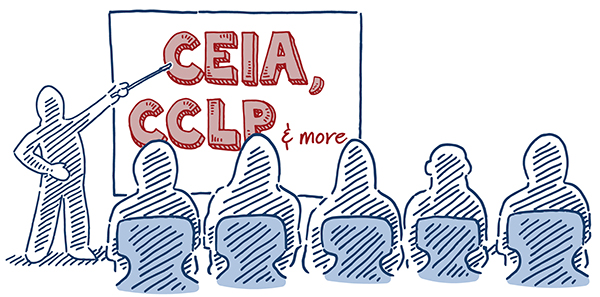
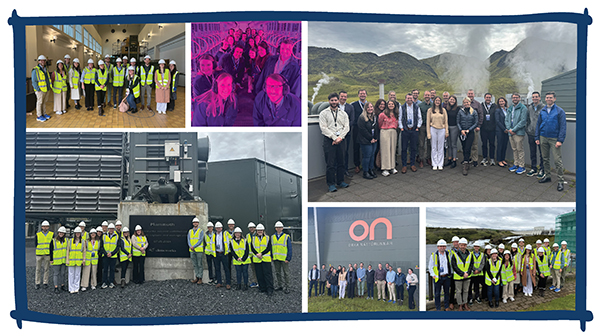
ClearPath brought a delegation of 10
Congressional staff to Reykjavik,
Iceland, as part
of its Clean Energy Innovation Academy (CEIA). Iceland, which uses 30
percent geothermal energy for its grid, has innovative drilling,
carbon management and power generation techniques. |
Congressional staff toured geothermal, direct air capture,
agricultural and hydropower energy facilities.
|
ClearPath is empowering the next generation
of energy leaders through the ClearPath
Conservative Leadership Program (CCLP). The CCLP identifies future energy leaders,
fosters their professional development and places them into key
conservative Congressional offices and committees.
Reach
out if your office
is interested in expanding your team. |
Rep. Juan Ciscomani (R-AZ) and ClearPath advisor Kristen Soltis
Anderson discussed the importance of finding “win-win” policy
solutions at CCLP’s second annual professional development
event. |
ClearPath
partnered with the American Petroleum Institute (API), Foreign Policy
and Deploy/US at three separate events during New York Climate Week.
Covering a wide array of topics, including the advanced, next-generation energy
technologies that are driving U.S. energy
leadership, financing opportunities for
American energy expansion and how Republicans can deepen
our impact by building talent pipelines. |
L: CEO Jeremy Harrell
joined Roger Martella of GE Vernova and Jeff Wilson of EXIM on a panel
moderated by Maggie Lake and hosted by Foreign
Policy.
Center: Head of Policy
Lisa Epifani & FPISC Executive Director Emily
Domenech.
R: ClearPath and
Deploy/US event
|
5. Up next: Our
priorities for 2026 |
|
ClearPath Action looks forward to
collaborating with you on advancing policies that accelerate American
energy dominance, including …
-
Modernizing Permitting & the Grid: As the permitting debate shifts to
the Senate, Congress has the opportunity to enact measures to
modernize NEPA, increase permit certainty and regulatory
predictability, better leverage technology and
build more energy infrastructure. A better
permitting system also needs a robust electric grid that can support
AI leadership, revitalize American manufacturing and keep energy
prices affordable.
-
Establishing Global Energy Leadership: The Export-Import Bank of the United
States’ (EXIM) upcoming reauthorization provides an opportunity to
empower EXIM to increase American manufacturing, bolster energy
security and allow America to better compete with Chinese energy
financing.
-
Concepts like Energy
Security Compacts
offer another potential pathway for encouraging more strategic,
long-term investments in energy infrastructure internationally.
-
Unleashing the Department of Energy: In this era of American energy dominance,
DOE is uniquely positioned to deploy new American nuclear, invest in
next-generation geothermal initiatives, expand global markets for
American manufacturers, support fusion innovators in the race with
China and leverage new and improved funding tools like the Office of
Energy Dominance Financing to accelerate U.S. energy
leadership.
-
Passing Surface Transportation Reauthorization: Bipartisan bills like the Concrete and
Asphalt Innovation Act (CAIA) in the Senate and IMPACT 2.0 in the
House will help state DOTs modernize regulations, accelerating new
materials and providing them with flexibility to use and scale-up
innovative, locally produced cement, concrete and asphalt that improve
highway infrastructure performance.
-
Passing the Energy Act of 2026: Many of the
important energy innovation programs
authorized in the Energy Act of 2020 are
expiring. We look forward to working with Congress to
reauthorize these critical provisions and bolster American leadership
in nuclear energy, carbon capture, geothermal,
long-duration storage, advanced manufacturing and other key
technologies.
|
ClearPath believes
America must lead the world in innovation over regulation…markets over
mandates…providing affordable, reliable, clean
energy. |
|
That's all from us. Thanks for reading and have a great
weekend!
View this Rundown online
|
|
ClearPath · 300 New Jersey Ave NW, Suite 800, Washington, DC 20001,
United States
This email was sent to
[email protected] · Unsubscribe
Created with NationBuilder.
Build the Future.
|
|
|
|