
| From | Liberty Fund <[email protected]> |
| Subject | Looking Back at the Ideas That Shaped Our Year |
| Date | December 19, 2025 2:02 PM |
Links have been removed from this email. Learn more in the FAQ.
Links have been removed from this email. Learn more in the FAQ.
[link removed]
WEEK OF DECEMBER 19, 2025
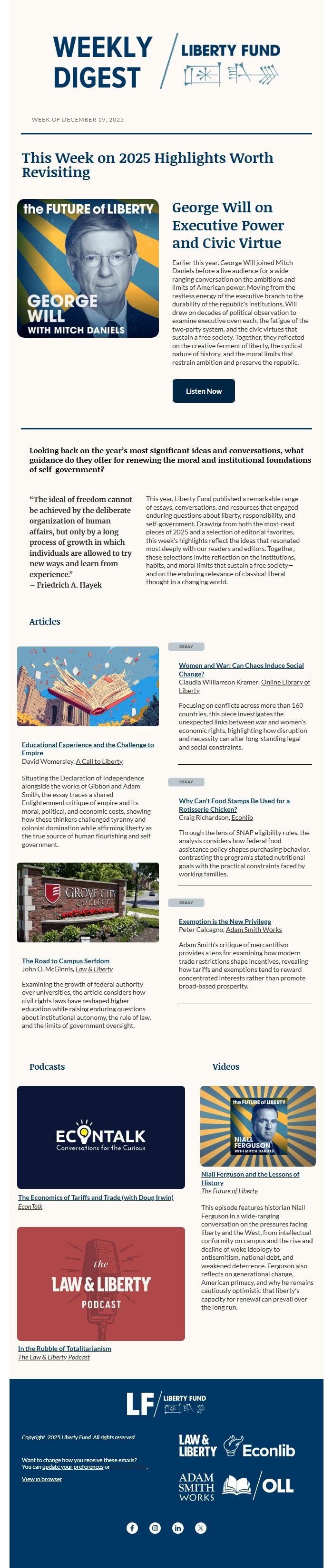
** This Week on 2025 Highlights Worth Revisiting
------------------------------------------------------------
[link removed]
** George Will on Executive Power and Civic Virtue ([link removed])
------------------------------------------------------------
Earlier this year, George Will joined Mitch Daniels before a live audience for a wide-ranging conversation on the ambitions and limits of American power. Moving from the restless energy of the executive branch to the durability of the republic’s institutions, Will drew on decades of political observation to examine executive overreach, the fatigue of the two-party system, and the civic virtues that sustain a free society. Together, they reflected on the creative ferment of liberty, the cyclical nature of history, and the moral limits that restrain ambition and preserve the republic.
Listen Now ([link removed])
** Looking back on the year’s most significant ideas and conversations, what guidance do they offer for renewing the moral and institutional foundations of self-government?
------------------------------------------------------------
** “The ideal of freedom cannot be achieved by the deliberate organization of human affairs, but only by a long process of growth in which individuals are allowed to try new ways and learn from experience.”
------------------------------------------------------------
** – Friedrich A. Hayek
------------------------------------------------------------
This year, Liberty Fund published a remarkable range of essays, conversations, and resources that engaged enduring questions about liberty, responsibility, and self-government. Drawing from both the most-read pieces of 2025 and a selection of editorial favorites, this week’s highlights reflect the ideas that resonated most deeply with our readers and editors. Together, these selections invite reflection on the institutions, habits, and moral limits that sustain a free society—and on the enduring relevance of classical liberal thought in a changing world.
** Articles
------------------------------------------------------------
[link removed]
** Educational Experience and the Challenge to Empire ([link removed])
------------------------------------------------------------
David Womersley, A Call to Liberty ([link removed])
Situating the Declaration of Independence alongside the works of Gibbon and Adam Smith, the essay traces a shared Enlightenment critique of empire and its moral, political, and economic costs, showing how these thinkers challenged tyranny and colonial domination while affirming liberty as the true source of human flourishing and self government.
[link removed]
** The Road to Campus Serfdom ([link removed])
------------------------------------------------------------
John O. McGinnis, Law & Liberty ([link removed])
Examining the growth of federal authority over universities, the article considers how civil rights laws have reshaped higher education while raising enduring questions about institutional autonomy, the rule of law, and the limits of government oversight.
** Women and War: Can Chaos Induce Social Change? ([link removed])
------------------------------------------------------------
Claudia Williamson Kramer, Online Library of Liberty ([link removed])
Focusing on conflicts across more than 160 countries, this piece investigates the unexpected links between war and women’s economic rights, highlighting how disruption and necessity can alter long-standing legal and social constraints.
** Why Can't Food Stamps Be Used for a Rotisserie Chicken? ([link removed])
------------------------------------------------------------
Craig Richardson, Econlib ([link removed])
Through the lens of SNAP eligibility rules, the analysis considers how federal food assistance policy shapes purchasing behavior, contrasting the program’s stated nutritional goals with the practical constraints faced by working families.
** Exemption is the New Privilege ([link removed])
------------------------------------------------------------
Peter Calcagno, Adam Smith Works ([link removed])
Adam Smith’s critique of mercantilism provides a lens for examining how modern trade restrictions shape incentives, revealing how tariffs and exemptions tend to reward concentrated interests rather than promote broad-based prosperity.
** Podcasts
------------------------------------------------------------
[link removed]
** The Economics of Tariffs and Trade (with Doug Irwin) ([link removed])
------------------------------------------------------------
EconTalk ([link removed])
[link removed]
** In the Rubble of Totalitarianism ([link removed])
------------------------------------------------------------
The Law & Liberty Podcast ([link removed])
** Videos
------------------------------------------------------------
[link removed]
** Niall Ferguson and the Lessons of History ([link removed])
------------------------------------------------------------
The Future of Liberty ([link removed])
This episode features historian Niall Ferguson in a wide-ranging conversation on the pressures facing liberty and the West, from intellectual conformity on campus and the rise and decline of woke ideology to antisemitism, national debt, and weakened deterrence. Ferguson also reflects on generational change, American primacy, and why he remains cautiously optimistic that liberty’s capacity for renewal can prevail over the long run.
[link removed]
Copyright 2025 Liberty Fund. All rights reserved.
Want to change how you receive these emails?
You can update your preferences ([link removed]) or unsubscribe ([link removed]) .
View in browser ([link removed])
[link removed] [link removed]
[link removed] [link removed]
[link removed]
[link removed]
[link removed]
[link removed]
WEEK OF DECEMBER 19, 2025
** This Week on 2025 Highlights Worth Revisiting
------------------------------------------------------------
[link removed]
** George Will on Executive Power and Civic Virtue ([link removed])
------------------------------------------------------------
Earlier this year, George Will joined Mitch Daniels before a live audience for a wide-ranging conversation on the ambitions and limits of American power. Moving from the restless energy of the executive branch to the durability of the republic’s institutions, Will drew on decades of political observation to examine executive overreach, the fatigue of the two-party system, and the civic virtues that sustain a free society. Together, they reflected on the creative ferment of liberty, the cyclical nature of history, and the moral limits that restrain ambition and preserve the republic.
Listen Now ([link removed])
** Looking back on the year’s most significant ideas and conversations, what guidance do they offer for renewing the moral and institutional foundations of self-government?
------------------------------------------------------------
** “The ideal of freedom cannot be achieved by the deliberate organization of human affairs, but only by a long process of growth in which individuals are allowed to try new ways and learn from experience.”
------------------------------------------------------------
** – Friedrich A. Hayek
------------------------------------------------------------
This year, Liberty Fund published a remarkable range of essays, conversations, and resources that engaged enduring questions about liberty, responsibility, and self-government. Drawing from both the most-read pieces of 2025 and a selection of editorial favorites, this week’s highlights reflect the ideas that resonated most deeply with our readers and editors. Together, these selections invite reflection on the institutions, habits, and moral limits that sustain a free society—and on the enduring relevance of classical liberal thought in a changing world.
** Articles
------------------------------------------------------------
[link removed]
** Educational Experience and the Challenge to Empire ([link removed])
------------------------------------------------------------
David Womersley, A Call to Liberty ([link removed])
Situating the Declaration of Independence alongside the works of Gibbon and Adam Smith, the essay traces a shared Enlightenment critique of empire and its moral, political, and economic costs, showing how these thinkers challenged tyranny and colonial domination while affirming liberty as the true source of human flourishing and self government.
[link removed]
** The Road to Campus Serfdom ([link removed])
------------------------------------------------------------
John O. McGinnis, Law & Liberty ([link removed])
Examining the growth of federal authority over universities, the article considers how civil rights laws have reshaped higher education while raising enduring questions about institutional autonomy, the rule of law, and the limits of government oversight.
** Women and War: Can Chaos Induce Social Change? ([link removed])
------------------------------------------------------------
Claudia Williamson Kramer, Online Library of Liberty ([link removed])
Focusing on conflicts across more than 160 countries, this piece investigates the unexpected links between war and women’s economic rights, highlighting how disruption and necessity can alter long-standing legal and social constraints.
** Why Can't Food Stamps Be Used for a Rotisserie Chicken? ([link removed])
------------------------------------------------------------
Craig Richardson, Econlib ([link removed])
Through the lens of SNAP eligibility rules, the analysis considers how federal food assistance policy shapes purchasing behavior, contrasting the program’s stated nutritional goals with the practical constraints faced by working families.
** Exemption is the New Privilege ([link removed])
------------------------------------------------------------
Peter Calcagno, Adam Smith Works ([link removed])
Adam Smith’s critique of mercantilism provides a lens for examining how modern trade restrictions shape incentives, revealing how tariffs and exemptions tend to reward concentrated interests rather than promote broad-based prosperity.
** Podcasts
------------------------------------------------------------
[link removed]
** The Economics of Tariffs and Trade (with Doug Irwin) ([link removed])
------------------------------------------------------------
EconTalk ([link removed])
[link removed]
** In the Rubble of Totalitarianism ([link removed])
------------------------------------------------------------
The Law & Liberty Podcast ([link removed])
** Videos
------------------------------------------------------------
[link removed]
** Niall Ferguson and the Lessons of History ([link removed])
------------------------------------------------------------
The Future of Liberty ([link removed])
This episode features historian Niall Ferguson in a wide-ranging conversation on the pressures facing liberty and the West, from intellectual conformity on campus and the rise and decline of woke ideology to antisemitism, national debt, and weakened deterrence. Ferguson also reflects on generational change, American primacy, and why he remains cautiously optimistic that liberty’s capacity for renewal can prevail over the long run.
[link removed]
Copyright 2025 Liberty Fund. All rights reserved.
Want to change how you receive these emails?
You can update your preferences ([link removed]) or unsubscribe ([link removed]) .
View in browser ([link removed])
[link removed] [link removed]
[link removed] [link removed]
[link removed]
[link removed]
[link removed]
[link removed]
Message Analysis
- Sender: Liberty Fund
- Political Party: n/a
- Country: United States
- State/Locality: n/a
- Office: n/a
-
Email Providers:
- MailChimp