|
 |
This content is available for free to all subscribers. But you really should consider a paid subscription. This unlocks our afternoon e-mails, our Saturday “What is Jon Reading” e-mail, and analysis on breaking news. Normally a subscription is a modest $7 a month or just $70 for the year.
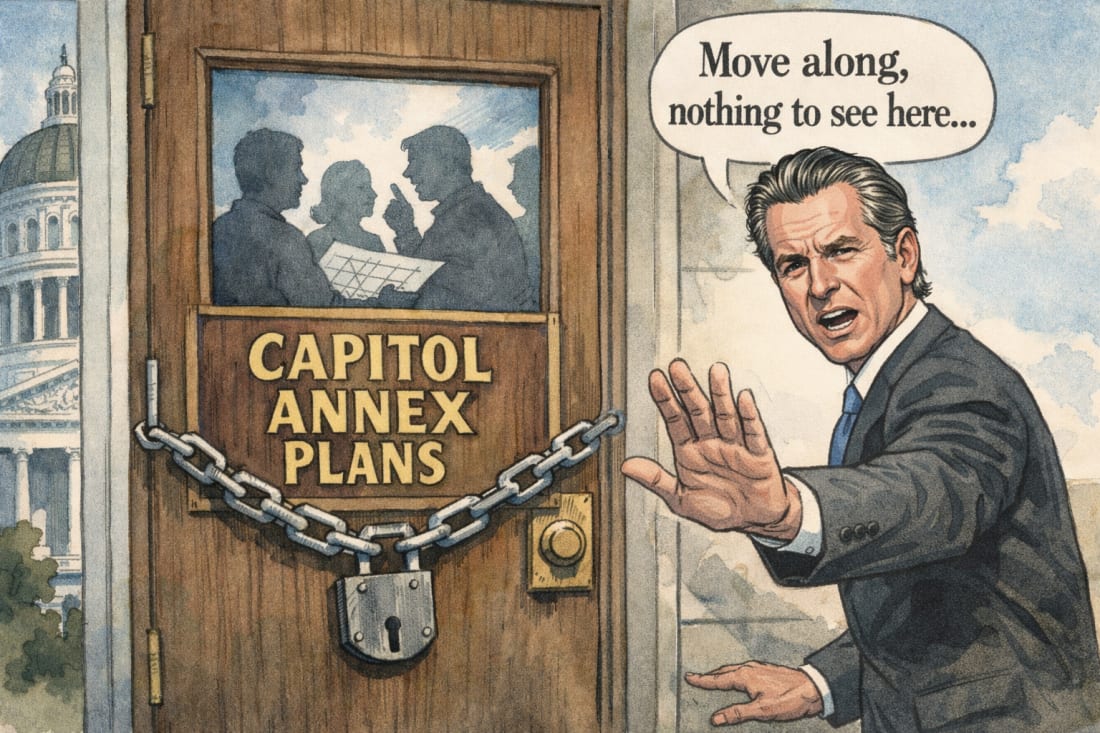
Gavin Newsom’s State Capitol Expansion Has a $1.1 Billion Budget - But No Final Cost Estimate
California lawmakers and the governor’s office still cannot provide taxpayers with the final cost of the State Capitol expansion, despite hundreds of millions already spent without public disclosure
|

| |||||||||||||||


 |
This is Part One of a two-part investigation into the State Capitol annex project. Both parts are available to all readers. If you value this reporting, please consider becoming a paid subscriber. Your support sustains our work and provides full access to premium content.
🕒 5-min
The Question That Still Has No Answer
For years, Californians have been told that a new office building behind the State Capitol is necessary, overdue, and responsibly managed. However, the actual cost remains undisclosed.
This is not a misunderstanding or a messaging issue. It reflects a failure of governance within Governor Newsom’s administration and the Democratic legislative majorities in Sacramento.
The public would know far less about this project without KCRA Political Director Ashley Zavala’s investigative reporting. While state leaders declined to grant interviews and delayed record requests, Zavala continued to seek answers and document the lack of transparency.
When lawmakers overseeing the Capitol Annex project spoke publicly earlier this month, they did not provide clarity. They confirmed that no one in charge is prepared to give a final cost estimate for the $1.1 billion State Capitol expansion.
Why the Missing Price Tag Matters
This secrecy comes as Californians face higher taxes, increased fees, and reduced public services, all under the premise of fiscal responsibility. When state leaders cannot explain the cost of their own office building, it raises questions about priorities.
Public trust erodes not from government spending, but from a lack of transparency about how and why funds are used. A taxpayer-funded project of this scale should exemplify openness, yet it has become a case study in avoidance.
Who Is Actually Running This Project?
A faceless bureaucracy is not managing the Capitol Annex. Day-to-day oversight rests with the Legislature’s Joint Rules Committee — a small group of lawmakers that has not held a public hearing on the project since 2021 and has allowed the project’s official website to sit untouched for years.
More consequential is a three-member executive committee created by a 2018 memorandum of understanding. That committee includes two Democratic legislators — Assemblymember Blanca Pacheco and State Senator John Laird — along with a representative from the Governor’s office, serving at Newsom’s direction.
That representative is responsible for keeping the governor apprised of the project and providing input on major design, scope, budget, and security decisions affecting the Governor’s offices — and, by definition, has access to the project’s full details.
The executive committee meets privately, votes on major decisions, and operates under strict confidentiality. All members have signed non-disclosure agreements.
Those facts point to a simple conclusion: this project is not drifting. It is being actively directed behind closed doors, with direct involvement from Gavin Newsom’s administration.
Newsom Can’t Claim Distance From This
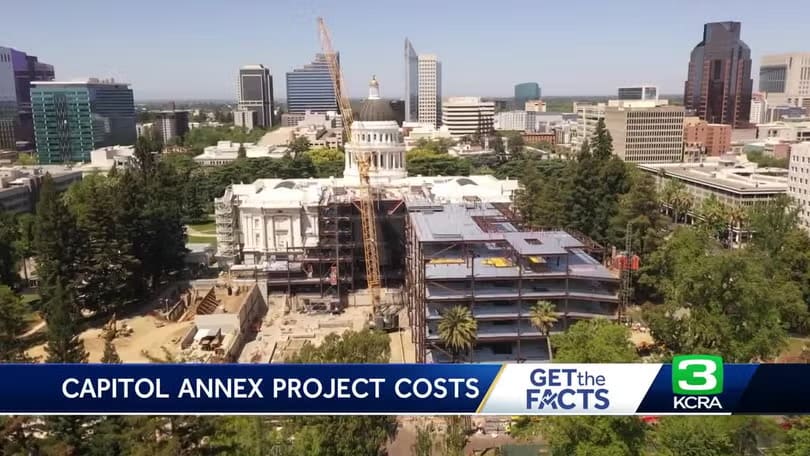 |
Governor Newsom has suggested that responsibility for the Capitol Annex lies with the Legislature. However, the record indicates otherwise.
A representative from Governor Newsom’s office sits on the project’s executive committee. Senior members of his staff have signed the same non-disclosure agreements that restrict public disclosure. He approved the funding bills that continue to move the project forward. Last year, he also signed the budget package that included a CEQA exemption, effectively ending litigation and allowing construction to proceed without further public review.
When asked about the cost, Newsom has stated that, as a taxpayer, he would also like to know the answer. However, governors cannot claim to be bystanders when their office is directly involved in decision-making.
It is not plausible to claim distance when authority is this direct.
Secrecy Is Not an Accident Here
This project has unfolded under extraordinary secrecy.
More than 2,000 people involved in the Capitol Annex — including lawmakers, staff, contractors, architects, and state employees — have been required to sign non-disclosure agreements. These agreements are not narrowly tailored to sensitive security details. They broadly restrict the sharing of basic information and threaten legal consequences for violations.
Meanwhile, the Legislature has repeatedly failed to comply with California’s Legislative Open Records Act. As documented by KCRA, requests for records have gone unanswered for months, statutory deadlines have been missed, and requests for contracts, financial documents, and security costs have been ignored.
“On Budget” Without a Budget
On large public construction projects, transparency is standard practice. Cost updates, public hearings, and itemized budget summaries are routinely provided so taxpayers can track spending and project progress.
That is precisely what has been missing here.
Supporters of the Capitol Annex often state that the Legislature remains “within the $1.1 billion allocation.” However, an allocation is a ceiling, not a forecast. Without an updated estimate, taxpayers cannot know if costs will remain within that limit.
Even Pacheco and Laird have acknowledged that costs are likely to change and that a comprehensive fiscal outlook will not be available until 2026, well into construction and close to completion.
Spending reported midstream tells taxpayers nothing about where the project will end.
So, Does It Matter?
This matters because it contributes to the erosion of public trust.
Without sustained pressure from reporters like Ashley Zavala, Californians might know little about how this $1.1 billion State Capitol project is managed. The fact that fundamental questions about cost, contracts, and access are only surfacing because of media pressure should concern anyone who values transparent government.
This project is proceeding under one-party rule, with Democratic supermajorities in the Legislature and a Democratic governor whose administration is directly involved in oversight. There is no divided government, veto power, or minority obstruction.
When the people running California cannot explain how much their own office building will cost — and take steps that make independent scrutiny harder — the problem is not concrete or steel. It is accountability.
Californians deserve a full, independent audit of this project, as well as access to contracts, budgets, and change orders. The State Capitol should reflect openness, not insulation from the public it serves.
Until that occurs, the central unanswered question of this project will remain, reflecting poorly on those responsible.
This concludes Part One of our two-part investigation into the State Capitol annex project. Later today, we will publish Part Two, which examines the broader consequences of this secretive, billion-dollar undertaking, including:
• How lawmakers designed the new Capitol complex to move without being seen by the public
• What the project reveals about press access and transparency inside the State Capitol
• The fight over the Capitol’s west steps and public gathering spaces
• How lawmakers exempted themselves from environmental law to keep the project moving
• Why this project says so much about power and accountability in modern Sacramento
You’re currently a free subscriber to So, Does It Matter? California Politics! For the full experience, upgrade your subscription. See how much more you get with an inexpensive, paid subscription, but clicking the button below! Support me in providing hard-hitting, clear-eyed analysis of California politics. I am beholding to no one, and sugar-coat nothing!
| ||||||||||

