|
 |
Thank you for being a free subscriber to So, Does It Matter? Please support what we do. And also get 100% of our content (right now you get about 60% of it!).
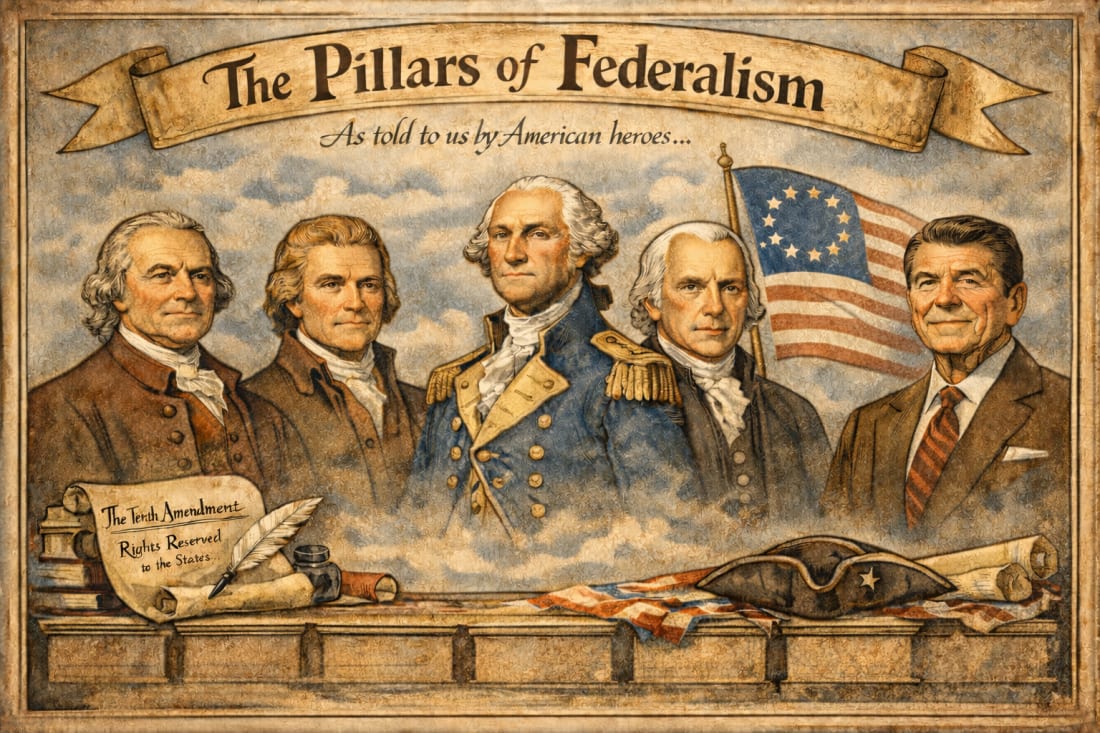
Issue Tool Kit: The Importance of Federalism (States’ Rights), in the Words of Our Founders
Why the Constitution divided power on purpose, and why that choice still matters today
|

| |||||||||||||||


⏱️ 6-minute read
 |
Generally, our afternoon content is for our paid subscribers. Like you can see about 20% of an iceberg above the water, you get a preview of this column. We encourage you to upgrade your membership and take advantage of all of our great content!
Federalism is one of those constitutional ideas that everyone claims to support — right up until it gets in the way of something they want Washington to do.
Federalism Was a Design Choice, Not an Accident
From the start, the American system was not intended to be a centralized government overseeing every aspect of national life. The Founders also did not want a weak or broken union. Instead, they created a system that intentionally divided power, giving certain, limited duties to the federal government and leaving most authority with the states.
That balance was no accident. The Founders argued, negotiated, and wrote it into the Constitution. Even as ratification was underway, the Founders did not ignore the lingering doubts. They answered those concerns directly.
That is why federalism was built into the Constitution and reinforced by the Bill of Rights.
Understanding how that system was supposed to work requires going back to the people who designed it — and, in particular, to James Madison. Madison appears repeatedly here not because of emphasis or preference, but because he was the Constitution’s chief architect and the most important explainer of how federalism was supposed to function in practice.
What follows is not a modern take on federalism. It is the argument the Founders made, ending with a warning issued almost two centuries later that remains relevant today.
The Constitutional Rule
“The powers not delegated to the United States by the Constitution, nor prohibited by it to the States, are reserved to the States respectively, or to the people.”
— Tenth Amendment
These words were not just for show. They came from a strict ratification process, in which many Americans sought explicit assurances that the new federal government would not assume powers not granted to it.
The rest of this analysis is for paid subscribers.
Upgrade now to read the full column and get access to almost 40% more original reporting and analysis each week. Your support helps independent journalism that sticks to the facts, not the talking points.
What paid subscribers will see below:
Why the Tenth Amendment was adopted for a reason
How Madison defined the limits of federal power
Why dividing authority was meant to protect liberty
How state consent anchors constitutional legitimacy
Why Jefferson worried about distant government
How ratification demands shaped the Bill of Rights
Washington’s warning about power gained by usurpation
Reagan’s modern restatement of the Founders’ design
AND AN ORIGINAL VIDEO WARNING!...
Keep reading with a 7-day free trial
Subscribe to FlashReport Presents: So, Does It Matter? On CA Politics! to keep reading this post and get 7 days of free access to the full post archives.
A subscription gets you:
 | Subscriber-only Afternoon Posts. Analysis on breaking News |
| Saturday’s Popular “What is Jon Reading” Column |
| 100% percent of our site content is yours! |
| ||||||||||

