|
 |


 |
When I read Chris Whipple’s Vanity Fair profile of Susie Wiles, the most powerful person in Donald Trump’s White House who is not named Donald Trump, one line stopped me cold.
"I’m not an enabler." - Susie Wiles
I’ve heard that sentence before. I said versions of it to myself while working in the first Trump White House.
And here’s the hard truth that only people who have worked inside that White House truly understand:
You cannot work for Donald Trump and not become an enabler at some point along the way.
Not because you wake up wanting to be one.
Not because you abandon your values on day one.
But because the system is designed to test, erode, and eventually corner your moral compass until the question is no longer “Is this right?,” but “How bad will it be if I don’t stop this?”
Chris Whipple’s reporting lays bare something that too often gets obscured by palace intrigue and personality profiles: power under Trump is not about restraint, it’s about facilitation.
JD Vance says it plainly in the piece. Susie Wiles is not there to steer, influence, or manipulate the president “for the national interest.” She is there to facilitate his vision.
That distinction matters, because facilitation has a body count.
This is what happened on Susie Wiles’s watch: life-saving USAID programs were eviscerated, halting immunizations and aid that kept thousands alive; PEPFAR, credited with saving millions, was crippled; U.S. citizens and their children, including a four-year-old undergoing treatment for stage-4 cancer, were deported; hundreds were sent to a brutal Salvadoran prison on sketchy or nonexistent evidence; January 6 rioters who assaulted police were pardoned; presidential power expanded by whim, not law; the National Guard was deployed into American cities; political enemies, universities, and the press were targeted; and extremist actors were empowered to turn ideology into policy.
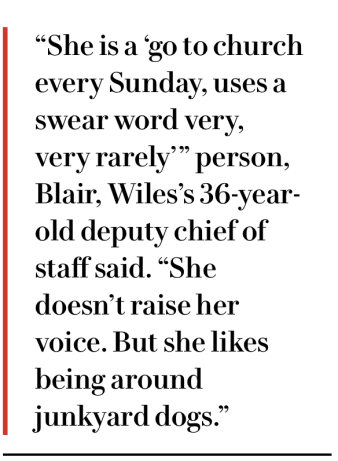
Going to church every Sunday does not negate the consequences of decisions that harmed people at home and around the world. You don’t walk out of a White House like this innocent, because innocence requires stopping harm, not facilitating it.
 |
The Lie We Tell Ourselves Inside the Building
Every person who enters that White House tells themselves a version of the same story:
If I’m not here, someone worse will be.
If I stay, maybe I can mitigate the damage.
If I leave, I lose any ability to protect people.
I told myself those things.
COVID will haunt me forever.
Watching children being separated from their parents will haunt me forever.
Every argument I had in the Situation Room.
Every warning about what happens when you downplay a pandemic.
Every fight over domestic extremism after yet another mass shooting.
Every moment when intelligence screamed one thing, and politics demanded another.
And then there were the talking points.
Writing words you know will mislead. Defending decisions you know will cost lives. Trying to thread the needle between truth and loyalty, and watching the needle snap anyway.
You don’t walk out of that White House innocent.
Every single one of us who worked there knows the moments when our integrity, our sense of self, and our moral clarity were pushed to the brink.
"I’m Not an Enabler" Is the First Step of Enabling
What makes Wiles’s comment so revealing isn’t arrogance, it’s familiarity.
"I’m not an enabler" is what people say when they believe proximity to power equals control over it.
But Whipple’s reporting shows something else entirely.
Wiles is powerful because she does not try to restrain Trump. She channels him. She absorbs the chaos. She empowers the “junkyard dogs”: Stephen Miller, Russell Vought, Dan Scavino–and keeps the machinery running.
That is not neutral.
Stephen Miller is not a misunderstood staffer.
Russell Vought is not a technocrat.
They are ideological zealots who understand exactly how to use the machinery of government to entrench minority rule, punish perceived enemies, and hollow out democratic guardrails.
Learning to navigate people like that is not a skill you put on a résumé.
It’s a moral hazard.
I learned the hard way who was truly an ally, and who would burn you the moment it was convenient. Sometimes I prevailed. Sometimes I didn’t. And sometimes the damage was already done before anyone realized what had happened.
That’s what "facilitation" looks like in practice.
The Myth of the Gatekeeper
Historically, chiefs of staff were expected to say no. To tell presidents when they were wrong. To be the final guardrail before disaster. Whipple reminds us of that tradition: James Baker with Reagan, Donald Rumsfeld with Ford.
But this White House is different. The question is no longer whether Susie Wiles can restrain Donald Trump. The question is whether she wants to. And the reporting suggests she does not. She believes the American people elected Trump, therefore his impulses must be executed, not questioned. That is not democratic humility. That is abdication.
Why This Matters More Than Personalities
This is not about Susie Wiles alone. It’s about the dangerous fiction that good people can sanitize a bad system simply by standing close to it. I know how seductive that belief is. I lived it.
But here’s what experience teaches you:
When you normalize extremism in service of order, you don’t contain it, you professionalize it. When you excuse cruelty as “process,” you don’t reduce harm, you routinize it. When you call enabling “facilitation,” you give cover to outcomes you would never defend on their merits.
There are moments inside the government where compromise is necessary. And then there are moments where compromise becomes complicity. Trump’s White House blurs that line by design.
The Reckoning No One Escapes
I don’t write this from a place of superiority. I write it from a place of honesty. I carry the weight of the moments when I stayed. The moments when I should have pushed harder. The moments when I believed mitigation was enough.
Susie Wiles says time will tell whether she’s been effective. Time always tells. And history is not kind to those who confuse proximity to power with moral authority.
You don’t leave that White House unmarked. Not if you were paying attention.
Not if you cared about the consequences. The question is not whether you were an enabler.
The question is whether you’re willing to be honest about it, and what you do with that truth next.
-Olivia
This Substack is reader-supported. Paid subscriptions allow me to continue to pour significant time and energy into breaking down the headlines and keeping my content available to others. Thank you for your support!
Have an idea or feedback? Reply directly to this email.
| ||||||||||

