|
Public opinion is turning against sports gambling
The public is starting to notice just how bad companies like FanDuel and DraftKings are.
|

| |||||||||||||||


This is a follow-up to what I wrote two weeks ago. And because it’s not a partisan issue, there’s a chance for Democrats and Republicans to come together to address this growing crisis. In case you missed it, here’s what I wrote:
 |
|
I flew into the St. Louis airport a few nights ago and was immediately hit with more sports gambling ads.¹
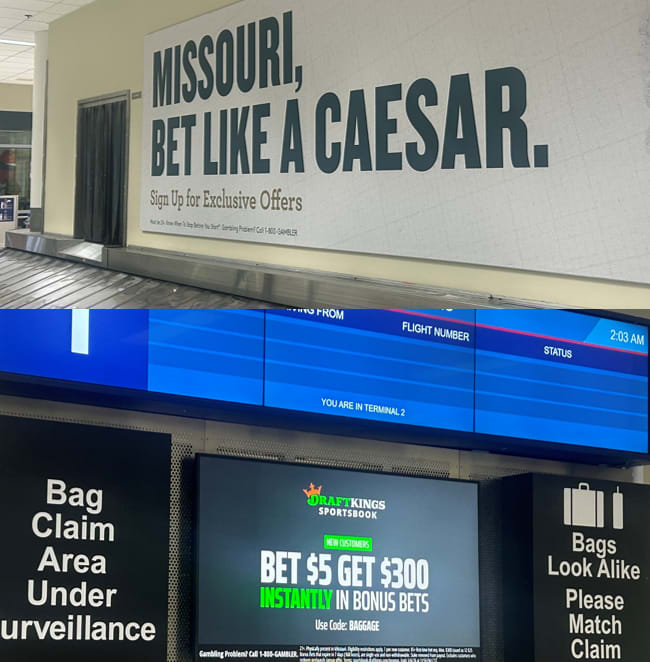 |
Because I am extremely on-record acknowledging that online sports gambling is bad, I have friends sending me these sorts of ads all the time now.² They’re inescapable.
But if you’ve been paying attention to the news lately, what you’ll notice: a recent groundswell of coverage on the negative impact that sports gambling is having on communities, especially on boys and young men.
Public opinion is finally shifting, and I’m optimistic that in a few years there may be an opportunity to limit the damage that companies like FanDuel and DraftKings are causing.
Here’s a roundup on what I’ve been reading on the topic.

Americans are increasingly skeptical of online gambling and sports gambling
The Washington Post recently ran a poll that shows Americans’ growing concerns about sports gambling. In May 2022, 23% of Americans said states allowing people to bet on sports was “a bad thing.” As of earlier this month, that number has grown to 36%. (A plurality, 49%, say that it’s “neither good nor bad.”)
What’s interesting: every group measured increasingly thinks that sports gambling is bad, relative to what they believed in 2022.
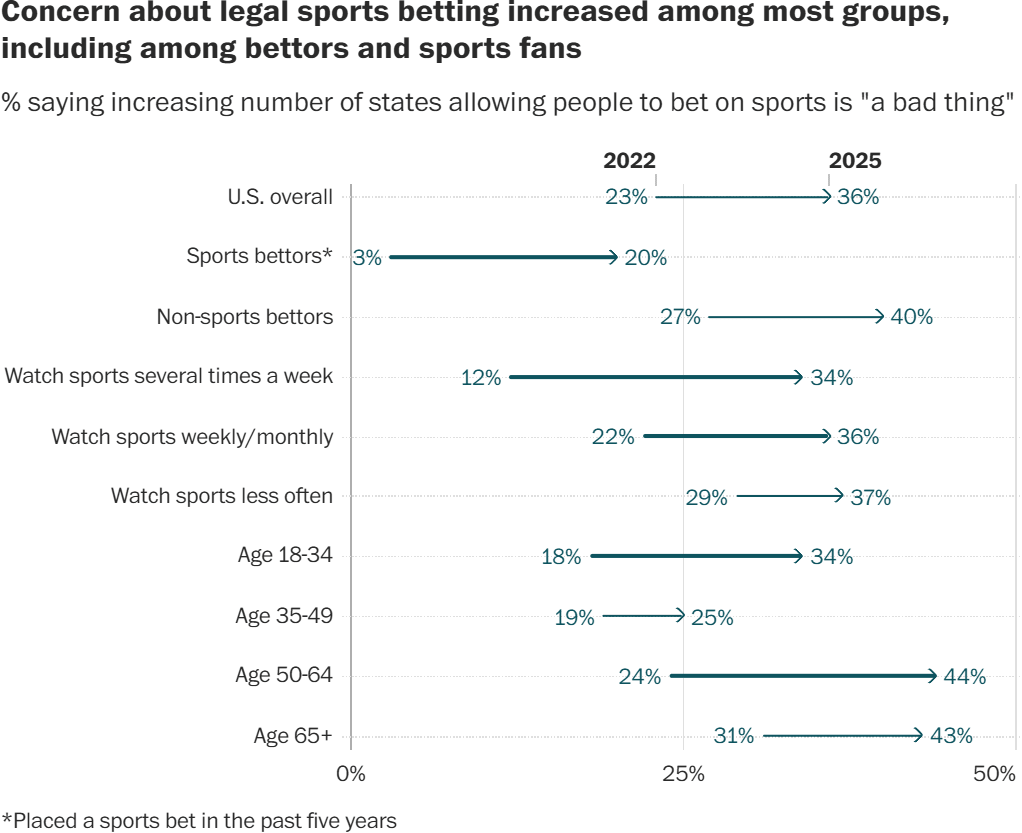
What I find most notable is that the people most exposed to this—the gamblers themselves and sports fans generally—are some of the people who’ve moved the most on this issue in the last 3.5 years. Today, relative to 2022:
6.7× more sports bettors agree that legal sports gambling is a bad thing.
2.8× more devoted sports fans agree that it’s a bad thing.
Other polls find something similar. A recent survey in Massachusetts finds that “56 percent of monthly gamblers in Massachusetts now believe that the harms of gambling outweigh the benefits.”
The Economist: “College campuses have become a front line in America’s sports-betting boom”
I’ll start with a few quotes from The Economist article:
“The NCAA survey found that 16% of 18-to-22-year-olds engage in problematic sports gambling.” (Here’s the underlying data.) For additional context, in most states, it’s not even legal for 18-year-olds to gamble.³
“At Pennsylvania State University, which has 64,000 undergraduate students, Stephanie Stama, an assistant director at the student psychological services centre, reports that ‘it is increasingly common for us to hear that students have lost a significant amount of money’ in sports betting and that it ‘is interfering with basic needs like eating and sleeping.’”
“Timothy Fong, a professor of psychiatry at the University of California, Los Angeles sees a similar pattern. Every one of his clients of late has been an 18-to-24-year-old man seeking help for a sports-betting or cryptocurrency addiction. The financial wreckage can be severe, too.”
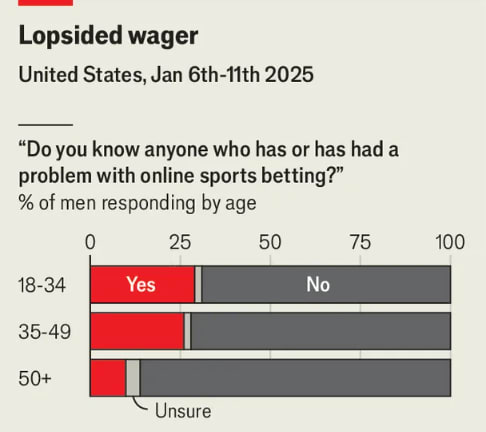
Finally, the chart below is instructive. I was first turned onto the issue of sports gambling because, as a young (ish) man,⁴ I’ve seen people I know end up getting themselves in way too deep—and I’m confident there are people whose problem gambling I know nothing about. So it’s no surprise that young men increasingly know people who are problem gamblers:
 |
Axios: “The high cost of the U.S. sports betting boom”
Three data points taken verbatim from this article, all of which I’ve spoken about before:
In states with access to online gambling, bankruptcy rates rose 28% and debt collection amounts rose 8% — roughly two years after legalization, one paper found.
Another study found that every dollar spent on sports betting shaved 99 cents off investments — meaning bettors are pulling from savings, not “fun money.”
A third study tracked a 20% jump in mass-market alcohol consumption and a 75% spike in calls to helplines after legalization.
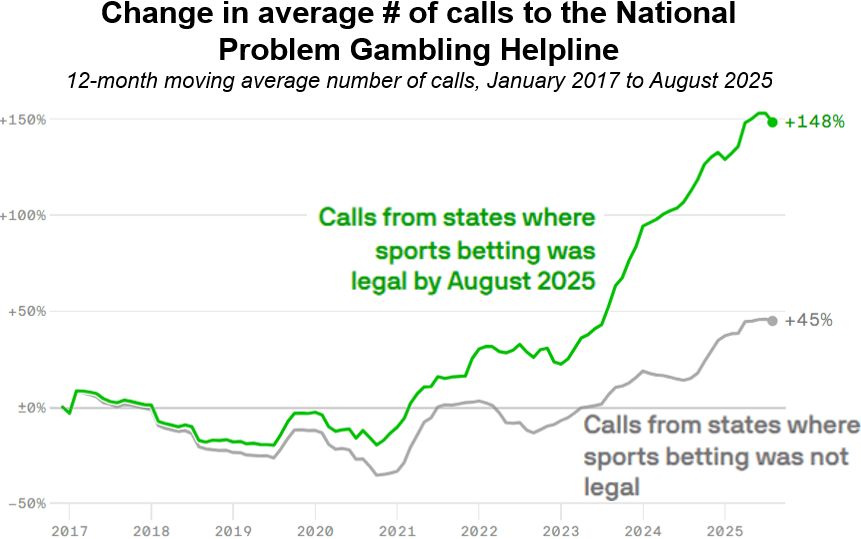
Because it’s been a staggered legalization from one state to the next, we can more clearly see the impact in states where there’s gambling vs. states where there’s not.
In short: gambling addiction—because of illegal markets, crypto, and national ads—is up everywhere. But it’s way up in states where online gambling has been legalized:
 |
The New York Times: “Inside the Dark and Predatory World of Crypto Casinos”
I’ve focused most of my writing and research on online sports gambling, but the problem is much bigger than that. Here’s a video recap of this NYT article that I think is really instructive:

In short: a lot of casinos use cryptocurrencies to operate illegally. They lure people (usually men, usually young, often under 18) in with celebrities and the promise of wealth, but people are finding themselves with addictions and debt before they’re legal adults.
The Wall Street Journal wrote something similar last week about the risks young men are taking by gambling on things like crypto and stock-market options trading.
Lawmakers are taking notice, but they’re (generally) too old to see the carnage first-hand
On both sides of the aisle, lawmakers are taking notice: Republican Senators Ted Cruz (TX) and Ron Johnson (WI) and Democratic Senator Richard Blumenthal (CT) are all on record calling for more regulation. Right here in Missouri, Josh Hawley has expressed plenty of skepticism on this in the past.⁵
But Congress is disproportionately old, which means that members of Congress are:
Less likely to know someone who’s a problem gambler, online or otherwise.
What this means: it’s incumbent upon those of us who are most impacted, and those of us whose friends are most impacted, to keep speaking up.
It’s why I’m still writing about this, and why I will continue to do so.
Feel free to share this post with someone who will find this interesting. If you’re reading this email because someone sent it to you, please consider subscribing.
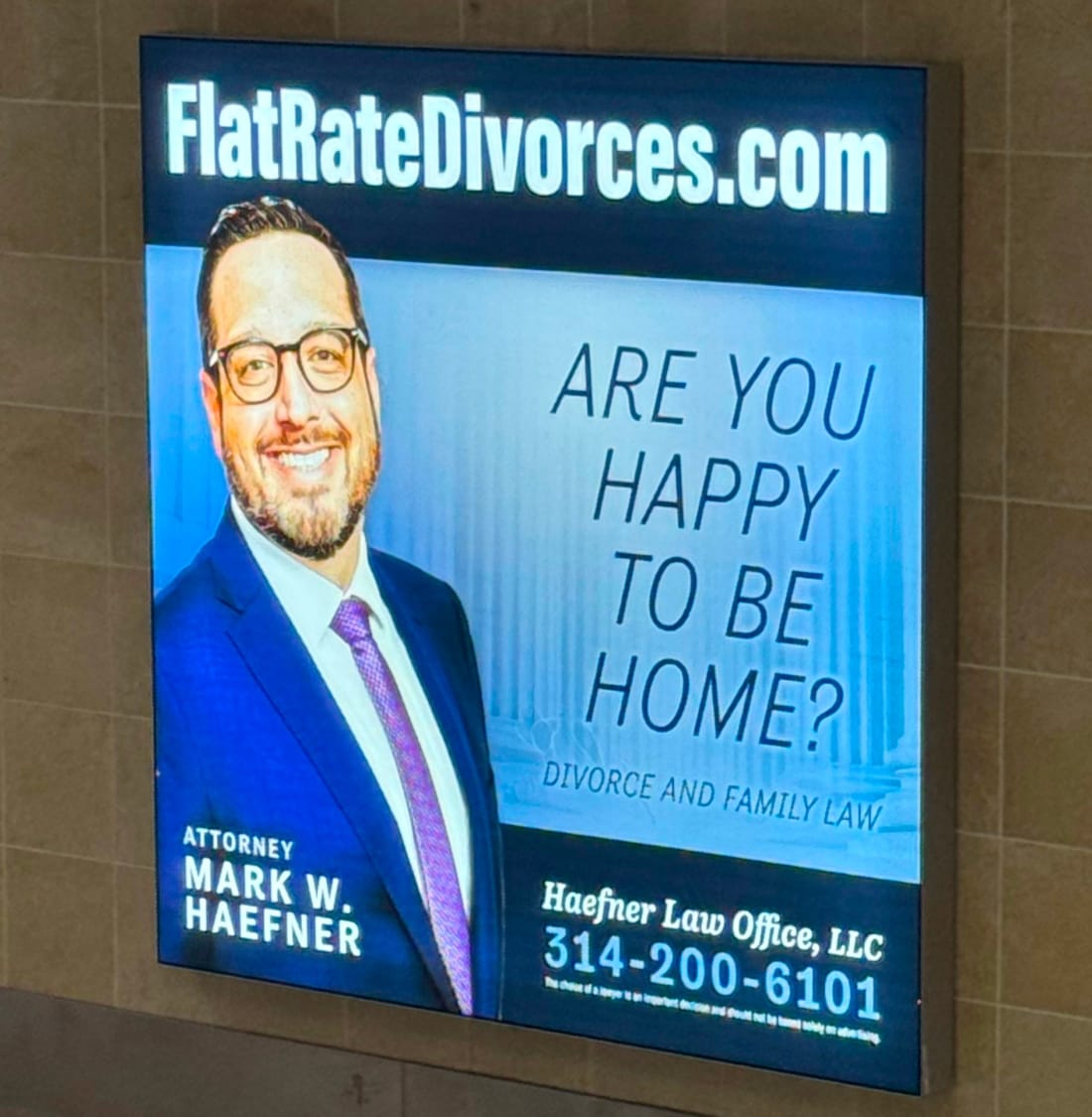
In fairness, it’s better than the “Are you happy to be home?” divorce lawyer ad that greets travelers on their way down the escalator to baggage claim in the Southwest terminal:
 |
That’s not to say that I want you to stop sending them to me, by the way. I find them interesting and motivating. Keep them coming!
Further context: relative to people ages 18-22, far fewer people in the general population are problem gamblers. As few as 2% of people over 55 are problem gamblers, according to the National Council on Problem Gambling.
I’m holding onto this designation for the last few years that I’m younger than the median American, thank you very much!
“I certainly respect the right of state voters, including ours, to make up their own minds on this. I’m a skeptic, though. I will just tell you I’m concerned about the consequences here,” U.S. Sen. Josh Hawley told ABC 17 News. “I’m worried here about what the consequences are downstream on families, on the game itself, collegiate athletics, young athletes. I hope that policymakers in the state are keeping a close eye on that.”
At least when it comes to the issue of abortion access, it’s worth noting that Hawley’s respect-the-right-of-state-voters-to-make-up-their-own-minds approach is, to state the obvious, inconsistent.
| ||||||||||

