Pundits Blame Sydney Slaughter on Protest Slogan
Ari Paul

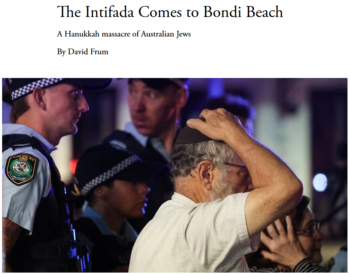
For David Frum (Atlantic, 12/14/25) "people who dress up like Hamas terrorists"—that is to say, like Palestinians, by wearing keffiyehs—"are not merely opining. They are...inciting the actions they believe in."
Australian officials are still learning about the individuals who carried out the Bondi Beach attack, killing more than a dozen Jews celebrating Hanukkah in Sydney. But the pundits, with their magnifying glasses and meerschaum pipes, have cracked the case. The culprit is: pro-Palestine protesters.
“When people chant ‘intifada revolution,’ they are revealing something important about their goals and methods," wrote noted Iraq War enthusiast David Frum (Atlantic, 12/14/25). "Yet in many Western countries, public authorities have been reluctant—or unwilling—to hear the message.” Frum went on:
It is helpful to possess a lexicon of what is typically intended by these vocabularies. Armed struggle means shooting people or blowing them up with bombs. By any means necessary means targeting the most defenseless: children, the elderly, other civilians. Globalize the intifada means shooting or bombing people in Sydney, London, Paris, Toronto, Los Angeles and New York City, as well as in Tel Aviv or Jerusalem. From the river to the sea means the annihilation of a sovereign democratic state and the mass murder, expulsion and enslavement of much of its population.
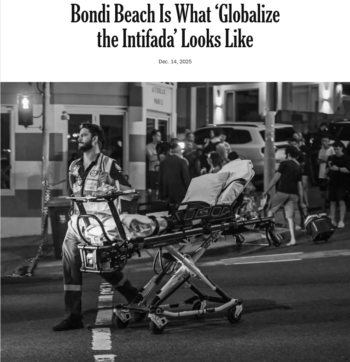
For Bret Stephens (New York Times, 12/14/25), "Bondi Beach Is What ‘Globalize the Intifada’ Looks Like"—or at least, it's "reasonable to surmise" that it is.
New York Times columnist Bret Stephens (12/14/25) did something similar in a piece headlined “Bondi Beach Is What ‘Globalize the Intifada’ Looks Like.” Stephens wrote: "Though we’ll probably learn more in the weeks ahead about the mind-set of Sunday’s killers, it’s reasonable to surmise that what they thought they were doing was 'globalizing the intifada.'”
Wall Street Journal columnist Walter Russell Mead (12/15/25) said protesters have unknowingly called for terrorism:
Slogans like “globalize the intifada” either mean nothing at all, or they mean support for massacres like the one on Bondi Beach—and the one at the Nova music festival near the Gaza Strip. Fortunately, the majority of those chanting such slogans have no idea what they are shouting about, and are just vacuously following the herd. But a dangerous minority for whom the globalization of terror and the random murder of Jews has become a life goal seeks to build student unrest into an enduring movement and hopes that habits of hate learned early will persist into adult life.
Versions of this narrative are all over the Anglophone press. At Canada’s National Post (12/14/25), a Vivian Bercovici column was headlined “Bondi Beach Massacre Is What Globalizing the Intifada Looks Like.” At the British Telegraph (12/15/25), Danny Cohen's piece was labeled “Chanting 'Globalise the Intifada’ Leads to Bondi Beach.”
At CNN (12/15/25), senior reporter Stephen Collinson wrote, as if media have nothing to do with these things, "The Australia attack will renew huge scrutiny of the huge global demonstrations in solidarity with tens of thousands of Palestinians in Gaza killed during Israel’s onslaught against Hamas." He continued in the same passive voice: “The chant ‘globalize the intifada’ has come to epitomize more radical aspects of the pro-Palestine movement. This latest antisemitic attack underscores why some Jewish people interpret it as a threat.”
'How ordinary people resist a system of domination'

To say "globalize the intifada," Rouand X (Mondoweiss, 10/3/25) writes, "means recognizing that solidarity is not only expressed in moments of crisis or mass protest, but in the choices people make every day."
The rush to blame the shooting on a pro-Palestinian slogan reflects the extent to which right-wing (and centrist) media serve as an echo chamber for Israeli talking points. After the shooting, Israeli Foreign Minister Gideon Sa'ar blamed "the antisemitic and inciting calls of 'Globalise the Intifada,'" and Israeli Knesset Speaker Amir Ohana posted, "This is what 'Globalize the Intifada' looks like" on X (Jerusalem Post, 12/14/25). It certainly feels as if pundits aren’t terribly eager to wait for news to emerge about what actually happened, and to create a narrative that scares critics of Israel into silence, as voicing such views would seem insensitive to the victims.
These media pieces seem to assume that everyone agrees that the word Intifada is synonymous with violence against Jews. But what does “globalizing the intifada” really mean? Rouand X wrote in Mondoweiss (10/3/25):
At its core, it captures the idea that the Palestinian Intifada—the term Palestinians popularized during their grassroots uprising against the occupation back in 1987, and which means to “shake off” and “rise up”—was never just a local uprising confined to the streets of Gaza or the alleyways of the West Bank. It was, instead, a model of struggle that revealed how ordinary people could resist a system of domination with nothing but their own bodies, voices and determination. To globalize the Intifada means to recognize that this form of resistance—decentralized, popular and rooted in everyday life—carries lessons for oppressed peoples everywhere.
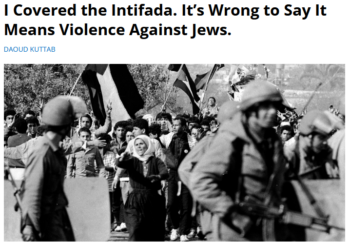
Daoud Kuttab (FAIR.org, 7/7/25): Intifada is "an Arabic word that has been hijacked and misused by people who would rather Palestinians remain silent and submissive under occupation."
In other words, it means a commitment to anti-colonial struggle, not random acts of violence. Media attempts to paint the intifada as inherently violent are missing the point, as Daoud Kuttab, who covered the origins of the Intifada for the Palestinian English weekly Al-Fajr, wrote for FAIR (7/7/25): "The first Intifada embraced principles of nonviolent resistance championed by Martin Luther King Jr. and Mahatma Gandhi."
But the Israel government went out of its way to crush nonviolent Palestinian resistance (Electronic Intifada, 9/6/16; Waging Nonviolence, 10/7/24; +972, 7/2/25). As Kuttab noted, "In the first phase of the uprising—a little more than a year—332 Palestinians were killed, along with 12 Israelis (Middle East Monitor, 12/8/16)." This was the period where Prime Minister Yitzhak Rabin announced a policy of "force, might, beatings" to crush the uprising, instructions that resulted in Israeli soldiers systematically breaking the bones of Palestinian protesters (New York Times, 2/14/88). Kuttab wrote:
This brutality did not suppress the protests, but merely escalated the violence: At the end of six years, more than 1,500 Palestinians, including more than 300 children, and 400 Israelis—18 of whom were children—were dead, according to the Israeli human rights group B’tselem.
The call to globalize the intifada is a direct result of the Israeli government having made peaceful protest within Israel/Palestine virtually impossible.
There is no actual evidence cited in these pieces that the killers were in any way inspired by recent protests about Israel’s war against Gaza. So far, the available evidence is that the shooters were affiliated with the Islamic State (Times of Israel, 12/15/25). Also known as ISIS or Da’esh, the group’s origins are not Palestinian, and are rooted in fundamentalist outrage against the West. Most observers of the Middle East conflict know that Hamas, the party in control of Gaza, is at odds with ISIS (Politico, 11/21/23). The Lebanese resistance group Hezbollah, an official enemy of Israel, hates ISIS, as the groups fought each other in Syria (CNN, 8/29/17; Georgetown Journal of International Affairs, 5/5/19).
To say the least, it's unlikely that followers of ISIS are looking to US campus protesters or Democratic Socialists of America mayoral candidates for strategic guidance. And anyone who is genuinely engaged in the Palestine solidarity movement knows that Jewish people are a substantial part of that movement (FAIR.org, 10/17/23, 11/6/23, 4/17/25). Any meaningful discussion of antisemitism is going to include those Jewish voices as well.
|