|
What We Get Wrong When We’re Shocked by Gun Violence
The shooting at Brown University and the myth of exception.
|

| |||||||||||||||


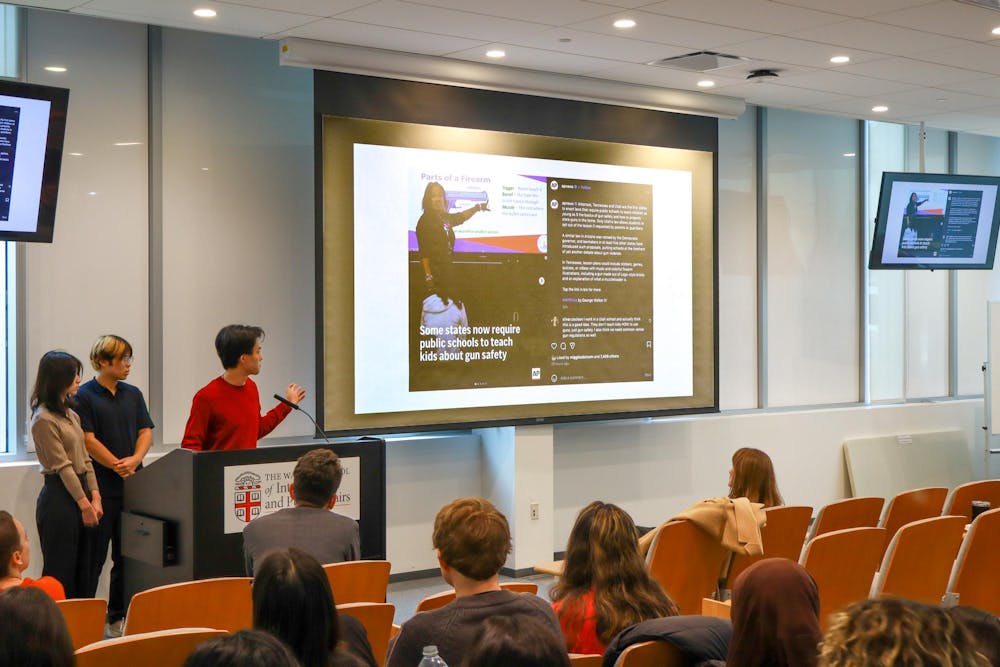
In early November, students at Brown University spent a weekend focused on gun violence. As part of Hack for Humanity 2025, they examined firearms as a global public health and human rights crisis, engaging with research on illicit arms trafficking, youth and school-based violence, domestic abuse, mass shootings, and prevention strategies grounded in policy, public health, and civil society. The framing of the event was direct and unsentimental. Gun violence was treated as a structural condition shaped by law, access, and political choice, not as a collection of rare or unforeseeable events.
And this weekend, just over a month later, there was a shooting at Brown.
The reaction that followed was immediate and familiar, particularly among the broader adult public. Across alumni forums, comment sections, and national coverage, disbelief surfaced almost reflexively. People wrote that they never imagined something like this could happen there, that Brown felt insulated from this kind of violence, that this was not what they associated with a campus like that. The shock was not subtle; it was expressed as a rupture, as though an implicit promise had been broken.

What that reaction reveals is not confusion about gun violence, but a persistent belief about where it belongs. For many adults, especially those accustomed to experiencing gun violence through headlines rather than proximity, it remains something that happens to other communities, under different conditions, often far away. When violence appears in spaces associated with prestige, safety, or intellectual seriousness, it feels like an exception rather than a pattern.
The students who participated in Hack for Humanity were operating under a different set of assumptions. Their work did not begin from the question of whether gun violence could reach a place like theirs. It began from the recognition that it already does, repeatedly, and that no amount of institutional stature or geographic context confers immunity. The questions they were asking in November focused on why gun violence persists, how harm is distributed, and why prevention remains so limited despite decades of data and lived experience
 |
This difference in perspective matters because it shapes how people respond when violence occurs. For many adults, shock functions as a way of preserving distance. It allows the event to be processed as an anomaly, a deviation from the norm, rather than as evidence of conditions that have been long established and largely unaddressed. Shock, in this sense, is not just an emotional response, but rather a way of postponing reckoning.
Students today do not have that luxury. Their realism is not resignation, but adaptation. It shows up in how they plan, organize, and study. It shows up in the fact that gun violence is already part of their intellectual and civic formation, not because they are uniquely interested in it, but because it has shaped the environment they are expected to navigate.
Framing the shooting at Brown as ironic or cruelly timed obscures this reality. Irony depends on surprise, on a meaningful gap between expectation and outcome. But there is nothing surprising about gun violence occurring in a country where firearms are widely accessible, where schools and universities have repeatedly been sites of violence, and where policy failure has been allowed to harden into background noise. What is surprising is how often adults continue to act as though certain places remain exceptions.
This is why moments like this feel destabilizing to those who are shocked by them. The destabilization does not come from a sudden change in reality, but from the collapse of an assumption. The belief that gun violence can be kept at arm’s length, that it respects social boundaries, or that it announces itself before arriving has been contradicted countless times. Still, it persists.
The online disbelief that followed the shooting at Brown reveals a gap that has consequences. As long as gun violence is understood as something that arrives unexpectedly, it can be treated episodically, mourned briefly, and then set aside. As long as it is framed as an intrusion rather than a condition, responsibility remains diffuse and urgency remains optional.
This moment should not be framed as irony or cruel timing. It should be understood as evidence of how misaligned public expectations remain. Gun violence did not suddenly arrive at Brown in December. It was already there in November, shaping the questions students felt compelled to ask. If the sequence feels unsettling, it is not because reality changed, but because some people are only now confronting conditions students have been navigating for years.
Thanks for reading! Subscribe to stay connected to the young leaders, stories, and ideas shaping the future of this movement.
| ||||||||||

