|
Updates from the Office of the Commissioner Representing Employers |
|
|
Employers and Workforce Leaders,
This year, I’ve been honored to work with an incredible group of workforce leaders as well as innovative business owners, and I’m always impressed by your commitment to your communities. Everything you do advances the local workforce and employers, which in turn powers the economic engine of your region.
First as Commissioner Representing Employers and now as Chairman of TWC, it’s a privilege to be a partner in your mission.
I’ve been asked several times recently about my vision for workforce development and TWC, and it’s that we promote a system where Texans are trained, supported, and ready to grow alongside the businesses that want to call Texas home.
I see one of my roles at TWC is to support the innovations that help you meet the needs of your region. That means modern tools, smarter data, finding more flexibility for you, and promoting our shared commitment.
One of the highlights this year has been partnering with several of you to bridge the gap between students and employers, unlocking potential for both. I’m grateful for your partnership to bring our Texas Intern Network conference to students in El Paso and Brownsville, as well as Dallas College and Texas State University.
The events focused on engaging students with internships and work-based learning opportunities, which are vital for helping young Texans build career skills and connect with employers. These efforts are essential for cultivating a future-ready workforce.
We have a few locations on the schedule for 2026 and will be releasing those locations and schedule very soon.
Speaking of events, I want to express my appreciation for your continued support in making our Texas Conference for Employers events a success in your communities. Your help in promoting and speaking at these forums has been invaluable. These employment law forums wouldn’t be the same without your hard work and dedication.
I’m also excited that we've continued our “Another Week of Available Work” podcast. We launched this podcast to explore Texas’s workforce landscape, some economic development, share success stories, and dive into the challenges and triumphs we’re all facing. I’d love for each of you to tune in and consider joining us as a guest. It would be a great way to share what’s happening in your region and highlight projects.
Going back to our shared mission, of creating and promoting programs that help employers access a skilled workforce, I also want to highlight our work to enhance child care access.
We recently launched the Quad Agency Child Care Initiative, bringing together the key players in child care policy so we can move the needle and help child care providers get the support they need to offer quality child care. We all know what a critical link child care plays in accessing a skilled workforce and I appreciate your partnership in this mission as well.
Thank you for the opportunity to serve as your advocate and represent you. I look forward to seeing what we will accomplish in the next year!
- Joe Esparza

|
|
Texas Business Minute

Texas Conference for Employers
 |
|
- January 9, 2026: Victoria - Sign Up
- February 6, 2026: Big Spring - Sign Up
- March 13, 2026: Lubbock - Sign Up
- March 27, 2026: College Station - Sign Up
- April 17, 2026: Baytown - Sign Up
- May 1, 2026: Lancaster - Sign Up
- May 29, 2026: Corpus Christi - Sign Up
- June 26, 2026: Harlingen - Sign Up
- August 7, 2026: Waco
- September 18, 2026: San Angelo - Sign Up
|

Creating an Effective Policy Handbook
By: Jikku John
Legal Counsel to Chairman Esparza
While there is no such thing as a perfect policy handbook, having a clear, well-organized employee handbook can serve as a powerful tool for communicating the employer’s expectations as well as the types of conduct that are deemed unacceptable.
This article seeks to provide helpful tips and guidance for employers for drafting effective policy handbooks.
Drafting your Policies
When creating your employee handbook, the first step is determining which policies to include. This is your prime opportunity to clearly communicate expectations, define unacceptable conduct, and outline the consequences of violating company standards.
After deciding on the policies, focus on drafting them effectively. Remember the handbook's purpose: to explain company practices, procedures, and rules. Therefore, write with your employees in mind, using simple language that is easy to understand. The goal is for employees to be able to read and comprehend the contents of the document. Finally, organize the handbook logically, making it easy to navigate. Using an index or detailed table of contents is a helpful strategy for many employers.
Distributing the Handbook
Proper distribution of the handbook is just as important as proper drafting of policies. An employer can have the most beautifully written handbook, but if it doesn’t reach the employees it’s intended for, it will be viewed as meaningless.
The above issue comes more into light in the context of an unemployment claim. For an unemployment claim, to successfully contest a claim related to an involuntary separation, the employer must show misconduct connected with the work. This requires the employer to show that the claimant was fired for a specific act of misconduct that happened close in time to the discharge. Crucially, the employer must show that the claimant either knew or should have known that they would be fired for such a reason. See. https://efte.twc.texas.gov/ui_law_qualification_issues.html#dq-mc. If the employer failed to properly distribute their handbook, proving that the employee was aware of the policy they allegedly violated becomes significantly more challenging.
|

Employers should implement a consistent process for distributing the employee handbook. A common practice is to provide the handbook during orientation or initial training. It’s essential to have employees acknowledge receipt of the handbook and any related documents by signing acknowledgment forms. This will serve as the strongest possible evidence that the employee was aware of, or should have been aware of, company policies and expectations.
Updating the Policy Handbook
Existing, unchallenged policies are prone to complacency. The employer should regularly review and update outdated policies. Consulting with legal counsel to ensure that the handbook complies with current laws is a worthwhile investment. Any updates must be similarly distributed and acknowledged by all employees in a consistent and documented manner.
Policy Enforcement
Employers must be vigilant and careful to enforce their policies even-handedly and consistently. In the context of an unemployment claim, if the claimant was fired for an offense for which others were only warned, and there was no compelling reason for treating the claimant differently, the employer will likely lose an unemployment claim. Even-handed enforcement of policies will also help employers defend against claims of discrimination and wrongful discharge. See. https://efte.twc.texas.gov/atoz_introduction.html.
Conclusion
To be truly effective, an employee handbook must be clear, simple, and easy for employees to understand. This means carefully considering the policies, making the handbook readily accessible, and thoroughly explaining company expectations and unacceptable behaviors. While no handbook is perfect, a well-written and implemented one is a valuable resource that empowers both employers and employees.
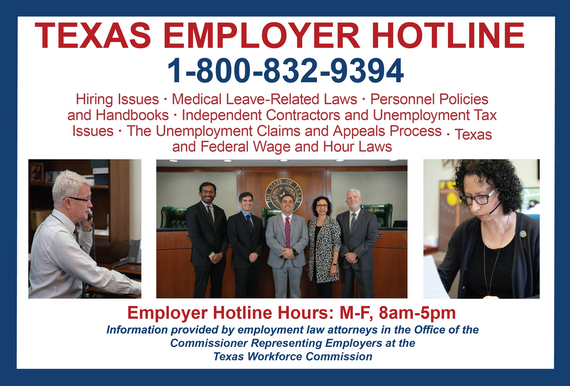
For questions about this issue, or any other employment-related matters, employers can call our employer hotline at 1-800-832-9394 or email us at: [email protected].
|
Another Week of Available Work:
A Podcast with Chairman Joe Esparza

In this episode, we discuss exactly what you need to know about seasonal hiring for employees. Discover the benefits of bringing on seasonal staff during peak times, learn how to navigate legal requirements, and get tips on effective onboarding and offboarding practices. Whether you're considering hiring for the first time or looking to refine your approach, this episode provides valuable insights to optimize your workforce during the busy season.
Texas Business Today is provided to employers free of charge
Texas Business Today is a monthly update devoted to a variety of topics of interest to Texas employers. The views and analyses presented herein do not necessarily represent the policies or the endorsement of the Texas Workforce Commission. Articles containing legal analyses or opinions are intended only as a discussion and overview of the topics presented. Such articles are not intended to be comprehensive legal analyses of every aspect of the topics discussed. Due to the general nature of the discussions provided, this information may not apply in each and every fact situation and should not be acted upon without specific legal advice based on the facts in a particular case.
Connect with the Office of the Commissioner Representing Employers
Email: [email protected]
Mail: Commissioner Representing Employers
101 E. 15th St., Rm 630
Austin, TX 78778
|
|
|
|
|