|
 |
The Left wants you to forget about their summer of violence...
Don't let them get away with the "Peaceful Protest" narrative
|
| |||||||||||||||


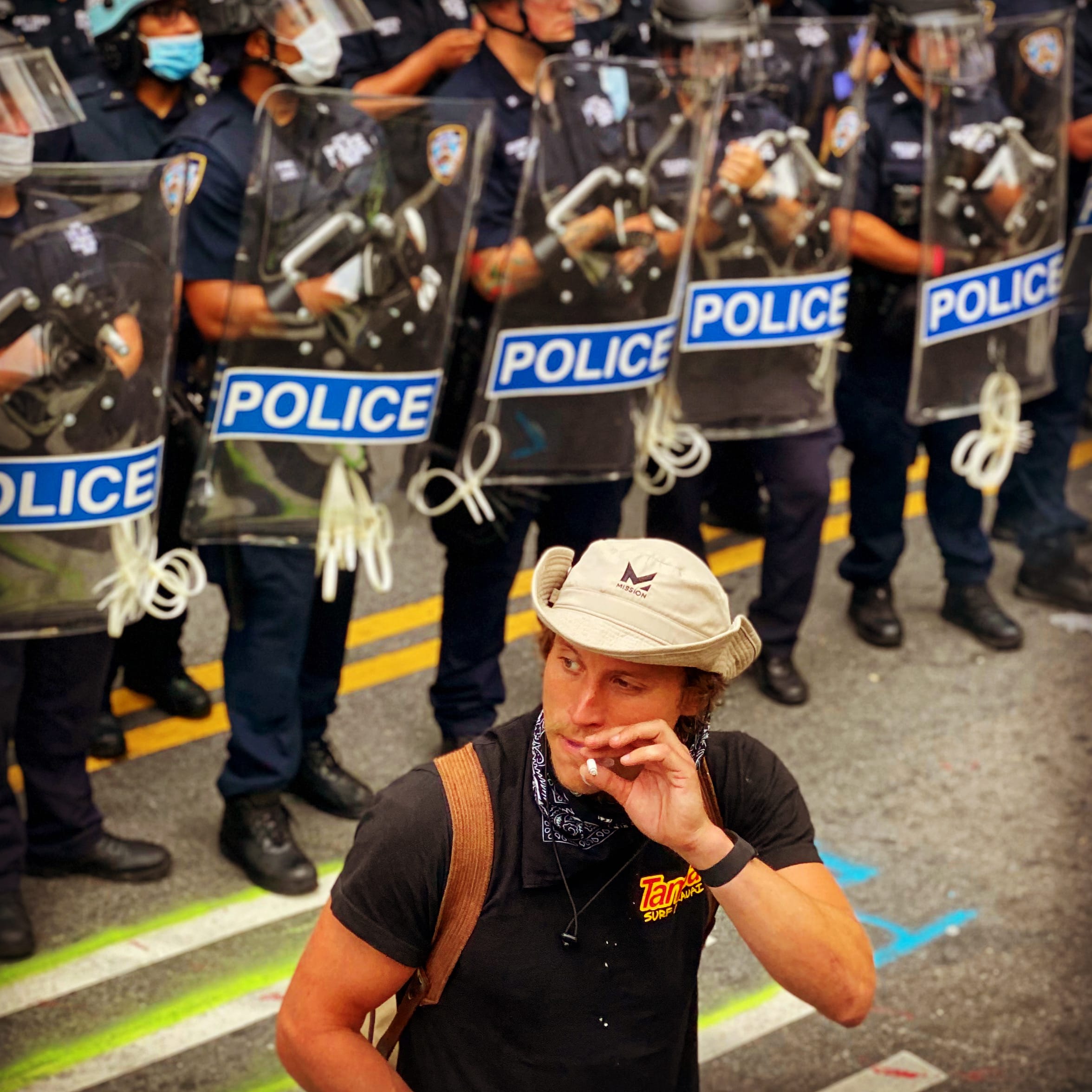
PolitiBrawl contributor and brave independent reporter Richie McGinniss documented the horrific riots during the summer of 2020 on the ground as a reporter armed only with a phone to record what was happening in real time.
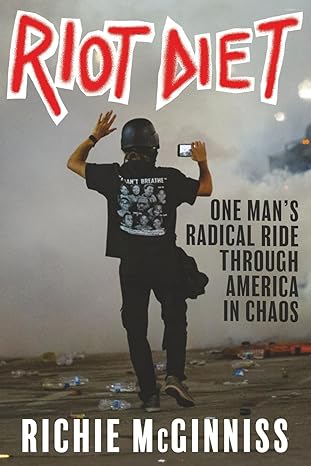
Here is an excerpt from his new book RIOT DIET: One Man’s Radical Ride Through America in Chaos
Are you Christmas shopping for anyone who called the 2020 BLM riots “Peaceful Protests?” This is the perfect book to gift them this Christmas…
Pick up the book today:
RIOT DIET: One Man’s Radical Ride Through America in Chaos
 |
LORD OF THE CHAZ
By Richie McGinniss
June 11, 2020: Capitol Hill, Seattle, Washington
“This is our island. It’s a good island. Until the grown ups come to fetch us we’ll have some fun.”
—Ralph, Lord of the Flies
 |
Thanks to the pandemic, Shelby, Jorge, and I enjoyed an empty flight, but now we were packed in the back of our rideshare from the airport to Capitol Hill. I marveled at the sight of Seattle’s modern cityscape for the first time. I narrated while zooming my phone camera into the fog beyond the Seahawks’ stadium, “Well, folks, somewhere over there, there’s a new country. And we’re gonna see it.”
After a week of protests and multiple riots throughout Seattle’s Capitol Hill, on Friday, June 5, Mayor Jenny Durkan promised a 30-day ban on the use of chemical irritants, pending an internal review. “This review should better emphasize de-escalation techniques.” What ensued for the next two days was anything but “de-escalation” and was instead a continuation of the same shit show—rioters threw bricks and bottles, and shot fireworks at police. By Sunday, June 7, under a barrage of improvised projectiles, cops desperately discharged chlorine tear gas, the chemical irritant that the city’s politicians pledged not to use.
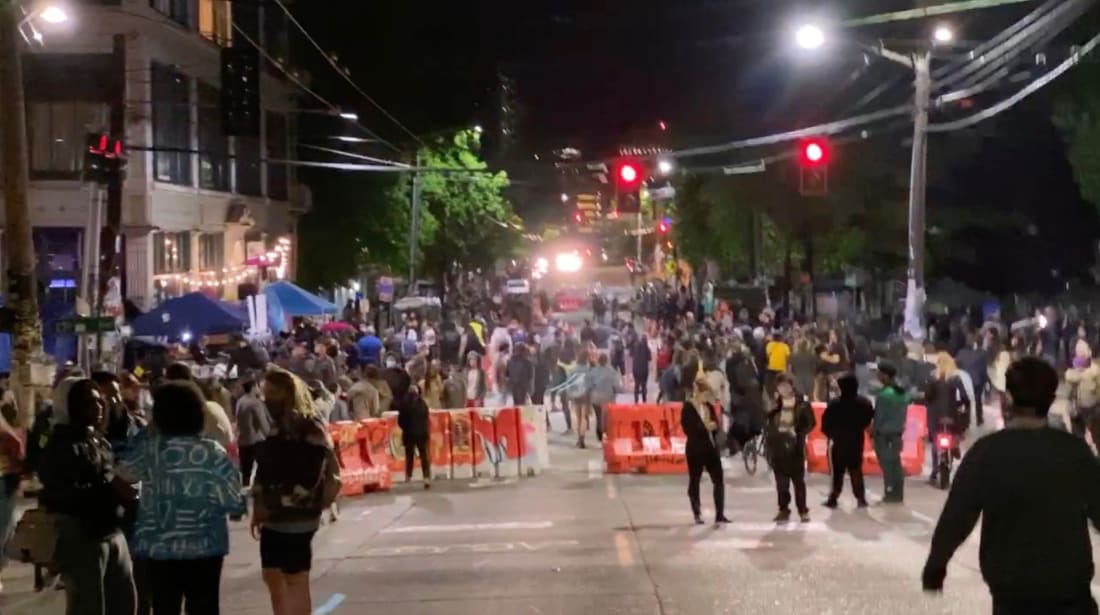
In the days before our trip, I watched the escalation of progressive violence from a computer screen in D.C. It concluded with a police evacuation as cops hastily loaded onto armored vehicles and drove away from Seattle’s East Precinct. Hundreds of jubilant activists and agitators filled the void behind them. A trumpet man ushered in the occupying army of demonstrators. The boarded-up front of the station endured over a week of anti-police protests-turned-riots before they finally capitulated to the mob. As night fell on Monday, the BLM demonstrators took control of the front of the police HQ on the top of the hill. A rapper named Raz distributed a trunk-full of AR-15s. By sunrise the next morning, they set up roadblocks and established checkpoints, expanding their inchoate dominion to a five-block area in the heart of the city. The ousters triumphantly named their new fiefdom the Capitol Hill Autonomous Zone [CHAZ].
On our ride to CHAZ beneath the slanting sun, we drove past Seattle’s Pioneer District, where the city’s founders had settled in 1852. At the center of the district rose the Smith Tower, which was the tallest building west of the Mississippi River at the time of its completion in 1914. The 34-story building was one of the oldest monuments to corporate prospecting in Seattle. New York typewriter and firearms tycoon Lyman Smith financed the neoclassical structure, hence the name. In the background of my shot, the larger skyscrapers that now dwarf Smith Tower disappeared into the misty low clouds—today’s tech companies elevated above the industrial revolutionaries of the past. Somewhere beneath the foggy skyline was a post-modern experiment without sanctioned businesses, or police, or posing politicians.
At the entrance of the CHAZ, a colonial-looking sign painted white and cut in the shape of a house, said in neatly stenciled letters, “You Are Now Entering Free Cap Hill.” Can’t be worse than that open-air drug market in San Juan, I thought. An amalgamation of city planters, road construction dividers, metal barricades, and plywood created a de facto wall marking the border. The individuals who tended the checkpoint wore all black and carried walkie-talkies, but they appeared more interested in socializing than security.
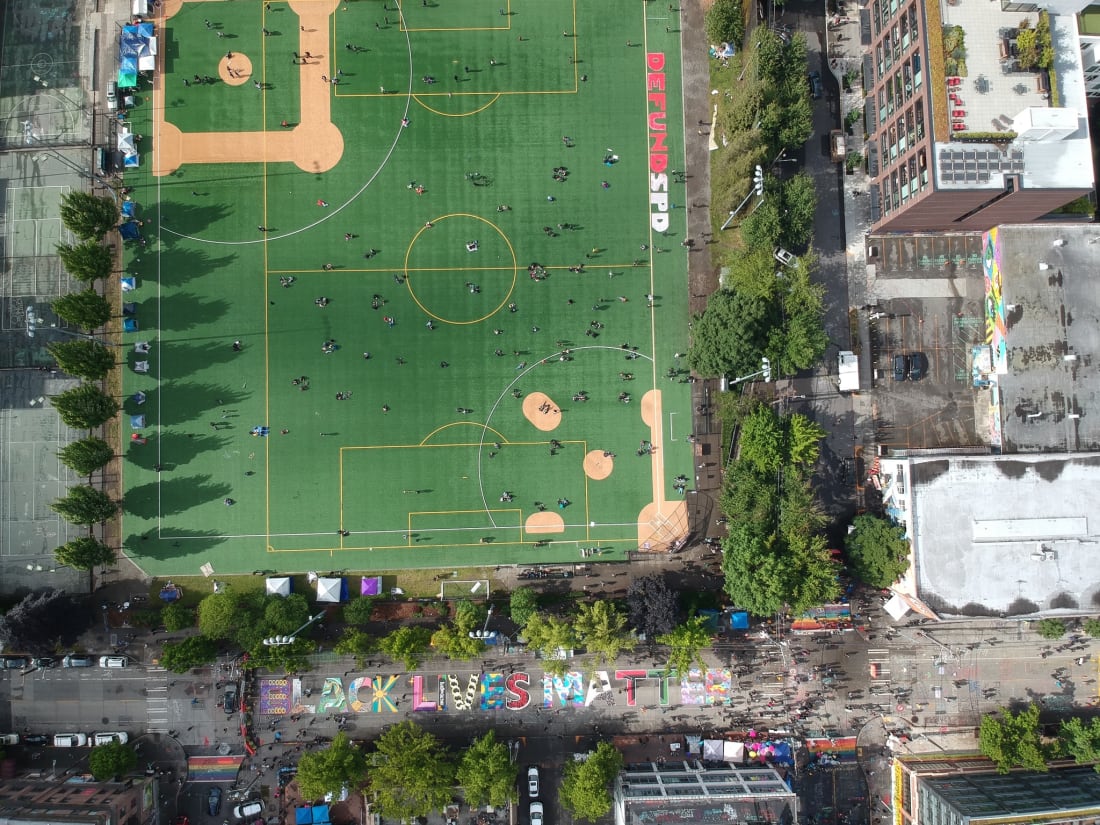
The first thing we recorded as we stepped inside was a giant “Black Lives Matter” mural that spanned the width of East Pine Street, stretching eastward two blocks up the hill to the police precinct.
 |
At the intersection of East Pine Street and 11th Avenue, next to the “R” in the aforementioned BLM mural, stood a piece of plywood that read “Defund/Not Decaf/Coffee Tea Cocoa.” Directly in the center of the intersection, a set of couches was arranged in a circle. I narrated from behind the camera, adding context for the viewers, “We got a lounge zone over here?” Two signs drawn on cardboard, propped up by art easels with sharpie-drawn letters, said “Conversation Café/Let’s Talk About Antifascism.” The patrons of the café sat forward in their relaxed furniture, seemingly engaged in some intense political discussion—passing the conch. All sorts of graffiti covered the ground with messages like “FUCK THE POLICE” written in elegantly scripted periwinkle letters.
When I summited the hill in front of the precinct, I hit record on my phone, cracked a spiked seltzer, and aimed the camera at a man dressed in full knight’s armor. He lowered the metal visor over his eyes, clanking it shut with a hard slap. I exclaimed from behind the camera, “White Claws, no laws!” but got no response.
We walked a block beyond the abandoned police precinct and arrived at the intersection of Pine and 13th Avenue, where someone had parked an old Chevy Suburban horizontally across the street. A variety of barriers stacked alongside the vehicle reinforced the checkpoint that marked the easterly reaches of the dominion. Three centurions manned the roadblock, smoking cigarettes and conversing amongst themselves. One man with a bright red beard and scraggly red hair flowing from a blue construction helmet sat on top of the ‘90s-era truck.
I pulled out my phone and hit record, aiming at the ground at first to avoid upsetting the security detail. The guy on the roof was in the middle of a spirited diatribe about how to properly build a shield from PVC pipe, pool noodles, and duct tape. He had the panache of a hardcore LARPer paired with the garrulous bravado of your high school’s most annoying theater kid. “If the Zulu shields, which were just wood and leather, could stop a rifle round, duct tape can stop a rifle round. You just need enough of it!”
I injected myself into the conversation. “Yeah, the Zulus did beat the Brits that one time.”
He brought a cigarette up to his mouth, raised the lighter, but then gestured with the cigarette instead of lighting it. “It was the only time that a technologically inferior group managed to whoop the ever-living shit out of the British!”
I chuckled. Now that we had him talking, Shelby pivoted to a more relevant topic: “Do you think that the police—they came today, right?”
Pick up the book today:
RIOT DIET: One Man’s Radical Ride Through America in Chaos
|
He waved the unlit cigarette in her direction. “You know they might come back. They might be hiding in some bunker, gathering resources, waiting for one big-ass push against us. And I’d rather, when they show up with their goons with riot shields, we have our own, going—” He pulled both his hands up as if he held an imaginary shield in a defensive position with the cigarette protruding from his fist and yelled, “Ours look cooler!”
Shelby laughed nervously and sputtered, “Yeah.”
The guard took the lighter and cigarette up to his mouth, but lowered them again. Now he aimed the cig at me. “You seem like you’re, you know, of some significance!”
I laughed from behind the camera, and Shelby chimed in, always eager to chirp me when given the opportunity. “Don’t give him a big ego.”
We all laughed, and the guard added gregariously, “Hey, we’re all important. We’re all just doing our part.” He finally lit his cigarette.
Shelby used the silence to shift the conversation again. “How long have you been out here for?”
The didactic defender took a long huff on the cigarette before he replied. “I just got here today. I was at the [May] 30th protest.” He coughed into his sleeve before he finished the story. “Got my ass beat by police. Healed up. Came back out!” He smoked the cigarette satisfactorily.
Shelby pressed. “It seems like there’s no police out here tonight.”
Exhaling smoke, the guard growled, “Yeah, but you got the fuckin’ alt-right retards threatenin’, posturin’, and just, like, all right, come out here. I am more Aryan than thou, motherfucker. Hitler loved him some blue-eyed gingers!”
I stifled a laugh, fearing his Hitler joke crossed the line and might attract negative attention from the other two guards loitering nearby. Shelby ignored the joke and gently followed up on his claim. “Have you seen a lot of alt-right people out here?”
The boisterous ginger looked around. “No, I have not, not since I got out here. There was one Jeep that was circling around, and I was like, ‘Why have you passed us multiple times? Are you friend or foe?’” He hocked a loogie and spit in my direction. The large wad of mucus splattered loudly on the pavement a few feet below my camera’s microphone.
A shirtless, heavily tattooed man approached the checkpoint. The guy explained in slurred speech how he had been wronged during a fight earlier. He drunkenly appealed his case to the red-bearded security guy, seeking some kind of restitution.
We turned our attention to another border guard. The young man, who was maybe in his mid-20s, rocked anxiously from one foot to the other in front of the passenger door of the Suburban. He wore black, top-of-the-line running shoes. He also sported an extremely expensive-looking black waterproof hiking bag and a windbreaker that probably cost more than many of the people inside the CHAZ had in their bank accounts. A needlepoint belt slung around his chest served as some kind of ill-fitting holster/sling for a giant silver .50 caliber Desert Eagle. The bright chrome of the gun was just barely visible from inside a black holster that had been looped through the belt. The firearm looked cartoonishly large alongside tight-fitting black clothing that clung to his scrawny torso.
Shelby asked him where he got the needlepoint belt, and he said that his mom made it for him, and he thought it worked well. In fact, it did not work well, as the hand cannon swayed from side to side when the young man shifted on his feet. The firearm dangled between 20 degrees and 30 degrees shy of parallel to the ground, which meant it flagged everyone who crossed his flank.
Convinced that the bony boy with the big gun was a hazard to our health, we approached a third guard, an Asian fellow who had a walkie-talkie with a large, silver antenna sticking up near his face. His arms rested on a repurposed plastic road divider. Large white stickers on the barrier read “Defund SPD” in black letters with the symbol of a raised, closed fist—synonymous with the BLM movement and also closely resembling the logo for Maoist China’s communist uprising. He looked in our direction as we approached, holding a cigarette in his hand like a writer holds a pen. This time, Shelby launched into her most pressing question right off the bat, “So, is there anyone like running this? Or is it just like a whole group? Because I’ve seen news reports that claim there’s a certain person [Raz] running it?”
The guard clasped his free hand on the butt of the unlit cigarette and pondered the question before he replied, “I can really say with a lot of certainty that there is not a specific person running it.”
Shelby waved her hand, indicating that it was time to go. We thanked the guards and walked back toward the police station. Save for the faint sound of a few partiers, things were quiet. We reconvened with Jorge and updated him on the tenuous security situation at the border. After our first night, it was apparent that this no-cop utopia had already devolved to infighting.
Pick up the book today:
RIOT DIET: One Man’s Radical Ride Through America in Chaos
|
June 14, 2020: Heart of the CHAZ, Seattle, Washington
“Which is better—to have laws and agree, or to hunt and kill?”
—Piggy, Lord of the Flies
I recorded a portly black man who carried an AR pistol. His girthy figure was clothed in a gray camo sweatshirt with the hood cinched down to his eyes and a bandana pulled up over his face. Affixed to the weapon was a drum magazine capable of holding at least 60 rounds, but it was hard to tell with the circular mag resting on his rotund gut while he stood casually outside the police station.
As I published the scene on Twitter, I heard some commotion around the corner. I scurried to the northeast side of the precinct and found Shelby recording a fight. She employed her signature move, where she holds the phone vertically along the straps of her backpack while recording to appear less obvious.
The fight started after someone slipped inside the perimeter fence surrounding the station and added graffiti to the already copiously spray-painted walls. Another individual intervened by publicly chastising the vandal. As the face-off escalated to physical contact, a few observers entered damage control mode, scanning for anyone who might be recording or broadcasting the mayhem. I was nervous for Shelby, but as the censorship brigade turned their attention to an individual with a larger, more eye-catching camera, she slyly holstered her phone.
Amid the ensuing brouhaha, distant but more frenzied screams reverberated off the boarded-up businesses northeast of our position. Jorge was the first one to hear the turbid echoes and take off. Shelby and I were quick to follow.
We raced a few blocks outside the border of CHAZ, where a pack of two dozen people howled while they smashed a chain-link fence surrounding an auto shop. As I neared the fence, I could see a smaller group inside with cameras and lights aimed in the direction of two men, one of whom was armed with a rifle. They stood next to an F-250 pickup truck with the doors flung open and hazard lights flashing orange on their pale skin. I recognized Jorge’s crooked helmet bobbing among the handful of people filming inside the fence.
I ran 10 yards down the sidewalk where the fence was shaking less violently, and I quickly scaled over. Jumping barriers had been a valued skill ever since I successfully evaded police by vaulting a picket fence at age 17—though my less agile buddy got caught, and I had to turn myself in the next day.
The older and taller of the two shop defenders had an AR-15 rifle slung over the front of his body, this one with a standard 30-round magazine. A tactical strap supported the weapon in front of his vest, which held extra mags, as well as his cell phone camera aimed back at the surrounding streamers. His left hand clutched the stock of the rifle while his right hand rested on its handguard. He yelled at me as I approached his periphery for an angle that showed both the mob and the men standing their ground. “Get back! Don’t try to get behind me. I don’t want anyone behind me.” Given that he was heavily armed and this appeared to be his property, I politely acquiesced to his demand.
Turning his attention from me, the rifleman removed his hand from its hold on the rail and waved the gaggle of recorders away. The cries from the other side of the fence calmed down as he stood tall and returned his free hand to the gun.
This scene initially kicked off after someone allegedly broke into their shop and attempted to light a fire. After the two men caught the intruder, they held him at gunpoint and waited for police to arrive. However, the mob showed up at their gate long before the cops, demanding the alleged arsonist’s release. The men decided to give in to the crowd rather than wait God knows how long for the officers of the law. They were greatly outnumbered and had no other choice. It was difficult to imagine what would have happened if the man with the rifle had not kept everyone at bay.
On June 20, a 19-year-old man named Horace Lorenzo Anderson was shot four times by another 19-year-old man who worked as a volunteer for the “security” team tasked with defending the citizen-run autonomous zone. When police showed up to investigate the shooting, they were confronted by a violent protest. As if the first homicide and a series of shootings were not enough, it took one more death before the government decided the CHAZistani experiment needed to be shut down.
On June 29, a 16-year-old boy was shot and killed at one of the checkpoints, the same checkpoint where we saw multiple armed men who claimed they were defenders of the postmodern paradise. The car the deceased young man drove was riddled with bullets. According to witnesses, all of whom were sympathetic to the protest, the boy attempted a drive-by shooting before he was gunned down. We will never know what actually happened because the incident was not captured on video, and no impartial witnesses were present. No one was prosecuted for the homicide.
After the shootings, the city simply disbanded the experiment and moved on as if nothing had happened. Progressive city leaders pointed their fingers to the other side of the political aisle while homelessness skyrocketed, and small businesses were destroyed by draconian lockdowns in their own backyards.
On the ride home, we were once again afforded an empty fuselage. We spread our tired bodies out across entire rows, and I should have comfortably drifted to sleep. But I could not get the face of the primal beast that lies within all of us out of my mind.
The local leaders who capitulated the police precinct and the CHAZistanis who conquered it shared a delusion that—due to exponential technological advancement—modern man had somehow evolved beyond our primordial roots. Yet the miracle of wireless internet also tethered us to a window into the world we can’t have: from power to money and lust and most of all the fear of a virus that had shattered the world we knew. The electrification of our existence has only left us more prideful, close-minded, envious of some, and hateful towards the rest.
Even with a galvanized effort led by “science,” politicians were unable to stop the spread of the invisible killer that was the focus of every news show for over a year. The idealistic armed CHAZ border guards and their proponents in elite media were powerless to pacify their darkest desires to seize control. Within weeks, the cop-free zone turned into a deadly shooting gallery. As in any power vacuum since the dawn of mankind, those who had weapons prevailed over even the most passionate calls for de-escalation.
In Lord of the Flies, the boys were only rescued because a passing warship saw the fire that scorched the whole island. When the adults showed up, a British naval officer inquired, “Nobody killed, I hope? Any dead bodies?”
“Only two. And they’ve gone,” Ralph replied.
You're currently a free subscriber to PolitiBrawl. For the full experience, upgrade your subscription.
| ||||||||||

