Washington, D.C., November 26, 2025 - On General Augusto Pinochet’s 60th birthday, November 25, 1975, four delegations of Southern Cone secret police chieftains gathered in Santiago, Chile, at the invitation of the Chilean intelligence service, DINA. Their meeting—held at the War College building on la Alameda, Santiago’s downtown thoroughfare—was called “to establish something similar to INTERPOL,” according to the confidential meeting agenda, “but dedicated to Subversion.” During the three-day meeting, the military officials from Argentina, Bolivia, Chile, Paraguay and Uruguay agreed to form “a system of collaboration” to identify, track, capture and eliminate leftist opponents of their regimes. As the conference concluded on November 28, a member of the Uruguayan delegation rose to toast the Chileans for convening the meeting and proposed naming the new organization after the host country’s national bird, the condor. According to secret minutes of the meeting, there was “unanimous approval.”
Chilean records refer to Condor as “Sistema Condor.” CIA intelligence reports called it Operation Condor. It was, as John Dinges writes in his comprehensive history, The Condor Years, an agency of “cross-border repression, teams went far beyond the frontiers of the member countries to launch assassination missions and other criminal operations in the United States, Mexico and Europe.” His investigation documented 654 victims of kidnapping, torture and disappearance during Condor’s active operational period in the Southern Cone between 1976 and 1980. A subdivision of Condor codenamed “Teseo”—for Theseus, the heroic warrior king of Greek mythology—established an international death squad unit based in Buenos Aires that launched 21 operations in Europe and elsewhere against opponents of the military regimes.
On the 50th anniversary of the secret inauguration of Operation Condor, the National Security Archive is posting a selection of documents that record the dark history of transnational repression under the Condor system. The selected records include:
- The only known DINA document on the inaugural meeting—the “Closing Statement of the First Inter-American Meeting of National Intelligence”—which summarized the agreement between the original five Condor nations.
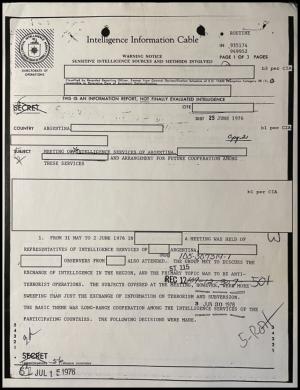
- The first declassified CIA document to name “CONDOR” as a “cooperative arrangement” against subversion. The heavily censored CIA document, dated June 25, 1976, provides initial intelligence on the 2nd Condor meeting held from May 31 to June 2 in Santiago. It was the first in a flurry of CIA intelligence cables in the summer of 1976 on Condor’s evolution from an intelligence sharing collaboration to a transnational system of disappearance and assassination. “The subjects covered at the meeting,” this CIA report noted, “were more sweeping than just the exchange of information on terrorism and subversion.”
- A CIA translation of the “Teseo” agreement—an extraordinary document that bureaucratically records the procedures, budgets, working hours, and operational rules for selecting, organizing and dispatching death squads to eliminate targeted enemies of the Southern Cone regimes. The “Teseo” operations base would be located “at Condor 1 (Argentina).” Each member country was expected to donate $10,000 to offset operational costs, and dues of $200 would be paid “prior to the 30th of each month” for maintenance expenses of the operations center. Expenses for agents on assassination missions abroad were estimated at $3,500 per person for ten days “with an additional $1000 first time out for clothing allowance.”
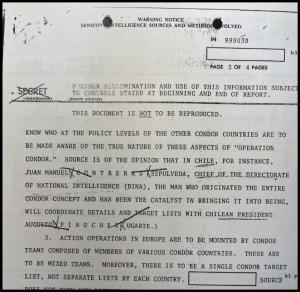
- A CIA report on how the Teseo unit will select targets “to liquidate” in Europe and who will know about these missions. The source of the CIA intelligence suggests that “in Chile, for instance, Juan Manuel Contreras Sepulveda, chief of the Directorate of National Intelligence (DINA) the man who originated the entire Condor concept and has been the catalyst in bringing it into being, will coordinate details and target lists with Chilean President Augusto Pinochet Ugarte.”
- The first briefing paper for Secretary of State Henry Kissinger alerting him to the existence of Operation Condor and the political ramifications for the United States. In a lengthy August 3, 1973, report from his deputy Harry Shlaudeman, Kissinger is informed that the security forces of the Southern Cone “have established Operation Condor to find and kill terrorists…in their own countries and in Europe. Brazil is cooperating short of murder operations."
- CIA memoranda, written by the chief of the Western Hemisphere division, Ray Warren, sounding the alarm on Condor’s planned missions in Europe, and expressing concern that the CIA will be blamed for Condor’s assassinations abroad. One memo indicates that the CIA has taken steps to preempt the missions by alerting French counterparts that Condor operatives planned to murder specific individuals living in Paris.
- The completely unredacted FBI “Chilbom” report, written by FBI attaché Robert Scherrer one week after the car bomb assassination of former Chilean Ambassador Orlando Letelier and Ronni Moffitt in downtown Washington, D.C. It was this FBI report that resulted in the revelation of the existence of the Condor system in 1979, when its author, FBI attaché Robert Scherrer, testified at a trial of several Cuban exiles who assisted the Chilean secret police in assassinating Letelier and Moffitt.
- The first Senate investigative report on Condor based on CIA documents and briefings written in early 1979 by Michael Glennon, a staff member of the Senate Foreign Relations Subcommittee on International Operations. The draft report was never officially published but was leaked to columnist Jack Anderson; a copy was eventually obtained by John Dinges and Saul Landau and used in their book, Assassination on Embassy Row. A declassified copy was released as part of the Obama-authorized Argentina Declassification Project in 2019.
“These documents record the dark history of multilateral repression and state-sponsored terrorism in the Southern Cone—a history that defined those violent regimes of the past,” notes Peter Kornbluh, author of The Pinochet File: A Declassified Dossier on Atrocity and Accountability. “Fifty years after Condor’s inauguration, these documents provide factual evidence of coordinated human rights atrocities that can never be denied, whitewashed or justified.”
After many years of investigations and resulting trials, it is now clear that Condor may have backfired on its perpetrators, according to John Dinges, whose updated and expanded edition of The Condor Years was published in Spanish in 2021 as Los Años del Condor: Operaciones Internacionales de asesinato en el Cono Sur. “It is a kind of historic irony,” Dinges notes, “that the international crimes of the dictatorships spawned investigations, including one resulting in Pinochet’s arrest in London, that would eventually bring hundreds of the military perpetrators to justice. Moreover, because Condor’s most notorious crime was in Washington, D.C., the United States government unleashed the FBI to prosecute DINA and the Chilean regime.”
Other documents on Condor discovered in the archives of member states such as Uruguay can be found on this special website—https://plancondor.org/—established to record the history of Condor’s human rights atrocities and hold those who committed them accountable for their crimes.
Special thanks to Carlos Osorio whose years of work documenting Operation Condor made this posting possible.
Read the documents.
Founded in 1985 by journalists and scholars to check rising government secrecy, the National Security Archive combines a unique range of functions: investigative journalism center, research institute on international affairs, library and archive of declassified U.S. documents ("the world's largest nongovernmental collection" according to the Los Angeles Times), leading non-profit user of the U.S. Freedom of Information Act, public interest law firm defending and expanding public access to government information, global advocate of open government, and indexer and publisher of former secrets.