|
 |
I’ve Sat in the Rooms Where These Are Written. This One Stunned Me.
The quiet rewrite of America’s national security priorities.
|

| |||||||||||||||


 |
While the country was consumed with Trump’s latest insult, the Supreme Court’s signals, the FIFA “peace” circus, and the daily churn of chaos, the White House quietly did something far more consequential: it rewrote America’s grand strategy for dealing with the world.
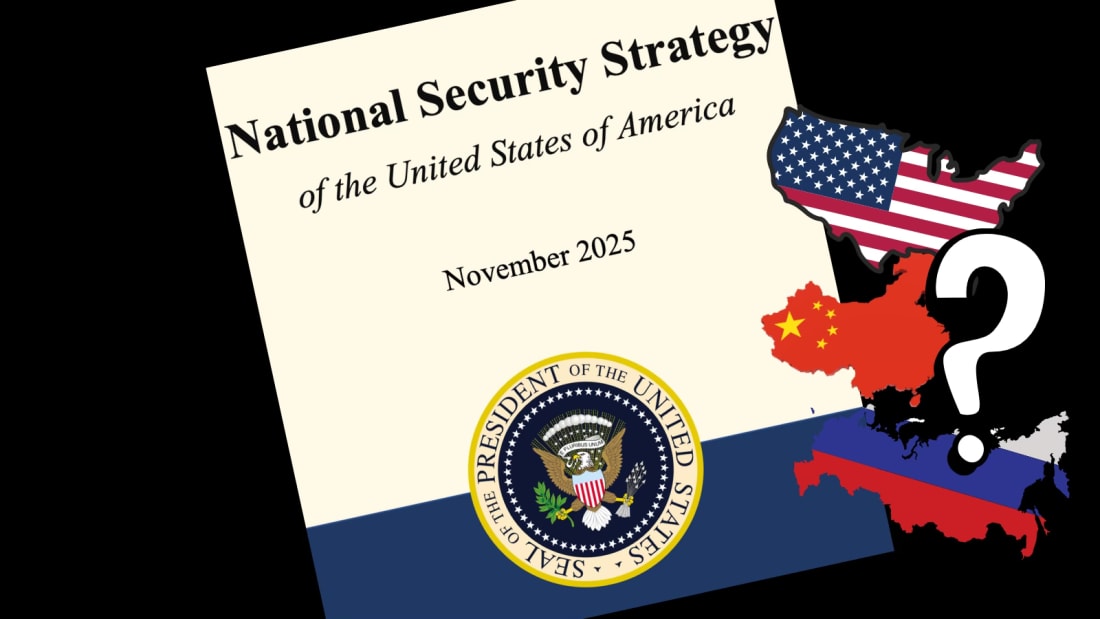
A new National Security Strategy has dropped, and it bluntly states what the U.S. government will prioritize, defend, ignore, or reshape over the next four years.
Normally, this is front-page news. This time, it landed with a thud. Most people didn’t even know it happened.
I did. Because I used to live inside this process. I’ve staffed, written, and implemented National Security Strategies in both Republican and Democratic administrations. So when I tell you this one is different, I don’t mean in a “Washington insiders are rattled” kind of way.
This is not a normal strategy. This is a blueprint for a very different America, at home and abroad. Let’s walk through what it actually says, in plain English.
Migration, not Russia or China, is now “the” security threat.
Here’s the headline that should have broken the internet: This NSS does not mention “great power competition” even once.
That phrase defined Trump’s own first-term strategy and Biden’s. It has been the backbone of U.S. foreign policy for a decade. It’s the idea that China and Russia are the primary threats to American security. This new NSS departs from that framework entirely. It’s gone. In its place?
Mass migration, framed as the central danger to American survival.
The strategy declares that the Western Hemisphere must be “stable and well-governed enough to prevent and discourage mass migration to the United States.” All other threats, including Russia, China, and terrorism, are presented as secondary.
This isn’t a policy tweak. It’s an ideological rewrite.
The “Trump Corollary” to the Monroe Doctrine…
The NSS announces a new doctrine, literally named after Trump, and reorients the entire U.S. military posture around it.
The Western Hemisphere becomes the primary security theater, with promises of:
a larger military footprint
an expanded Coast Guard and Navy to “control sea lanes”
“targeted deployments”
and, when deemed necessary, lethal force against cartels
This is the legal and strategic scaffolding for a far more militarized U.S. presence across Latin America and the Caribbean, not just for drugs or migration, but to reassert U.S. dominance and push China out of ports, minerals, infrastructure, and investment. And it does this while claiming to respect sovereignty.
You can already see the outlines in the real-world operations we’ve watched this year, from controversial “drug boat” strikes to the growing push to expand military roles in migration enforcement. The NSS is the paperwork that makes that posture permanent.
Yes, China is expanding globally. That part is real. It’s buying up ports, securing mineral rights, financing infrastructure, and doing what rising powers do: extend influence. But here’s what’s also true: you don’t beat China’s economic playbook with a military one. China shows up with loans, construction crews, and long-term agreements. The Trump strategy shows up in the form of warships and a Monroe Doctrine reboot.
One builds leverage. The other breeds resentment.
Latin American and Caribbean countries aren’t asking to choose between the U.S. and China. They’re asking for real partnership, investment, and respect. Despite many of these China offerings being bad deals in the end, if Washington responds to China’s economic expansion by militarizing an entire hemisphere, we won’t just fail to contain Beijing; we’ll push our neighbors straight into its arms.
I sat through enough Trump 1.0 Situation Room meetings to know this wasn’t a strategic plan; it was a fantasy. Stephen Miller pushed this worldview relentlessly during Cabinet meetings, driven largely by xenophobia, with little understanding of the geopolitical consequences.
Now that worldview isn’t just rhetoric, it’s policy.
Europe Isn’t an Alliance Anymore. It’s a Culture-War Arena.
The Europe chapter is the most jarring. It warns of "civilizational erasure," suggests NATO allies may become "majority non-European," and questions whether they will "view their place in the world" the same way.
It positions far-right "patriotic European parties" as America’s real allies, and openly states that the U.S. should "cultivate resistance" inside European democracies.
That’s not diplomacy. That’s interference. It’s the U.S. government taking sides in Europe’s internal politics and aligning itself with hard-right movements that share its current civilizational and nativism rhetoric.
Meanwhile, Russia, which launched the largest land war in Europe since World War II, gets softer language than our allies.
If you’re Vladimir Putin, you’re reading this with a smile.
Climate and culture hardwired into national security
The NSS doesn’t just abandon climate as a strategic priority; it calls climate policy an ideology that "threatens the United States." Then, in the same breath, it says America’s security requires "restoring spiritual and cultural health" and "growing numbers of strong, traditional families." In past strategies, values sections were broad and aspirational. This one is prescriptive and ideological.
National security is now directly tied to culture war objectives. Decisions about energy, science, healthcare, and research will be filtered through that lens. I’ve never seen anything like it in an official U.S. strategy.
The personalization of power
Throughout the document, Trump is positioned not just as a president but as a central global actor whose personal leadership is responsible for "unprecedented peace."
It praises his foreign policy as "pragmatic, realistic, principled, muscular, and restrained." It credits him with ending conflicts from Southeast Asia to the Middle East, including claims on Gaza and Iran that do not match the realities on the ground.
This is not how national strategies are supposed to read. They’re meant to articulate enduring U.S. interests, not construct mythology.
When a strategy elevates one man’s ego over institutional continuity, decisions become less about national goals and more about personal narratives. That’s dangerous.
Why almost no one talked about this…
Because that’s how this administration works: loud chaos on the surface, quiet architecture underneath.
The daily noise—the insults, the theatrics, the manufactured conflicts—keeps the country chasing outrage while the structural shifts slide through unnoticed.
This NSS is one of those shifts. It’s the operating system everything else will run on:
migration crackdowns
hemispheric militarization
weakened alliances
far-right transatlantic alignment
sidelining climate
expanded executive authority
This is the operating system beneath the spectacle.
What this means for you?
You don’t need to read all 33 pages. That’s my job. Here’s what I want you to take away:
-Mass migration is now officially treated as America’s defining security threat.
This framing will be used to justify harsher raids, military deployments, expanded surveillance, and the normalization of lethal force scenarios in our own hemisphere, far beyond what most Americans think of as "border security."
-The U.S. is throwing its weight behind far-right “civilizational” politics in Europe.
We’re not just asking allies to spend more on defense; we’re siding with parties that define their politics by who “belongs” and who doesn’t. That will boomerang into weaker alliances and stronger autocrats.
-Climate policy and “traditional family” ideology are now embedded in national security.
Decisions about energy, research, reproductive rights, and basic science will be filtered through a culture-war lens, not through what actually keeps Americans safe.
-Personality and punishment sit at the center of the strategy.
When a National Security Strategy reads like a campaign ad, complete with inflated peace claims and an obsession with “retribution” against perceived enemies, it’s a warning that power will be used selectively and vindictively, not consistently and strategically.
I spent years inside rooms where these documents were debated, drafted, and implemented. They were never perfect. But they were supposed to be grounded in reality—not in fantasies of God-chosen leaders and civilizational purity.
This one is different.
And remember: this strategy isn’t just policy, it’s politics. With the 2026 midterms ahead, Trump and his enablers will use this framework to manufacture a sense of crisis, escalate raids and military actions, and rally voters through fear. Mass migration isn’t just being defined as the top security threat; it’s being positioned as the central campaign weapon, again.
That’s why I’m launching the Behind the Noise weekly series: to pull the curtain back and show you the architecture hiding beneath the chaos. Because if we only chase the loudest outrage of the day, we’ll miss the quiet sentences that tell us where this is all really going.
Thank you to all of you who have stepped up as paid subscribers. I don’t take your support lightly. It allows me to write with independence and speak truths that don’t always fit neatly into the news cycle. You make this work possible.
More soon,
Olivia
This Substack is reader-supported. Paid subscriptions allow me to continue to pour significant time and energy into breaking down the headlines and keeping my content available to others. Thank you for your support!
Have an idea or feedback? Reply directly to this email.
| ||||||||||

