
| From | The American Enterprise <[email protected]> |
| Subject | Who Will Secure the Arctic's Commanding Heights? |
| Date | December 11, 2025 8:32 PM |
Links have been removed from this email. Learn more in the FAQ.
Links have been removed from this email. Learn more in the FAQ.
Exploring pressing issues and ideas critical to a free society
TheAmericanEnterprise_test3 (1) ([link removed] )
December 2025
Welcome to the winter edition of The American Enterprise. This month, we are featuring essays by Heather A. Conley on the global competition for dominance in the Arctic, Daniel J. Samet on why Anti-Zionism should have no place on the political right, and Kevin R. Kosar on cancel culture’s history in America.
Make sure to subscribe ([link removed] ) and read the online version here ([link removed] ) !
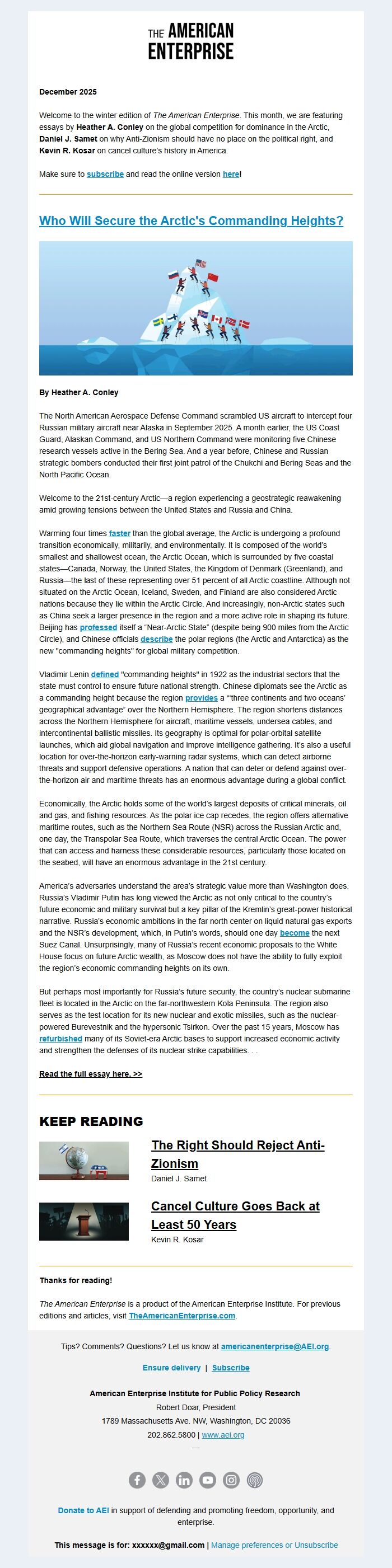
Who Will Secure the Arctic's Commanding Heights? ([link removed] )
heather conley fdp tae ([link removed] )
By Heather A. Conley
The North American Aerospace Defense Command scrambled US aircraft to intercept four Russian military aircraft near Alaska in September 2025. A month earlier, the US Coast Guard, Alaskan Command, and US Northern Command were monitoring five Chinese research vessels active in the Bering Sea. And a year before, Chinese and Russian strategic bombers conducted their first joint patrol of the Chukchi and Bering Seas and the North Pacific Ocean.
Welcome to the 21st-century Arctic—a region experiencing a geostrategic reawakening amid growing tensions between the United States and Russia and China.
Warming four times faster ([link removed] ) than the global average, the Arctic is undergoing a profound transition economically, militarily, and environmentally. It is composed of the world’s smallest and shallowest ocean, the Arctic Ocean, which is surrounded by five coastal states—Canada, Norway, the United States, the Kingdom of Denmark (Greenland), and Russia—the last of these representing over 51 percent of all Arctic coastline. Although not situated on the Arctic Ocean, Iceland, Sweden, and Finland are also considered Arctic nations because they lie within the Arctic Circle. And increasingly, non-Arctic states such as China seek a larger presence in the region and a more active role in shaping its future.
Beijing has professed ([link removed] ) itself a “Near-Arctic State” (despite being 900 miles from the Arctic Circle), and Chinese officials describe ([link removed] ) the polar regions (the Arctic and Antarctica) as the new "commanding heights" for global military competition.
Vladimir Lenin defined ([link removed] ) "commanding heights" in 1922 as the industrial sectors that the state must control to ensure future national strength. Chinese diplomats see the Arctic as a commanding height because the region provides ([link removed] ) a “‘three continents and two oceans’ geographical advantage” over the Northern Hemisphere. The region shortens distances across the Northern Hemisphere for aircraft, maritime vessels, undersea cables, and intercontinental ballistic missiles. Its geography is optimal for polar-orbital satellite launches, which aid global navigation and improve intelligence gathering. It’s also a useful location for over-the-horizon early-warning radar systems, which can detect airborne threats and support defensive operations. A nation that can deter or defend against over-the-horizon air and maritime threats has an enormous advantage during a global conflict.
Economically, the Arctic holds some of the world’s largest deposits of critical minerals, oil and gas, and fishing resources. As the polar ice cap recedes, the region offers alternative maritime routes, such as the Northern Sea Route (NSR) across the Russian Arctic and, one day, the Transpolar Sea Route, which traverses the central Arctic Ocean. The power that can access and harness these considerable resources, particularly those located on the seabed, will have an enormous advantage in the 21st century.
America’s adversaries understand the area’s strategic value more than Washington does. Russia’s Vladimir Putin has long viewed the Arctic as not only critical to the country’s future economic and military survival but a key pillar of the Kremlin’s great-power historical narrative. Russia’s economic ambitions in the far north center on liquid natural gas exports and the NSR’s development, which, in Putin’s words, should one day become ([link removed] ) the next Suez Canal. Unsurprisingly, many of Russia’s recent economic proposals to the White House focus on future Arctic wealth, as Moscow does not have the ability to fully exploit the region’s economic commanding heights on its own.
But perhaps most importantly for Russia’s future security, the country’s nuclear submarine fleet is located in the Arctic on the far-northwestern Kola Peninsula. The region also serves as the test location for its new nuclear and exotic missiles, such as the nuclear-powered Burevestnik and the hypersonic Tsirkon. Over the past 15 years, Moscow has refurbished ([link removed] ) many of its Soviet-era Arctic bases to support increased economic activity and strengthen the defenses of its nuclear strike capabilities. . .
Read the full essay here. >> ([link removed] )
KEEP READING
samet essay ([link removed] )
The Right Should Reject Anti-Zionism ([link removed] )
Daniel J. Samet
Kosar-Essay-Image-2048x878 ([link removed] )
Cancel Culture Goes Back at Least 50 Years ([link removed] )
Kevin R. Kosar
Thanks for reading!
The American Enterprise is a product of the American Enterprise Institute. For previous editions and articles, visit TheAmericanEnterprise.com ([link removed] ) .
Tips? Comments? Questions? Let us know at [email protected] (mailto:[email protected]) .
Ensure delivery ([link removed] ) | Subscribe ([link removed] )
American Enterprise Institute for Public Policy Research
Robert Doar, President
1789 Massachusetts Ave. NW, Washington, DC 20036
202.862.5800 | www.aei.org ([link removed] )
Unsubscribe from the link below. ([link removed] )
Facebook ([link removed] )
X ([link removed] )
LinkedIn ([link removed] )
YouTube ([link removed] )
Instagram ([link removed] )
Podcast Logo New_Gray ([link removed] )
Donate to AEI ([link removed] ) in support of defending and promoting freedom, opportunity, and enterprise.
This message is for: [email protected] | ([link removed] ) Manage preferences or Unsubscribe ([link removed] )
TheAmericanEnterprise_test3 (1) ([link removed] )
December 2025
Welcome to the winter edition of The American Enterprise. This month, we are featuring essays by Heather A. Conley on the global competition for dominance in the Arctic, Daniel J. Samet on why Anti-Zionism should have no place on the political right, and Kevin R. Kosar on cancel culture’s history in America.
Make sure to subscribe ([link removed] ) and read the online version here ([link removed] ) !
Who Will Secure the Arctic's Commanding Heights? ([link removed] )
heather conley fdp tae ([link removed] )
By Heather A. Conley
The North American Aerospace Defense Command scrambled US aircraft to intercept four Russian military aircraft near Alaska in September 2025. A month earlier, the US Coast Guard, Alaskan Command, and US Northern Command were monitoring five Chinese research vessels active in the Bering Sea. And a year before, Chinese and Russian strategic bombers conducted their first joint patrol of the Chukchi and Bering Seas and the North Pacific Ocean.
Welcome to the 21st-century Arctic—a region experiencing a geostrategic reawakening amid growing tensions between the United States and Russia and China.
Warming four times faster ([link removed] ) than the global average, the Arctic is undergoing a profound transition economically, militarily, and environmentally. It is composed of the world’s smallest and shallowest ocean, the Arctic Ocean, which is surrounded by five coastal states—Canada, Norway, the United States, the Kingdom of Denmark (Greenland), and Russia—the last of these representing over 51 percent of all Arctic coastline. Although not situated on the Arctic Ocean, Iceland, Sweden, and Finland are also considered Arctic nations because they lie within the Arctic Circle. And increasingly, non-Arctic states such as China seek a larger presence in the region and a more active role in shaping its future.
Beijing has professed ([link removed] ) itself a “Near-Arctic State” (despite being 900 miles from the Arctic Circle), and Chinese officials describe ([link removed] ) the polar regions (the Arctic and Antarctica) as the new "commanding heights" for global military competition.
Vladimir Lenin defined ([link removed] ) "commanding heights" in 1922 as the industrial sectors that the state must control to ensure future national strength. Chinese diplomats see the Arctic as a commanding height because the region provides ([link removed] ) a “‘three continents and two oceans’ geographical advantage” over the Northern Hemisphere. The region shortens distances across the Northern Hemisphere for aircraft, maritime vessels, undersea cables, and intercontinental ballistic missiles. Its geography is optimal for polar-orbital satellite launches, which aid global navigation and improve intelligence gathering. It’s also a useful location for over-the-horizon early-warning radar systems, which can detect airborne threats and support defensive operations. A nation that can deter or defend against over-the-horizon air and maritime threats has an enormous advantage during a global conflict.
Economically, the Arctic holds some of the world’s largest deposits of critical minerals, oil and gas, and fishing resources. As the polar ice cap recedes, the region offers alternative maritime routes, such as the Northern Sea Route (NSR) across the Russian Arctic and, one day, the Transpolar Sea Route, which traverses the central Arctic Ocean. The power that can access and harness these considerable resources, particularly those located on the seabed, will have an enormous advantage in the 21st century.
America’s adversaries understand the area’s strategic value more than Washington does. Russia’s Vladimir Putin has long viewed the Arctic as not only critical to the country’s future economic and military survival but a key pillar of the Kremlin’s great-power historical narrative. Russia’s economic ambitions in the far north center on liquid natural gas exports and the NSR’s development, which, in Putin’s words, should one day become ([link removed] ) the next Suez Canal. Unsurprisingly, many of Russia’s recent economic proposals to the White House focus on future Arctic wealth, as Moscow does not have the ability to fully exploit the region’s economic commanding heights on its own.
But perhaps most importantly for Russia’s future security, the country’s nuclear submarine fleet is located in the Arctic on the far-northwestern Kola Peninsula. The region also serves as the test location for its new nuclear and exotic missiles, such as the nuclear-powered Burevestnik and the hypersonic Tsirkon. Over the past 15 years, Moscow has refurbished ([link removed] ) many of its Soviet-era Arctic bases to support increased economic activity and strengthen the defenses of its nuclear strike capabilities. . .
Read the full essay here. >> ([link removed] )
KEEP READING
samet essay ([link removed] )
The Right Should Reject Anti-Zionism ([link removed] )
Daniel J. Samet
Kosar-Essay-Image-2048x878 ([link removed] )
Cancel Culture Goes Back at Least 50 Years ([link removed] )
Kevin R. Kosar
Thanks for reading!
The American Enterprise is a product of the American Enterprise Institute. For previous editions and articles, visit TheAmericanEnterprise.com ([link removed] ) .
Tips? Comments? Questions? Let us know at [email protected] (mailto:[email protected]) .
Ensure delivery ([link removed] ) | Subscribe ([link removed] )
American Enterprise Institute for Public Policy Research
Robert Doar, President
1789 Massachusetts Ave. NW, Washington, DC 20036
202.862.5800 | www.aei.org ([link removed] )
Unsubscribe from the link below. ([link removed] )
Facebook ([link removed] )
X ([link removed] )
LinkedIn ([link removed] )
YouTube ([link removed] )
Instagram ([link removed] )
Podcast Logo New_Gray ([link removed] )
Donate to AEI ([link removed] ) in support of defending and promoting freedom, opportunity, and enterprise.
This message is for: [email protected] | ([link removed] ) Manage preferences or Unsubscribe ([link removed] )
Message Analysis
- Sender: American Enterprise Institute
- Political Party: n/a
- Country: United States
- State/Locality: n/a
- Office: n/a
-
Email Providers:
- HubSpot