|
 |
Can we restore America's high-trust communities?
Intercollegiate Review | Conservatism's sharpest voices, curated weekly. ISI's weekly newsletter brings you the best in serious conservative thought.
|

| |||||||||||||||


America’s HOA Problem
 |
Homeowners’ associations have long been seen as the playgrounds of busybodies and micromanagers. And while many homeowners appreciate the boost HOAs can give to property values, far fewer enjoy paying monthly fees so that their neighbors can dictate where they can place their trash cans or when Christmas lights may go up. Yet despite this, the number of HOAs in the United States has been steadily climbing since they first appeared in the 1960s.
Writing for Blaze Media, Auron MacIntyre argues that the growth of HOAs says something deeper about the state of American society. MacIntyre views HOAs as an attempt to artificially recreate the high-trust communities that used to be a natural part of life in America. As social structures began to break down and people became more isolated from one another, the shared cultural norms that once bound neighborhoods together began to collapse. This left HOAs to fill the gap, enforcing order through rules, fines, and oversight.
MacIntyre argues that the HOA boom is part of a broader national trend to replace shared cultural norms with legalistic frameworks and bureaucratic enforcement. Although the government may be able to enforce some degree of order, the loss of a common culture in America cannot be easily remedied.
Read the rest of MacIntyre’s take on America’s HOA problem here.
|
Trump’s Complicated Christianity
 |
For the past decade, progressives have been decrying President Trump’s supposed Christian nationalist agenda. Yet Trump rarely speaks about his own faith, and he has openly questioned core Christian beliefs such as the command to forgive one’s enemies. Though he has consistently held the support of American evangelicals, Trump’s own life is far from the typical evangelical mold.
In his opinion column for The New York Times, Ross Douthat suggests that this surface-level Christianity is also modeled in the second Trump administration’s policymaking. Though the administration affirms the value of Christianity, it pays little attention to traditional Christian concerns such as the defense of the unborn and the regulation of vices. Likewise, in its defense strategies, the Trump administration has embraced a more utilitarian approach rather than any form of Christian just war theory.
Douthat argues that the White House would benefit from more robust Christian politics, including a “Christian social vision” and a “public rhetoric infused with more Christian charity.” Overall, Douthat believes that the second Trump administration would benefit from “a little more Christianity in its nationalism.”
Read the rest of Douthat’s critique of the Trump administration here via a gift link.
Compendium
Every article we feature here is available to read for free. Articles from paywalled publications are available through gift links.
Christopher Caldwell on the Trump administration’s impact on the European Union in The New York Times.
Nathan Pinkoski on globalization’s slide into digital-age tribalism in First Things.
Andrew Klavan and Spencer A. Klavan on the newest flavor of Biblical idolatry in The Washington Post.
Jared Hayden interviews Chris Kaspar on a redemptive, family-first vision for technology in Institute for Family Studies.
Chris Arnade on the lack of personal fulfillment and cultural spirit in America in his Substack.
Meg Leta Jones on the pervasive nature of technology in children’s lives in The New Atlantis.
Pedro Gonzalez on the decline of intellectual seriousness and the rise of conservative victimhood mindsets in Chronicles.
 |
Upcoming ISI Events
If you enjoy what you’re reading here, we invite you to engage with ISI at one of our upcoming in-person events.
Christmas Open House | December 15 | Washington, DC
Join the Intercollegiate Studies Institute on Monday, December 15 for a free, exclusive Christmas gathering at Butterworth’s in Washington, DC. This is a festive occasion to network with fellow conservatives and ring in the holiday season.
Visit our events page on our website to see all upcoming events.
Thanks for reading Intercollegiate Studies Institute! Subscribe for free to receive new posts.

This week, from ISI’s Digital Media:
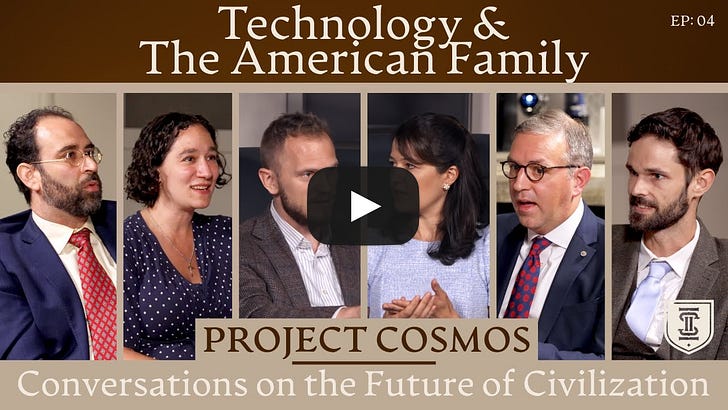
In the latest episode of Project Cosmos, Spencer Klavan, Rachel Bovard, Michael Toscano, Gladden Pappin, Leah Libresco Sargeant, and Johnny Burtka gather to discuss the impact of technology on the family unit and society at large. Their conversation covers the global race for technological supremacy, economic and family policy, the promises and perils of AI, and more.
See all episodes of Project Cosmos here.
Subscribe to our YouTube channel for more content like this.
This week, from the Collegiate Network:
ISI’s Collegiate Network supports over 80 student-run publications across the country, empowering students to run independent college newspapers, magazines, and journals that report on important issues ignored by the mainstream media.
Stanford Compromises Excellence for Inclusivity: The 100 Unit Cap Exposed via The Stanford Review
An investigation into Stanford’s decreasing academic standards driven by an unrealistic ideal of “accessibility.”
The U.S. Military’s Change of Culture: The Return to Common Sense via The Princeton Tory
An explanation of Secretary of War Pete Hegseth’s 2025 overhaul of the U.S. military, how it has driven unprecedented increases in recruitment, and how he aims to rebuild a tougher, more traditional fighting force.
The Mehra Menu: Hong Kong: Neon Skylines and Nature’s Hidden Edges via The Lemur
An exploration of Hong Kong and its unexpected contradictions between urban life and natural scenery.
Dorian Abbot’s Intellectual Navigation Class Breaks the Ideological Blockade in Academia via The Chicago Thinker
A recap of Dorian Abbott’s Freedom of Intellectual Navigation Conference, where academics known for facing censorship presented uncensored arguments on divisive issues.
What If We Have It All Wrong? via The Claremont Independent
An argument that college has drifted from its true purpose into a culture of hollow careerism, and a call for students to reject résumé-driven living.
Visit our Student Journalism section to read more from the Collegiate Network.
In Defense of the Gentleman
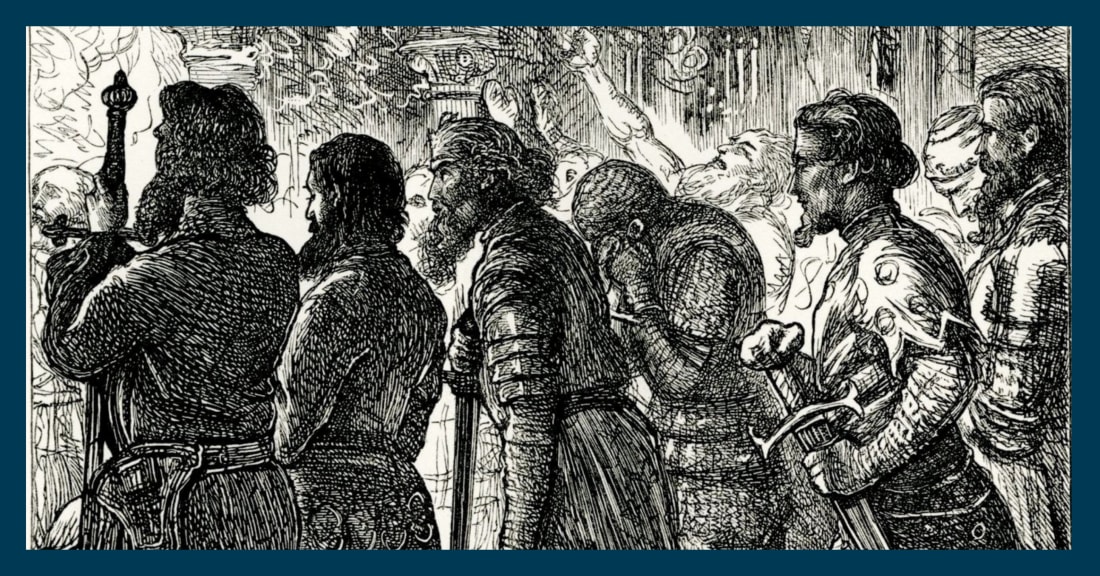 |
For centuries, the title of “gentleman” carried deep respect in the West, understood as a position of both honor and duty. Yet today, the very idea of a “gentleman” is often treated with skepticism at best and derision at worst, evoking either images of awkward bow-tied youths or slick salesmen with hidden agendas.
In this week’s essay from Modern Age, Luke Foster seeks to recover the original spirit of the gentleman. He describes the ideal as defined by some of the greatest Western minds, from Homer, Aristotle, and Cicero to Edmund Burke, John Henry Newman, and Leo Strauss. These thinkers portrayed the gentleman as one whose natural strength is exercised in defense of the weak and whose power is elevated by grace.
Foster contrasts the traditional idea of the gentleman with modern misconceptions from both the left and the right, which cast the gentleman as either a hypocrite or a weakling. He concludes that “to reanimate the spirit of a gentleman…we must recover faith in the grace that does not destroy nature but perfects it.”
Read the rest of Foster’s defense of the traditional Western gentleman here on the Modern Age website.
Modern Age is ISI’s flagship publication. Visit modernagejournal.com and subscribe to receive a free daily newsletter.
“Nothing is more certain than that our manners, our civilization, and all the good things which are connected with manners and with civilization, have, in this European world of ours, depended for ages upon two principles and were, indeed, the result of both combined: I mean the spirit of a gentleman and the spirit of religion.”
– Edmund Burke
Celebrate America’s semiquincentennial with ISI and help shape the next 250 years of our country. Your support of the America 500 Education Fund will help ISI reach, teach, and launch the next generation of conservative leaders. Visit isi.org/america500 to learn more.
| ||||||||||

