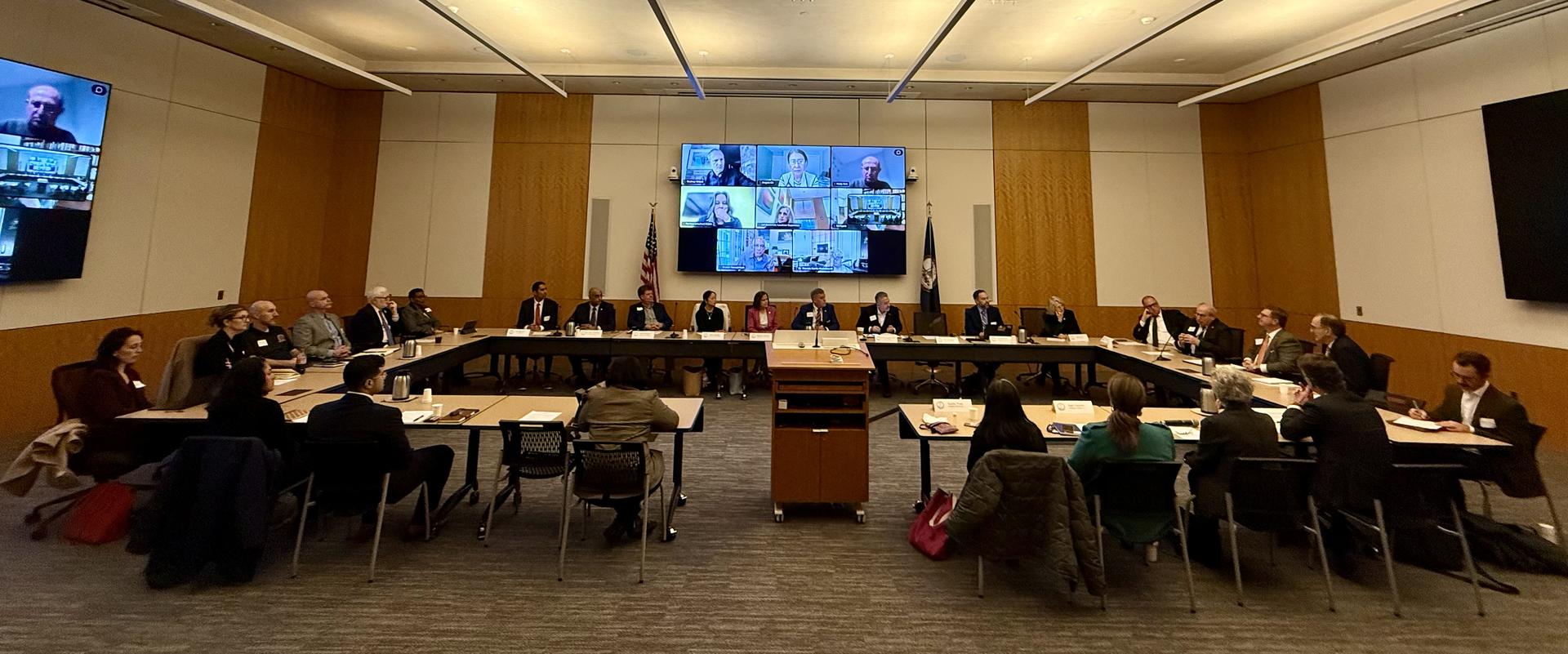
Addressing the Crisis of Hunger in Virginia
The recent federal shutdown, coupled with the damaging effects of federal actions on the nation’s Supplemental Nutrition Assistance Program (SNAP), exposed serious vulnerabilities in the Commonwealth as we work to address the issues of hunger in Virginia.
Virginia remains a state in which hunger persists despite considerable resources and effort. According to the Federation of Virginia Food Banks (Federation), roughly 1 in 8 Virginians, or about 12.1% of Virginians, are food insecure. That means hundreds of thousands of Virginians do not always know where their next meal will come from. Among children, the rates are especially troubling: one in seven children in the Commonwealth face food insecurity. Recent data from a statewide report (2025) estimates there are about 880,000 food-insecure Virginians, including roughly 238,000 children.
Given those numbers, Virginia cannot afford to view hunger as an occasional problem or rely solely on emergency food distribution. Instead, the state must build resilient systems capable of preventing hunger before it happens. A key part of that is ensuring core public nutrition programs are robust, accessible, and adequate. For example, the Supplemental Nutrition Assistance Program (SNAP) remains a critical backbone: in good times and bad, SNAP helps stabilize families so they do not slip into food insecurity. As of recent estimates, about 564,000 Virginians participate in SNAP; that number represents roughly 6.5% of the population. However, during crises such as the current period of federal funding uncertainty or benefit cuts, state-level responses must be ready.
Beyond public benefits, we must invest in an infrastructure in Virginia that supports food distribution at all times, including during non-emergency periods, most especially for rural and underserved areas. For example, the Federation reports that Virginia’s food banks distributed 175 million pounds of groceries in 2024, during a period not classified as an emergency. This level of distribution represents a massive volume, and we know that relying on charity alone is risky. Strengthening regional food hubs, investing in cold storage and logistics, and supporting local procurement (for example, from small and mid-sized farms) will help us to reinforce supply chains so that communities can respond quickly when need spikes, whether that escalation of demand is triggered by economic downturns, policy changes, or disasters. Such investment is not simply humanitarian; it also supports Virginia’s agricultural economy, our local farmers, and it reduces waste.
Data infrastructure is another area where resiliency could be improved. Today, hunger-prevention efforts in Virginia are spread across multiple agencies and nonprofits: from public schools providing free or reduced-price meals to local food banks, social-service agencies, and community organizations. That fragmentation may hamper early detection and targeted intervention. By developing a unified data-sharing platform in Virginia that helps us to coordinate social assistance, benefit receipts, school-meal usage, and emergency food demand, we would be better able to spot rising needs and deploy resources efficiently and effectively. Data-driven coordination would help to shift the state’s approach from reactive to preventative.
We must also recognize how hunger intersects with other areas of economic insecurity: housing, health care, childcare, low wages, and the rising cost of living. For many food-insecure families, the choice is not just between groceries or nothing; it is between groceries and rent, medicine, or transportation. Approaching the concerns of hunger through integrated assistance that combines food support with housing aid, job training, or child-care subsidies is more likely to stabilize families over the long run. Recent research and policy analyses increasingly point to the effectiveness of such holistic support in reducing food insecurity.
Under the broad picture, investments and policy must prioritize equity. Hunger is not evenly distributed across Virginia. According to food-bank data, Black and Hispanic households experience food insecurity at more than twice the rate of white households. Rural localities, especially in Southwest Virginia and other underserved regions, consistently rank among the areas with the highest food-insecurity rates. A resilient hunger-prevention system must ensure that funding, outreach, and resources reach those communities. These efforts should include language access concerns, simplified application processes, and support for community-based organizations that are rooted in the neighborhoods they serve.
Hunger in Virginia is a structural challenge interwoven with inequality, economic instability, and regional disparity. It is also a solvable problem. With serious investment in core public nutrition benefits, infrastructure for distribution, data-driven coordination, integrated economic supports, and equity-centered outreach, Virginia can build a hunger-prevention system resilient enough to withstand economic swings, benefit disruptions, and rising living costs. The question is not whether the tools exist because they do. The real question is when we will get the ball rolling. I am ready to work with my General Assembly colleagues and our incoming Administration to move forward with solutions to help all families in Virginia.