
Email
NEWS RELEASE: DNR Releases Its 2024 Water Withdrawal Report
| From | Wisconsin Department of Natural Resources <[email protected]> |
| Subject | NEWS RELEASE: DNR Releases Its 2024 Water Withdrawal Report |
| Date | December 9, 2025 5:02 PM |
Links have been removed from this email. Learn more in the FAQ.
Links have been removed from this email. Learn more in the FAQ.
DNR News Release Header Image [ [link removed] ]
*FOR IMMEDIATE RELEASE: *Dec. 9, 2025
*Contact: *Adam Freihoefer, DNR Water Use Section Manager
[email protected] or 608-514-6058
DNR Releases Its 2024 Water Withdrawal Report
"Report Examines Role Of Water Use In Wisconsin’s Energy Production"
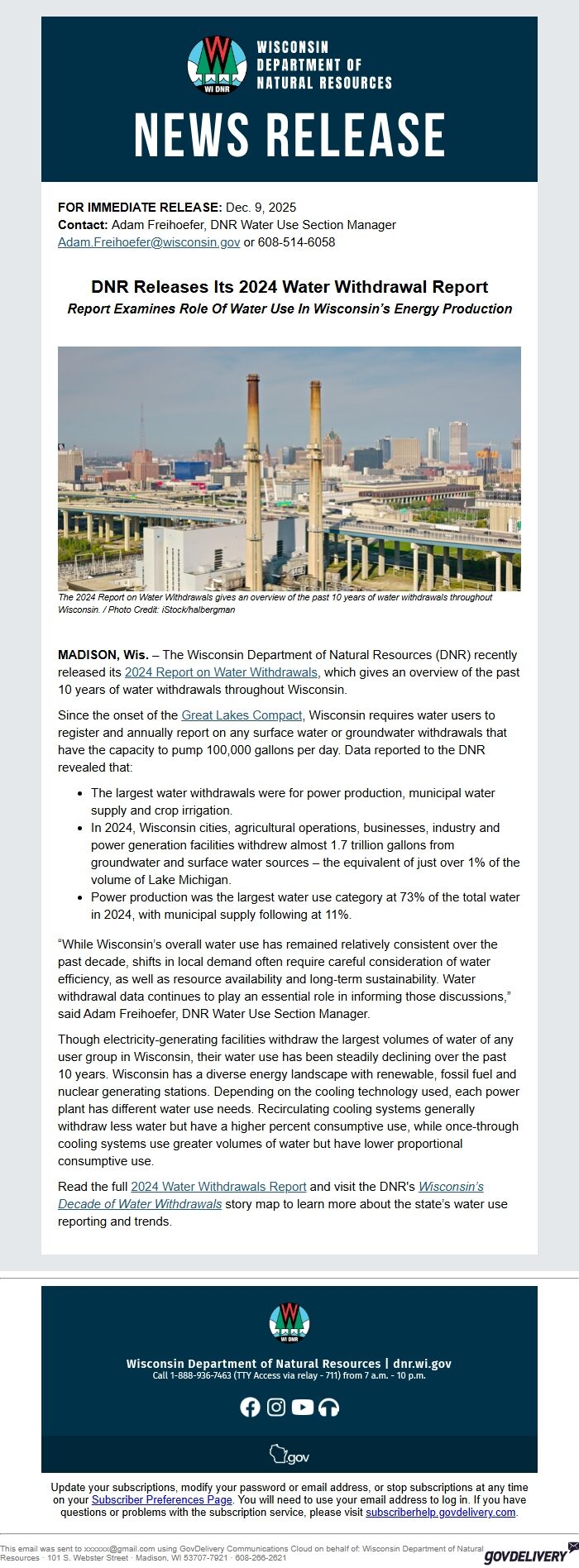
Aerial shot of downtown Milwaukee, Wisconsin on a hazy afternoon in Fall, looking past power plant chimneys and the Marquette Interchange.
The 2024 Report on Water Withdrawals gives an overview of the past 10 years of water withdrawals throughout Wisconsin. / Photo Credit: iStock/halbergman
*
MADISON, Wis.* – The Wisconsin Department of Natural Resources (DNR) recently released its 2024 Report on Water Withdrawals [ [link removed] ], which gives an overview of the past 10 years of water withdrawals throughout Wisconsin.
Since the onset of the Great Lakes Compact [ [link removed] ], Wisconsin requires water users to register and annually report on any surface water or groundwater withdrawals that have the capacity to pump 100,000 gallons per day. Data reported to the DNR revealed that:
* The largest water withdrawals were for power production, municipal water supply and crop irrigation.
* In 2024, Wisconsin cities, agricultural operations, businesses, industry and power generation facilities withdrew almost 1.7 trillion gallons from groundwater and surface water sources – the equivalent of just over 1% of the volume of Lake Michigan.
* Power production was the largest water use category at 73% of the total water in 2024, with municipal supply following at 11%.
“While Wisconsin’s overall water use has remained relatively consistent over the past decade, shifts in local demand often require careful consideration of water efficiency, as well as resource availability and long-term sustainability. Water withdrawal data continues to play an essential role in informing those discussions,” said Adam Freihoefer, DNR Water Use Section Manager.
Though electricity-generating facilities withdraw the largest volumes of water of any user group in Wisconsin, their water use has been steadily declining over the past 10 years. Wisconsin has a diverse energy landscape with renewable, fossil fuel and nuclear generating stations. Depending on the cooling technology used, each power plant has different water use needs. Recirculating cooling systems generally withdraw less water but have a higher percent consumptive use, while once-through cooling systems use greater volumes of water but have lower proportional consumptive use.
Read the full 2024 Water Withdrawals Report [ [link removed] ] and visit the DNR's "Wisconsin’s Decade of Water Withdrawals [ [link removed] ]" story map to learn more about the state’s water use reporting and trends.
________________________________________________________________________
[ [link removed] ]
[ [link removed] ]
[ [link removed] ] [ [link removed] ] [ [link removed] ] [ [link removed] ]
[ [link removed] ] Update your subscriptions, modify your password or email address, or stop subscriptions at any time on your Subscriber Preferences Page [ [link removed] ]. You will need to use your email address to log in. If you have questions or problems with the subscription service, please visit subscriberhelp.govdelivery.com [ [link removed] ].
________________________________________________________________________
This email was sent to [email protected] using GovDelivery Communications Cloud on behalf of: Wisconsin Department of Natural Resources · 101 S. Webster Street · Madison, WI 53707-7921 · 608-266-2621 GovDelivery logo [ [link removed] ]
body .abe-column-block { min-height: 5px; } table.gd_combo_table img {margin-left:10px; margin-right:10px;} table.gd_combo_table div.govd_image_display img, table.gd_combo_table td.gd_combo_image_cell img {margin-left:0px; margin-right:0px;} table.govd_hr {min-width: 100%;} p, li, h1, h2, h3 { overflow-wrap: normal; word-wrap: normal; word-break: keep-all; -moz-hyphens: none; -ms-hyphens: none; -webkit-hyphens: none; hyphens: none; mso-hyphenate: none; }
*FOR IMMEDIATE RELEASE: *Dec. 9, 2025
*Contact: *Adam Freihoefer, DNR Water Use Section Manager
[email protected] or 608-514-6058
DNR Releases Its 2024 Water Withdrawal Report
"Report Examines Role Of Water Use In Wisconsin’s Energy Production"
Aerial shot of downtown Milwaukee, Wisconsin on a hazy afternoon in Fall, looking past power plant chimneys and the Marquette Interchange.
The 2024 Report on Water Withdrawals gives an overview of the past 10 years of water withdrawals throughout Wisconsin. / Photo Credit: iStock/halbergman
*
MADISON, Wis.* – The Wisconsin Department of Natural Resources (DNR) recently released its 2024 Report on Water Withdrawals [ [link removed] ], which gives an overview of the past 10 years of water withdrawals throughout Wisconsin.
Since the onset of the Great Lakes Compact [ [link removed] ], Wisconsin requires water users to register and annually report on any surface water or groundwater withdrawals that have the capacity to pump 100,000 gallons per day. Data reported to the DNR revealed that:
* The largest water withdrawals were for power production, municipal water supply and crop irrigation.
* In 2024, Wisconsin cities, agricultural operations, businesses, industry and power generation facilities withdrew almost 1.7 trillion gallons from groundwater and surface water sources – the equivalent of just over 1% of the volume of Lake Michigan.
* Power production was the largest water use category at 73% of the total water in 2024, with municipal supply following at 11%.
“While Wisconsin’s overall water use has remained relatively consistent over the past decade, shifts in local demand often require careful consideration of water efficiency, as well as resource availability and long-term sustainability. Water withdrawal data continues to play an essential role in informing those discussions,” said Adam Freihoefer, DNR Water Use Section Manager.
Though electricity-generating facilities withdraw the largest volumes of water of any user group in Wisconsin, their water use has been steadily declining over the past 10 years. Wisconsin has a diverse energy landscape with renewable, fossil fuel and nuclear generating stations. Depending on the cooling technology used, each power plant has different water use needs. Recirculating cooling systems generally withdraw less water but have a higher percent consumptive use, while once-through cooling systems use greater volumes of water but have lower proportional consumptive use.
Read the full 2024 Water Withdrawals Report [ [link removed] ] and visit the DNR's "Wisconsin’s Decade of Water Withdrawals [ [link removed] ]" story map to learn more about the state’s water use reporting and trends.
________________________________________________________________________
[ [link removed] ]
[ [link removed] ]
[ [link removed] ] [ [link removed] ] [ [link removed] ] [ [link removed] ]
[ [link removed] ] Update your subscriptions, modify your password or email address, or stop subscriptions at any time on your Subscriber Preferences Page [ [link removed] ]. You will need to use your email address to log in. If you have questions or problems with the subscription service, please visit subscriberhelp.govdelivery.com [ [link removed] ].
________________________________________________________________________
This email was sent to [email protected] using GovDelivery Communications Cloud on behalf of: Wisconsin Department of Natural Resources · 101 S. Webster Street · Madison, WI 53707-7921 · 608-266-2621 GovDelivery logo [ [link removed] ]
body .abe-column-block { min-height: 5px; } table.gd_combo_table img {margin-left:10px; margin-right:10px;} table.gd_combo_table div.govd_image_display img, table.gd_combo_table td.gd_combo_image_cell img {margin-left:0px; margin-right:0px;} table.govd_hr {min-width: 100%;} p, li, h1, h2, h3 { overflow-wrap: normal; word-wrap: normal; word-break: keep-all; -moz-hyphens: none; -ms-hyphens: none; -webkit-hyphens: none; hyphens: none; mso-hyphenate: none; }
Message Analysis
- Sender: Wisconsin Department of Natural Resources
- Political Party: n/a
- Country: United States
- State/Locality: Wisconsin
- Office: n/a
-
Email Providers:
- govDelivery