
Email
Vandenberg's Long History of Close Calls
| From | Military-Industrial America, Inkstick Media <[email protected]> |
| Subject | Vandenberg's Long History of Close Calls |
| Date | December 9, 2025 3:09 PM |
Links have been removed from this email. Learn more in the FAQ.
Links have been removed from this email. Learn more in the FAQ.
View this post on the web at [link removed]
This is Hannah Bowlus, writing from Inkstick to give you a heads up about my recent story.
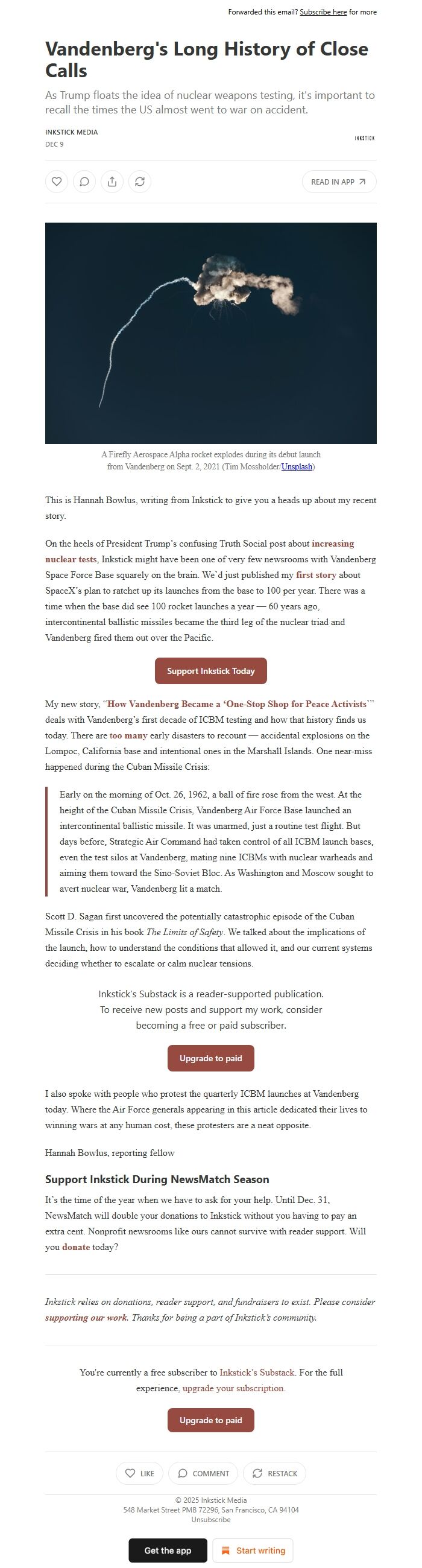
On the heels of President Trump’s confusing Truth Social post about increasing nuclear tests [ [link removed] ], Inkstick might have been one of very few newsrooms with Vandenberg Space Force Base squarely on the brain. We’d just published my first story [ [link removed] ] about SpaceX’s plan to ratchet up its launches from the base to 100 per year. There was a time when the base did see 100 rocket launches a year — 60 years ago, intercontinental ballistic missiles became the third leg of the nuclear triad and Vandenberg fired them out over the Pacific.
My new story, “How Vandenberg Became a ‘One-Stop Shop for Peace Activists [ [link removed] ]’” deals with Vandenberg’s first decade of ICBM testing and how that history finds us today. There are t [ [link removed] ]oo many [ [link removed] ] early disasters to recount — accidental explosions on the Lompoc, California base and intentional ones in the Marshall Islands. One near-miss happened during the Cuban Missile Crisis:
Early on the morning of Oct. 26, 1962, a ball of fire rose from the west. At the height of the Cuban Missile Crisis, Vandenberg Air Force Base launched an intercontinental ballistic missile. It was unarmed, just a routine test flight. But days before, Strategic Air Command had taken control of all ICBM launch bases, even the test silos at Vandenberg, mating nine ICBMs with nuclear warheads and aiming them toward the Sino-Soviet Bloc. As Washington and Moscow sought to avert nuclear war, Vandenberg lit a match.
Scott D. Sagan first uncovered the potentially catastrophic episode of the Cuban Missile Crisis in his book The Limits of Safety. We talked about the implications of the launch, how to understand the conditions that allowed it, and our current systems deciding whether to escalate or calm nuclear tensions.
Inkstick’s Substack is a reader-supported publication. To receive new posts and support my work, consider becoming a free or paid subscriber.
I also spoke with people who protest the quarterly ICBM launches at Vandenberg today. Where the Air Force generals appearing in this article dedicated their lives to winning wars at any human cost, these protesters are a neat opposite.
Hannah Bowlus, reporting fellow
Support Inkstick During NewsMatch Season
It’s the time of the year when we have to ask for your help. Until Dec. 31, NewsMatch will double your donations to Inkstick without you having to pay an extra cent. Nonprofit newsrooms like ours cannot survive with reader support. Will you donate [ [link removed] ] today?
Inkstick relies on donations, reader support, and fundraisers to exist. Please consider supporting our work [ [link removed] ]. Thanks for being a part of Inkstick’s community.
Unsubscribe [link removed]?
This is Hannah Bowlus, writing from Inkstick to give you a heads up about my recent story.
On the heels of President Trump’s confusing Truth Social post about increasing nuclear tests [ [link removed] ], Inkstick might have been one of very few newsrooms with Vandenberg Space Force Base squarely on the brain. We’d just published my first story [ [link removed] ] about SpaceX’s plan to ratchet up its launches from the base to 100 per year. There was a time when the base did see 100 rocket launches a year — 60 years ago, intercontinental ballistic missiles became the third leg of the nuclear triad and Vandenberg fired them out over the Pacific.
My new story, “How Vandenberg Became a ‘One-Stop Shop for Peace Activists [ [link removed] ]’” deals with Vandenberg’s first decade of ICBM testing and how that history finds us today. There are t [ [link removed] ]oo many [ [link removed] ] early disasters to recount — accidental explosions on the Lompoc, California base and intentional ones in the Marshall Islands. One near-miss happened during the Cuban Missile Crisis:
Early on the morning of Oct. 26, 1962, a ball of fire rose from the west. At the height of the Cuban Missile Crisis, Vandenberg Air Force Base launched an intercontinental ballistic missile. It was unarmed, just a routine test flight. But days before, Strategic Air Command had taken control of all ICBM launch bases, even the test silos at Vandenberg, mating nine ICBMs with nuclear warheads and aiming them toward the Sino-Soviet Bloc. As Washington and Moscow sought to avert nuclear war, Vandenberg lit a match.
Scott D. Sagan first uncovered the potentially catastrophic episode of the Cuban Missile Crisis in his book The Limits of Safety. We talked about the implications of the launch, how to understand the conditions that allowed it, and our current systems deciding whether to escalate or calm nuclear tensions.
Inkstick’s Substack is a reader-supported publication. To receive new posts and support my work, consider becoming a free or paid subscriber.
I also spoke with people who protest the quarterly ICBM launches at Vandenberg today. Where the Air Force generals appearing in this article dedicated their lives to winning wars at any human cost, these protesters are a neat opposite.
Hannah Bowlus, reporting fellow
Support Inkstick During NewsMatch Season
It’s the time of the year when we have to ask for your help. Until Dec. 31, NewsMatch will double your donations to Inkstick without you having to pay an extra cent. Nonprofit newsrooms like ours cannot survive with reader support. Will you donate [ [link removed] ] today?
Inkstick relies on donations, reader support, and fundraisers to exist. Please consider supporting our work [ [link removed] ]. Thanks for being a part of Inkstick’s community.
Unsubscribe [link removed]?
Message Analysis
- Sender: n/a
- Political Party: n/a
- Country: n/a
- State/Locality: n/a
- Office: n/a