|
Hi Friend,
I know you’re busy, so if
you’re not interested in the Government’s replacement to the Resource
Management Act, feel free to delete this email.
But I know for many of our supporters, the RMA is
important. It is New Zealand's biggest regulatory tax and the
most significant handbrake on our country's economic prosperity and
living standards.
I’m just back from a Beehive “lock-up” where
about 100 journalists and analysts have been working through the
Government’s just-released replacement to the RMA.
Planning law is inherently difficult, detailed,
and technical. Having only had the material for a few hours, we don’t
pretend to have our head around all the detail – but I wanted
to get to you the source material rather than wait.
As we worked through the
eight press releases, 11
“Fact Sheets”, and the 40-page “Overview”
document, we liked what we saw.
The actual bills – a Planning
Bill and Environment
Bill – amount to nearly 800 pages.
If you’re looking
for a broad overview of the reforms, I recommend this ‘Overview’ to
get up to speed.
Summary:
If Chris Bishop delivers what he has said he
wants to, he will cement himself as the boldest reforming Minister of
the current Government.
These proposals will, more than any
other reform since the introduction of MMP, ‘fix’ both New Zealand’s
lack of housing affordability and infrastructure deficit. Both have
been seeded by the RMA handbrake.
Based on the summaries provided by officials,
Minister Bishop and his second-in-command on this project, ACT’s Simon
Court, are on track. But there is a long way to go to amend the Bills
at the Select Committee in the first half of next year to get to where
they set out to get to: a regime based on property rights sitting at
the centre.
Key
features of the new system include:
-
Fewer effects
managed
- Many
currently considered effects will be removed from scope, including
internal site matters, retail distribution effects, visual amenity,
competition impacts and the financial viability of a
project.
-
Fewer
consents
- Fewer
activity categories, with low-impact activities no longer requiring
consent.
-
More
proportionate conditions
- All
consent conditions must be necessary and proportionate, reducing red
tape.
-
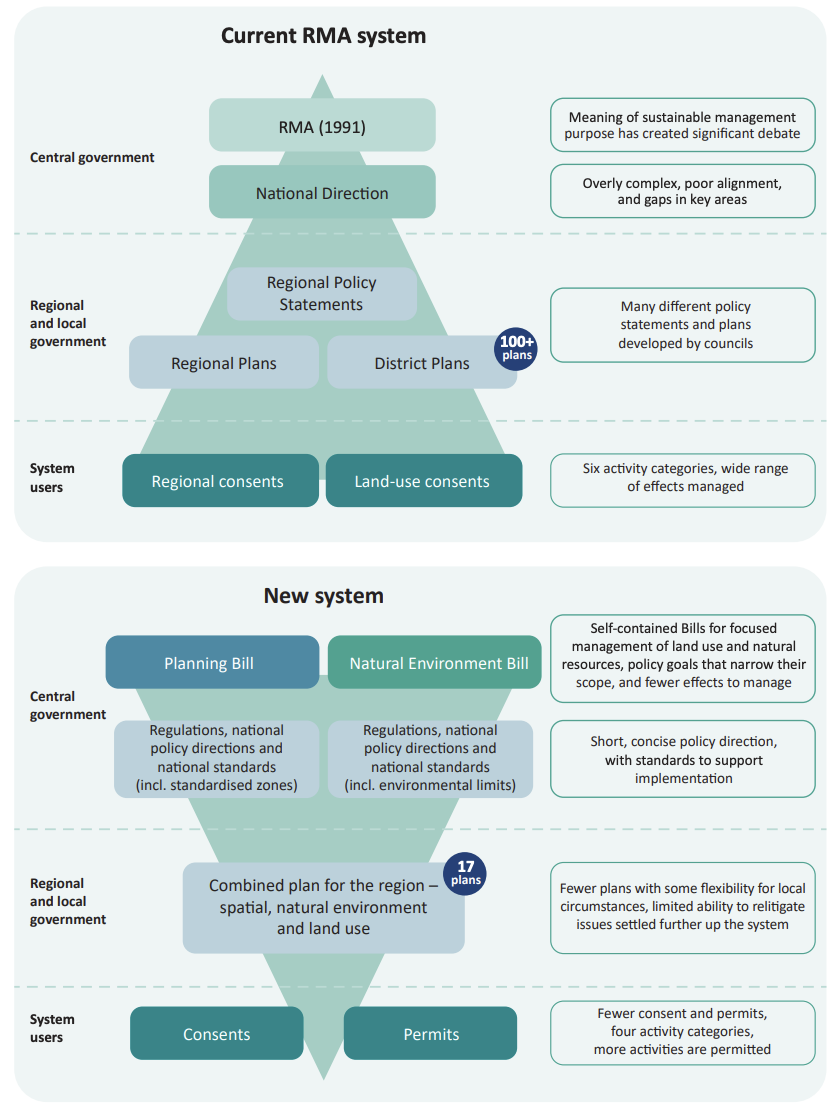
Fewer
plans
- More than
100 existing plans will be reduced to 17 regional combined plans that
bring together spatial, land use and natural environment planning in
one place, making it easier for New Zealanders to know what they can
do with their property.
-
Spatial
planning
- 30-year
regional spatial plans to identify growth areas, infrastructure
corridors and areas requiring protection.
-
Faster
plan-making
- Plan
development time will fall from an average of 6 to 7 years to around 2
years for a regional combined plan.
-
Standardised
zones
- A major
reduction from 1,175 bespoke zones to a nationally consistent set
decided by central government.
-
National
standards
- A
comprehensive suite of national standards for common activities to
reduce costs and speed up consenting.
-
Regulatory
relief
- When
imposing significant restrictions, such as heritage protections and
significant natural areas, councils must provide practical relief
mechanisms.
-
Clearer
consultation requirements
- Clarity
about who must be consulted and when, including iwi.
-
Faster
conflict resolution
- A new
Planning Tribunal to resolve straightforward disputes quickly and at
low cost.
-
Clear
environmental limits
- Clear
limits to support community decision making, improve efficient
resource use and reduce unnecessary application costs.
-
Better, more
consistent enforcement
- Centralised oversight to ensure consistent and effective
enforcement across the country.
In his speech, Minister Bishop talked a
lot about the new funnel approach making the system more directive
from the top, ensuring consistency across the country, and allowing
local communities to focus on applying that approach in their
area.
The documents state: "It would make
decision-making more focused at each stage of the planning system. As
the process narrows, fewer things would be up for debate, saving time
and money. It would also give people greater certainty about what they
can and can’t do, helping them understand likely outcomes before they
begin."
Our Initial
Observations:
Property rights are the cornerstone of a liberal
democracy, and a return to a property rights based system is contained
in the Government’s coalition agreements. But while officials have
clearly been instructed to develop various systems that adhere more
closely to the principle (such as limiting the scope of what planning
rules, and councils can actually regulate), the “property rights”
concept is conspicuously absent in the Bills. An obvious area to dig
into.
For some regulatory takings – such as
natural heritage and significant natural area overlays (that impact on
the value and potential use for a landowner) – it is proposed that
councils will be required to compensate with what the Bills call
“Regulatory Relief”. It is an excellent principle, but the scope of
the regime is not nearly wide enough. But it will mean that councils
will need to start considering the costs when they get out
the highlighter and change what you can do on your land because of
their preferences. Councils are going to hate
this!
The interface with the Treaty is also extremely
technical (and vulnerable to capture by vested interests). The
difficulty faced by Ministers is that some Treaty settlements give
special rights to iwi based on the current regime. Much of the detail
on how those are resolved are yet to be worked through, but the
direction of travel should be welcomed: Ministers want the early
identification of rights and obligations, rather than unclear
‘principle based’ legal requirements that are vulnerable to abuse and
rent seeking.
As the Bills stand, councils will not be required
to broadly ‘give effect’ to the Treaty but will have firmer, more
defined obligations to consult and identify areas of special interests
to local iwi.
While some special interests will complain,
clarity will clearly be applauded by others (both Maori and
non-Maori).
Conclusion:
The test is whether the details buried in the
Bills reflect the political rhetoric about getting 'clipboard man' (or
woman) out of the way and 'go for growth'. That’s what we’ll be
working through with our expert advisors in the weeks to
come.
But one thing is for sure: for the
homeowner in the Hutt who battled the Council for eight months because
a faceless planner didn’t like that his proposal to replace an
existing garage didn’t match the design and colour of his house (yes,
seriously!), these reforms are a major step in the right
direction. Ditto taxpayers paying $1.3 billion per
year ($634 per household) just for consenting
infrastructure – this is a major step forward.
The
RMA is one of the big kahuna items the Taxpayers’ Union has long
fought on. We’ll have our heads down over summer, and keep you in
the loop before submissions close early in the New Year.
Thank you for your support.
 |

Jordan
Williams
Executive Director
New Zealand
Taxpayers’ Union
|
Ps. Big
week this week - tomorrow the last Taxpayers' Union-Curia Poll of 2025
is released, and on Thursday, we plan to launch a very sweet (and
suddenly widely anticipated!) campaign to highlight the Government's
fiscal truths.
|
