|
 |
Get all access now and save 30% when you upgrade to become a paid subscriber today. Your subscription upgrade is a direct investment in defending democracy, helping Lincoln Square build a pro-democracy media machine to fight disinformation and inform voters with the facts.—We’ll also gift you $20 in Lincoln Bucks to use in our pro-democracy merchandise store for the holidays.
Justice Department Quietly Removes Indigenous Violence Report Under Trump Order
Officials say compliance with a new gender-definition executive order required taking down a federally mandated report on missing and murdered Indigenous people.
|
| |||||||||||||||


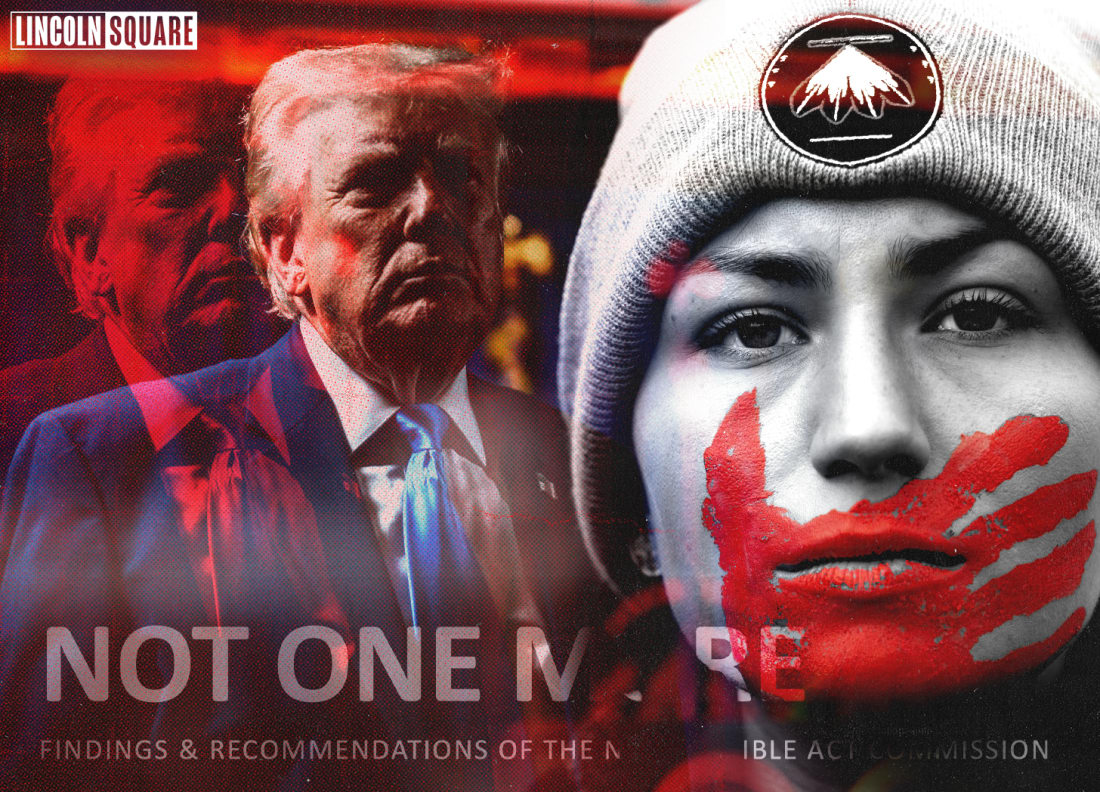 |
A congressionally mandated report on missing and murdered Indigenous people was removed from the Justice Department’s website under a Trump-era executive order, drawing bipartisan concern from lawmakers and Indigenous advocates who want the document restored.
The Justice Department removed a 212-page report on missing and murdered Indigenous people from its website in February, saying the action followed guidance from the U.S. Office of Personnel Management on implementing President Donald J. Trump’s executive order on gender definitions, according to department statements and a congressional letter.
The report titled, “Not One More: Findings and Recommendations of the Not Invisible Act Commission,” was created under the Not Invisible Act, bipartisan legislation signed by Mr. Trump in 2020 requiring the Justice and Interior Departments to address persistently high rates of violence affecting American Indian and Alaska Native people.
Lawmakers and tribal leaders say the removal weakens a congressionally directed effort to document the crisis of missing and murdered Indigenous people and to coordinate law-enforcement, public-health and victim-services responses nationwide, even though advocacy groups continue to host copies.
Under federal procedure, the Office of Personnel Management issues guidance directing agencies on how to apply executive orders to personnel training, internal communications and public-facing materials. Justice Department officials said they interpreted that guidance as requiring the removal or revision of documents they believed might conflict with the executive order’s definitions of sex and gender.
Federal documents maintained by advocacy organizations say the Not Invisible Act Commission brought together tribal leaders, survivors, family members, law-enforcement officials and service providers to identify failures in response systems affecting Native communities.
In a joint response submitted to Congress in 2024, the Justice and Interior Departments reported that the commission held national hearings—both virtual and in person—with testimony from at least 260 witnesses. Nearly 600 people attended seven listening sessions across the country, according to the federal response.
The federal response said the commission issued roughly 300 recommendations, including 148 directed to the Justice Department and 48 to the Interior Department, with the remaining recommendations aimed at agencies and institutions involved in public safety, data collection and victim services. A brief explanatory note in the response said the recommendations reflected areas where federal and non-federal systems had diverged.
Congressional materials accompanying the response cited federal data showing that more than 84 percent of Native American and Alaska Native men and women experience violence in their lifetimes and that homicide remains a leading cause of death for Native women, underscoring the severity of the crisis the commission documented.
In Oklahoma, Carmen Harvie, president of the Missing and Murdered Indigenous People Oklahoma chapter, said she served on the commission as a family member of someone who was murdered and helped develop the report to improve law-enforcement resources and expand community-support programs.
“This is to help people,” Ms. Harvie told KFOR, describing the report as a tool to guide funding and assist families. She said removing it from a federal website was “very disrespectful to our people, especially coming from our government.”
A Justice Department spokesperson told national and local outlets that the department removed the report to ensure compliance with Office of Personnel Management guidance implementing the executive order. The spokesperson said the joint Justice and Interior Department response to the commission’s findings remains available on the department’s Tribal Justice and Safety pages.
The Not Invisible Act requires the Interior and Justice Departments to assemble a commission that includes both federal officials and non-federal members such as tribal representatives, law-enforcement officers and family members of missing or murdered individuals to improve coordination across jurisdictions.
In written testimony submitted to Congress this year, Justice Department officials said the commission’s findings were informed by the experiences of Indigenous survivors and families and represented “the culmination of over a year’s worth of efforts” to document long-standing failures in public-safety systems.

The removal has drawn attention on Capitol Hill. Representative Sharice Davids of Kansas and other members of Congress sent a letter in July urging Attorney General Pamela Bondi to restore the document, saying the report does not promote gender ideology or conflict with the executive order.
Senators Catherine Cortez Masto of Nevada and Lisa Murkowski of Alaska have also questioned the removal and the status of related laws, including Savanna’s Act, saying the federal government has not met its obligations to address what they describe as an epidemic of violence against Indigenous people.
Multiple outlets, including The Guardian and KNBA, have reported that other federal webpages containing diversity, equity and inclusion materials or resources related to Indigenous communities have been altered or removed in recent months. Advocacy organizations such as the National Indigenous Women’s Resource Center and the Center for Native American Youth say they continue to host copies of federal reports to ensure access for families and tribal governments.
In Oklahoma, State Representative Ronald Stewart, a Democrat from Tulsa, said he amended state legislation to allow funding for the state Office of Liaison for Missing and Murdered Indigenous People. He said he supported the change before the report was removed and that he was encouraged lawmakers backed the measure.
Mr. Stewart said the crisis of missing and murdered Indigenous people spans generations and predates current political debates, adding that, in his view, state and tribal responses must continue regardless of changes to federal websites or agency pages.
Local and national organizations focused on missing and murdered Indigenous people say they continue to assist families and track cases using their own records and hosted copies of the commission’s report while urging the Justice Department to restore the document publicly.
“We’re going to continue to do our work for people because it’s a need and we know that our people need help,” Ms. Harvie said.
Brian Daitzman is the Editor of The Intellectualist. Read the original article here.
References
(References kept identical to the validated list—URLs are cleaned, real, and track-free.)
U.S. House of Representatives — Office of Rep. Gwen Moore and Rep. Sharice Davids | July 9, 2025 | “Members of Congress Urge DOJ to Restore ‘Not One More’ Report on Missing and Murdered Indigenous Persons” | https://gwenmoore.house.gov/uploadedfiles/final_not_invisible_act_letter.pdf
DOJ & DOI | March 5, 2024 | “Section 4(c)(2)(C) Response to ‘Not One More’ Report” | https://www.niwrc.org/sites/default/files/NIAC%20Final%20Report_03-05-2024_508.pdf
U.S. Senate Committee on Indian Affairs | 2024 | “S. Hrg. 118–440: Examining the Federal Response to the MMIP Crisis” | https://www.congress.gov/118/chrg/CHRG-118shrg57060/CHRG-118shrg57060.pdf
U.S. Department of Justice | 2024 | “DOJ and DOI Response to ‘Not One More’” | https://www.justice.gov/tribal/media/1341181
NIWRC | 2025 | “Not Invisible Act Commission — Final Report Resources” | https://www.niwrc.org/not-invisible-act-commission
Center for Native American Youth | 2025 | “Not Invisible Act Resources” | https://www.cnay.org/resources/not-invisible-act/
Aspen Public Radio | March 26, 2024 | “Federal Government Releases Response to MMIP Report” | https://www.aspenpublicradio.org/government/2024-03-26/the-federal-government-releases-their-response-to-a-2023-nationwide-report-on-the-mmip-crisis
The Guardian | March 20, 2025 | “‘A Slap in the Face’: Activists Reel as Report Removed” | https://www.theguardian.com/us-news/2025/mar/20/trump-missing-murdered-indigenous-peoples-report-removed
Turtle Talk | February 13, 2025 | “NIAC Final Report Removed From DOJ Website” | https://turtletalk.blog/2025/02/13/not-one-more-the-not-invisible-act-commission-final-report-removed-from-doj-wesbite/
KFOR / Yahoo News | November 24, 2025 | “Missing and Murdered Indigenous People Report Removal Sparks Concern” | https://www.yahoo.com/news/missing-murdered-indigenous-people-report-113317930.html
 |
 | A guest post by
|
You’re currently a free subscriber to Lincoln Square Media. For full access to our content, our Lincoln Loyal community, and to help us amplify the facts about the assault on our rights and freedoms, please consider upgrading your subscription today with this limited-time offer. Lock in this special holiday rate today. Offer Ends 12/31
Not ready to subscribe? Make a one-time donation of $10 or more to support our work amplifying the facts on social media, targeted to voters in red states and districts that we can help flip. Every $10 reaches 1000 Americans. The Truth needs a voice. Your donation will help us amplify it.
Want to help amplify this post? Please leave a comment and tell us what you think.
| ||||||||||

