
| From | Hudson Institute Weekend Reads <[email protected]> |
| Subject | Securing America’s Medical Supply Chains |
| Date | December 6, 2025 2:00 PM |
Links have been removed from this email. Learn more in the FAQ.
Links have been removed from this email. Learn more in the FAQ.
No images? Click here [link removed]
Weekend Reads
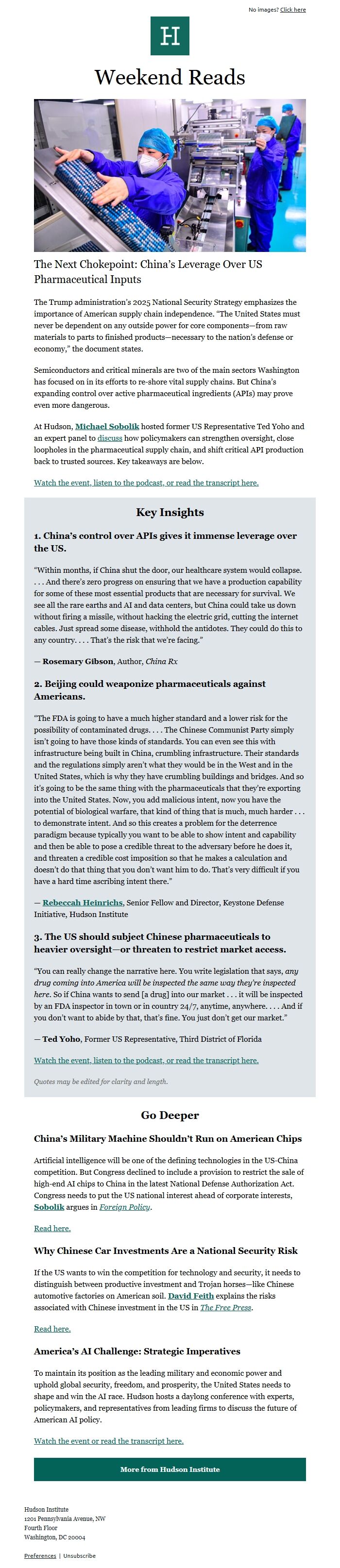
The Next Chokepoint: China’s Leverage Over US Pharmaceutical Inputs [[link removed]]
The Trump administration’s 2025 National Security Strategy emphasizes the importance of American supply chain independence. “The United States must never be dependent on any outside power for core components—from raw materials to parts to finished products—necessary to the nation’s defense or economy,” the document states.
Semiconductors and critical minerals are two of the main sectors Washington has focused on in its efforts to re-shore vital supply chains. But China’s expanding control over active pharmaceutical ingredients (APIs) may prove even more dangerous.
At Hudson, Michael Sobolik [[link removed]] hosted former US Representative Ted Yoho and an expert panel to discuss [[link removed]] how policymakers can strengthen oversight, close loopholes in the pharmaceutical supply chain, and shift critical API production back to trusted sources. Key takeaways are below.
Watch the event, listen to the podcast, or read the transcript here. [[link removed]]
Key Insights
1. China’s control over APIs gives it immense leverage over the US.
“Within months, if China shut the door, our healthcare system would collapse. . . . And there’s zero progress on ensuring that we have a production capability for some of these most essential products that are necessary for survival. We see all the rare earths and AI and data centers, but China could take us down without firing a missile, without hacking the electric grid, cutting the internet cables. Just spread some disease, withhold the antidotes. They could do this to any country. . . . That’s the risk that we’re facing.”
— Rosemary Gibson, Author, China Rx
2. Beijing could weaponize pharmaceuticals against Americans.
“The FDA is going to have a much higher standard and a lower risk for the possibility of contaminated drugs. . . . The Chinese Communist Party simply isn’t going to have those kinds of standards. You can even see this with infrastructure being built in China, crumbling infrastructure. Their standards and the regulations simply aren’t what they would be in the West and in the United States, which is why they have crumbling buildings and bridges. And so it’s going to be the same thing with the pharmaceuticals that they’re exporting into the United States. Now, you add malicious intent, now you have the potential of biological warfare, that kind of thing that is much, much harder . . . to demonstrate intent. And so this creates a problem for the deterrence paradigm because typically you want to be able to show intent and capability and then be able to pose a credible threat to the adversary before he does it, and threaten a credible cost imposition so that he makes a calculation and doesn’t do that thing that you don’t want him to do. That’s very difficult if you have a hard time ascribing intent there.”
— Rebeccah Heinrichs [[link removed]], Senior Fellow and Director, Keystone Defense Initiative, Hudson Institute
3. The US should subject Chinese pharmaceuticals to heavier oversight—or threaten to restrict market access.
“You can really change the narrative here. You write legislation that says, any drug coming into America will be inspected the same way they’re inspected here. So if China wants to send [a drug] into our market . . . it will be inspected by an FDA inspector in town or in country 24/7, anytime, anywhere. . . . And if you don’t want to abide by that, that’s fine. You just don’t get our market.”
— Ted Yoho, Former US Representative, Third District of Florida
Watch the event, listen to the podcast, or read the transcript here. [[link removed]]
Quotes may be edited for clarity and length.
Go Deeper
China’s Military Machine Shouldn’t Run on American Chips [[link removed]]
Artificial intelligence will be one of the defining technologies in the US-China competition. But Congress declined to include a provision to restrict the sale of high-end AI chips to China in the latest National Defense Authorization Act. Congress needs to put the US national interest ahead of corporate interests, Sobolik [[link removed]] argues in Foreign Policy [[link removed]].
Read here. [[link removed]]
Why Chinese Car Investments Are a National Security Risk [[link removed]]
If the US wants to win the competition for technology and security, it needs to distinguish between productive investment and Trojan horses—like Chinese automotive factories on American soil. David Feith [[link removed]] explains the risks associated with Chinese investment in the US in The Free Press [[link removed]].
Read here. [[link removed]]
America’s AI Challenge: Strategic Imperatives [[link removed]]
To maintain its position as the leading military and economic power and uphold global security, freedom, and prosperity, the United States needs to shape and win the AI race. Hudson hosts a daylong conference with experts, policymakers, and representatives from leading firms to discuss the future of American AI policy.
Watch the event or read the transcript here. [[link removed]]
More from Hudson Institute [[link removed]]
Hudson Institute
1201 Pennsylvania Avenue, NW
Fourth Floor
Washington, DC 20004
Preferences [link removed] | Unsubscribe [link removed]
Weekend Reads
The Next Chokepoint: China’s Leverage Over US Pharmaceutical Inputs [[link removed]]
The Trump administration’s 2025 National Security Strategy emphasizes the importance of American supply chain independence. “The United States must never be dependent on any outside power for core components—from raw materials to parts to finished products—necessary to the nation’s defense or economy,” the document states.
Semiconductors and critical minerals are two of the main sectors Washington has focused on in its efforts to re-shore vital supply chains. But China’s expanding control over active pharmaceutical ingredients (APIs) may prove even more dangerous.
At Hudson, Michael Sobolik [[link removed]] hosted former US Representative Ted Yoho and an expert panel to discuss [[link removed]] how policymakers can strengthen oversight, close loopholes in the pharmaceutical supply chain, and shift critical API production back to trusted sources. Key takeaways are below.
Watch the event, listen to the podcast, or read the transcript here. [[link removed]]
Key Insights
1. China’s control over APIs gives it immense leverage over the US.
“Within months, if China shut the door, our healthcare system would collapse. . . . And there’s zero progress on ensuring that we have a production capability for some of these most essential products that are necessary for survival. We see all the rare earths and AI and data centers, but China could take us down without firing a missile, without hacking the electric grid, cutting the internet cables. Just spread some disease, withhold the antidotes. They could do this to any country. . . . That’s the risk that we’re facing.”
— Rosemary Gibson, Author, China Rx
2. Beijing could weaponize pharmaceuticals against Americans.
“The FDA is going to have a much higher standard and a lower risk for the possibility of contaminated drugs. . . . The Chinese Communist Party simply isn’t going to have those kinds of standards. You can even see this with infrastructure being built in China, crumbling infrastructure. Their standards and the regulations simply aren’t what they would be in the West and in the United States, which is why they have crumbling buildings and bridges. And so it’s going to be the same thing with the pharmaceuticals that they’re exporting into the United States. Now, you add malicious intent, now you have the potential of biological warfare, that kind of thing that is much, much harder . . . to demonstrate intent. And so this creates a problem for the deterrence paradigm because typically you want to be able to show intent and capability and then be able to pose a credible threat to the adversary before he does it, and threaten a credible cost imposition so that he makes a calculation and doesn’t do that thing that you don’t want him to do. That’s very difficult if you have a hard time ascribing intent there.”
— Rebeccah Heinrichs [[link removed]], Senior Fellow and Director, Keystone Defense Initiative, Hudson Institute
3. The US should subject Chinese pharmaceuticals to heavier oversight—or threaten to restrict market access.
“You can really change the narrative here. You write legislation that says, any drug coming into America will be inspected the same way they’re inspected here. So if China wants to send [a drug] into our market . . . it will be inspected by an FDA inspector in town or in country 24/7, anytime, anywhere. . . . And if you don’t want to abide by that, that’s fine. You just don’t get our market.”
— Ted Yoho, Former US Representative, Third District of Florida
Watch the event, listen to the podcast, or read the transcript here. [[link removed]]
Quotes may be edited for clarity and length.
Go Deeper
China’s Military Machine Shouldn’t Run on American Chips [[link removed]]
Artificial intelligence will be one of the defining technologies in the US-China competition. But Congress declined to include a provision to restrict the sale of high-end AI chips to China in the latest National Defense Authorization Act. Congress needs to put the US national interest ahead of corporate interests, Sobolik [[link removed]] argues in Foreign Policy [[link removed]].
Read here. [[link removed]]
Why Chinese Car Investments Are a National Security Risk [[link removed]]
If the US wants to win the competition for technology and security, it needs to distinguish between productive investment and Trojan horses—like Chinese automotive factories on American soil. David Feith [[link removed]] explains the risks associated with Chinese investment in the US in The Free Press [[link removed]].
Read here. [[link removed]]
America’s AI Challenge: Strategic Imperatives [[link removed]]
To maintain its position as the leading military and economic power and uphold global security, freedom, and prosperity, the United States needs to shape and win the AI race. Hudson hosts a daylong conference with experts, policymakers, and representatives from leading firms to discuss the future of American AI policy.
Watch the event or read the transcript here. [[link removed]]
More from Hudson Institute [[link removed]]
Hudson Institute
1201 Pennsylvania Avenue, NW
Fourth Floor
Washington, DC 20004
Preferences [link removed] | Unsubscribe [link removed]
Message Analysis
- Sender: Hudson Institute
- Political Party: n/a
- Country: United States
- State/Locality: n/a
- Office: n/a
-
Email Providers:
- Campaign Monitor