
Email
Advent Hope w/ Robby Jones
| From | William Barber & Jonathan Wilson-Hartgrove <[email protected]> |
| Subject | Advent Hope w/ Robby Jones |
| Date | December 5, 2025 5:50 PM |
Links have been removed from this email. Learn more in the FAQ.
Links have been removed from this email. Learn more in the FAQ.
View this post on the web at [link removed]
Today we had our first conversation in our Advent in a Time of Authoritarianism [ [link removed] ] series. (We ask you to please pray for Bishop Barber; he’s recovering from a kidney stone.)
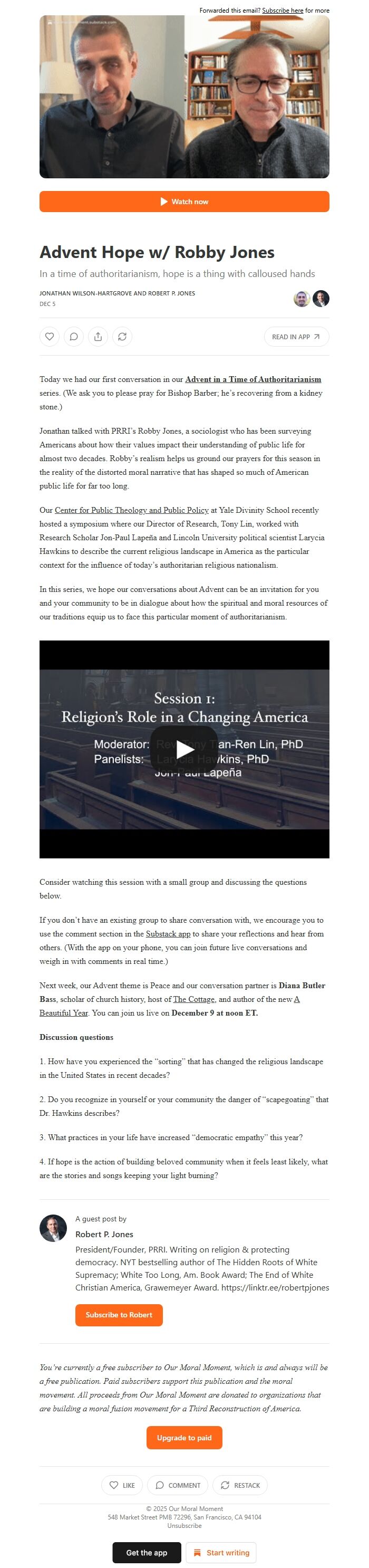
Jonathan talked with PRRI’s Robby Jones, a sociologist who has been surveying Americans about how their values impact their understanding of public life for almost two decades. Robby’s realism helps us ground our prayers for this season in the reality of the distorted moral narrative that has shaped so much of American public life for far too long.
Our Center for Public Theology and Public Policy [ [link removed] ] at Yale Divinity School recently hosted a symposium where our Director of Research, Tony Lin, worked with Research Scholar Jon-Paul Lapeña and Lincoln University political scientist Larycia Hawkins to describe the current religious landscape in America as the particular context for the influence of today’s authoritarian religious nationalism.
In this series, we hope our conversations about Advent can be an invitation for you and your community to be in dialogue about how the spiritual and moral resources of our traditions equip us to face this particular moment of authoritarianism.
Consider watching this session with a small group and discussing the questions below.
If you don’t have an existing group to share conversation with, we encourage you to use the comment section in the Substack app [ [link removed] ] to share your reflections and hear from others. (With the app on your phone, you can join future live conversations and weigh in with comments in real time.)
Next week, our Advent theme is Peace and our conversation partner is Diana Butler Bass, scholar of church history, host of The Cottage [ [link removed] ], and author of the new A Beautiful Year [ [link removed] ]. You can join us live on December 9 at noon ET.
Discussion questions
1. How have you experienced the “sorting” that has changed the religious landscape in the United States in recent decades?
2. Do you recognize in yourself or your community the danger of “scapegoating” that Dr. Hawkins describes?
3. What practices in your life have increased “democratic empathy” this year?
4. If hope is the action of building beloved community when it feels least likely, what are the stories and songs keeping your light burning?
Unsubscribe [link removed]?
Today we had our first conversation in our Advent in a Time of Authoritarianism [ [link removed] ] series. (We ask you to please pray for Bishop Barber; he’s recovering from a kidney stone.)
Jonathan talked with PRRI’s Robby Jones, a sociologist who has been surveying Americans about how their values impact their understanding of public life for almost two decades. Robby’s realism helps us ground our prayers for this season in the reality of the distorted moral narrative that has shaped so much of American public life for far too long.
Our Center for Public Theology and Public Policy [ [link removed] ] at Yale Divinity School recently hosted a symposium where our Director of Research, Tony Lin, worked with Research Scholar Jon-Paul Lapeña and Lincoln University political scientist Larycia Hawkins to describe the current religious landscape in America as the particular context for the influence of today’s authoritarian religious nationalism.
In this series, we hope our conversations about Advent can be an invitation for you and your community to be in dialogue about how the spiritual and moral resources of our traditions equip us to face this particular moment of authoritarianism.
Consider watching this session with a small group and discussing the questions below.
If you don’t have an existing group to share conversation with, we encourage you to use the comment section in the Substack app [ [link removed] ] to share your reflections and hear from others. (With the app on your phone, you can join future live conversations and weigh in with comments in real time.)
Next week, our Advent theme is Peace and our conversation partner is Diana Butler Bass, scholar of church history, host of The Cottage [ [link removed] ], and author of the new A Beautiful Year [ [link removed] ]. You can join us live on December 9 at noon ET.
Discussion questions
1. How have you experienced the “sorting” that has changed the religious landscape in the United States in recent decades?
2. Do you recognize in yourself or your community the danger of “scapegoating” that Dr. Hawkins describes?
3. What practices in your life have increased “democratic empathy” this year?
4. If hope is the action of building beloved community when it feels least likely, what are the stories and songs keeping your light burning?
Unsubscribe [link removed]?
Message Analysis
- Sender: n/a
- Political Party: n/a
- Country: n/a
- State/Locality: n/a
- Office: n/a