|
 |
Inside the House GOP divide on a federal AI moratorium, how Democrats’ dark money was spent in 2024, and more
How Sens. Tom Cotton and Chuck Grassley stopped a Biden amnesty, what Sen. Tim Scott thought about his NVIDIA meeting, Rep. Pete Sessions on housing prices, and more!
|

| |||||||||||||||


For advertising opportunities to reach our audience of center-right policymakers, contact [email protected]
December 4th, 2025
Let’s dive in.
INTERVIEW: Thirteen House Republicans debate a federal moratorium on AI and discuss lessons from the Schumer Shutdown
Heard on the Hill
EDITORIAL: David Sacks deserves praise for his public service, not smears from the press
EXCLUSIVE: How Democrats’ Sixteen Thirty Fund poured almost $20 million in 2024; Republicans brace for a repeat in spending onslaught
EXCLUSIVE: How Sen. Tom Cotton stopped Biden from giving citizenship to Afghan migrants
SCOOP: Democratic Senate candidate’s home county partners with ICE to deport illegal immigrants
SCOOP: What Americans Googled in 2025
SCOOP: Sen. Tim Scott’s takeaway from his closed-door meeting with NVIDIA CEO Jensen Huang
OPINIONATED: Rep. Pete Sessions on how House Republicans are tackling housing prices and Andrew Langer on the possible Paramount-Warner Brothers merger
If you have a tip you would like to anonymously submit, please use our tip form — your anonymity is guaranteed!
A message from our sponsor.
 |
Americans want clear, transparent information, expert guidance, and real access – not government-restricted options.
Cut through the noise and listen to the overwhelming majority.
America is stronger with the freedom to protect our health.
Learn more: fightinfectiousdisease.org
 |
INTERVIEW: Thirteen House Republicans debate a federal moratorium on AI and discuss lessons from the Schumer Shutdown
by Matthew Foldi
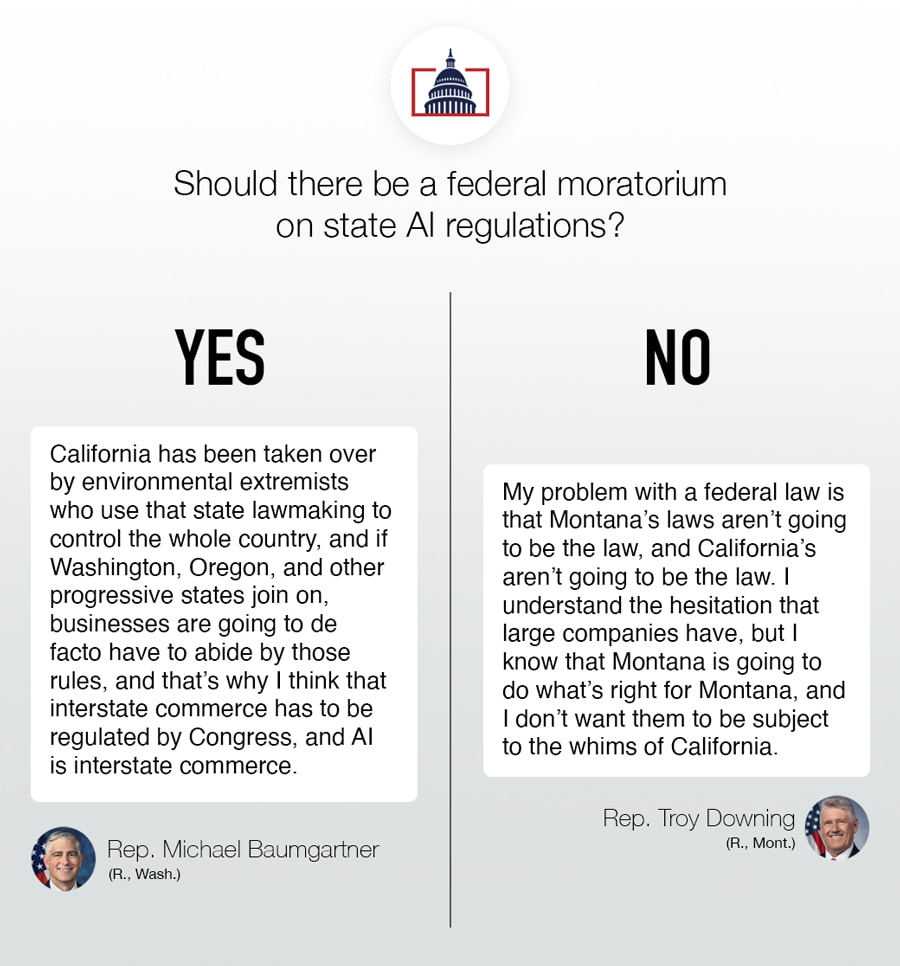
Do Republican lawmakers want guardrails on artificial intelligence (AI) regulation? Do they want to defer to the 50 laboratories of innovation? Are they concerned about turning regulation over to California or the European Union?
The answer is yes — depending on who you ask. The Washington Reporter interviewed 13 House Republicans about their thoughts on a potential federal moratorium on states regulating AI, and received a series of wide-ranging responses, ranging from staunch support for the moratorium to opposition.
While most House Republicans that we spoke with were supportive of a moratorium on state-based AI regulations, at least three of the 13 we spoke with either opposed or expressed concerns about a federal moratorium.
Rep. Michael Baumgartner (R., Wash.) cautioned that “we need to make sure that we don’t outsource AI regulation to California or to Brussels. If we allow each state to do it, because California is the largest market, Gavin Newsom and the radical leftists in California will have a significant impact on what happens with artificial intelligence, and this is a race against China.”
Heard on the Hill
HOME FOR THE HOLIDAYS: Rep. Vince Fong (R., Calif.) released a hype video about California’s 20th District, which Fong noted “is a powerhouse that feeds the nation, fuels American energy, and drives aerospace and defense innovation.”
CRUZ WAS RIGHT: In 2021, CNN fact checked Sen. Ted Cruz (R., Texas), claiming that the lawmaker was “spread[ing] misinformation about the refugees…suggest[ing] the Biden administration was inviting terrorism by bringing unvetted Afghans into the US.” As the tragic shooting of National Guardsmen showed, Cruz was tragically all too right.
FACT CHECK: Ambassador Richard Grenell, the executive director of the Kennedy Center, fact checked the “sports ‘reporters’” at the New York Times over their coverage of the Kennedy Center’s work with FIFA, which is paying the legendary arts facility “more than $7 million to do their world-wide event FIFA draw,” Grenell noted. “The Kennedy Center has raised $120 million (and growing) in 9 months with just 16 people in the Development Department. Thank you, President Trump. It is already way more than the previous team raised in 1 year with 94 staffers. (We saved $4m in staff salaries in one Department alone by firing 78 people in one Department).”
CRYPTO PARTY: Great Opportunity Policy hosted Crypto Christmas at PubKey DC with Sens. Tim Scott (R., S.C.), Bill Hagerty (R., Tenn.), and Cynthia Lummis (R., Wyo.). Tuesday’s party included the premiere of a short film called “Crypto Capital.” It was a high-energy crowd of more than 200 people celebrating the GENIUS Act being signed into law and looking forward to getting market structure accomplished next. Sen. Jon Husted (R., Ohio) also stopped by, along with officials from Trump’s administration, Capitol Hill, and industry players from a16z, the Digital Chamber, Coinbase, Kraken, Crypto Council, Crypto.com, Chainlink Labs, Ripple, and CleanSpark. Plus, the bar was serving up Bitcoin Bee’s Knees & Crypto Crush.
CRAWFORD BACKS TRUMP AND HEGSETH: Rep. Rick Crawford (R., Ark.), the Chairman of the House Intelligence Committee, explained why he backs President Donald Trump and Secretary of War Pete Hegseth drone striking narco-terrorists. “Those who appear ‘troubled’ by videos of military strikes on designated terrorists have clearly never seen the Obama-ordered strikes, or, for that matter, those of any other administration over recent decades,” Crawford noted. “I am deeply concerned by the public statements made by others that seek to ignore the realities of targeting terrorists to score political points. I call upon them to remember their own silence as our forces conducted identical strikes for years – killing terrorists and destroying military objectives the same as in this strike – and ask themselves why they would seek to attack our forces today.” In a recent interview with the Washington Reporter, Crawford explained why killing these people is America First.
SHE BROUGHT THE HOUSE DOWN: At the Daily Caller’s annual gala, Tulsi Gabbard, the Director of National Intelligence (DNI), treated the audience of hundreds to a series of laughs at the expense of Sen. Ruben Gallego (D., Ariz.), President Joe Biden and his autopen, and the legacy media. Gabbard, who received the organization’s Woman of the Year award, repeatedly thanked her staff for their tireless efforts at keeping Americans safe.
A message from our sponsor.
 |
The App Store “Freedom” Act compromises digital freedom and safety for every American family.
It forces app stores to dismantle safety tools, creating vulnerabilities and exposing users to cyberattacks. It also allows a flood of obscene content and breaks parental controls on app approvals.
Tell Congress to reject it.
EDITORIAL: David Sacks deserves praise for his public service, not smears from the press
by the Washington Reporter Editorial Board
The New York Times took aim at President Trump’s AI and Crypto Czar, David Sacks this week, claiming conflicts of interest without producing any real evidence to back up the charge. As an objective media outlet, we support fair scrutiny of anyone who steps into a senior advisory role. Conflict questions are appropriate. But nothing in the Times story substantiated wrongdoing by Sacks. In fact, the piece reads like the Times originally thought it had a blockbuster hit piece, only to watch each claim fall apart with basic fact checking. But rather than scrap the premise or write a simple feature on Sacks’s work on AI, the paper ran with an extremely damning and unfair headline anyway.
The strongest claim the Times attempted to surface was that Sacks may have used his visibility to promote his podcast, All In. Give us a break. That is not corruption. On a corruption scale from 0 being Mother Teresa, to 100 being Hunter Biden’s escapades, promoting a podcast is about a 2, at most. The Times framed it as controversial because it had nothing else to point to. Who can forget former Speaker Nancy Pelosi’s (D., Calif.) prolific day trades outperforming the stock market by millions? But yes, a podcast is a real problem.
Sacks is serving at the request of President Donald Trump. Sacks would almost certainly be making a lot more money if he were still in the private sector and not spending his time in the government. Does anyone really think David Sacks is doing this to make money? The Times may, but where is its evidence?
EXCLUSIVE: How Democrats’ Sixteen Thirty Fund poured almost $20 million in 2024; Republicans brace for a repeat in spending onslaught
by Matthew Foldi
Democratic dark money tied to organizations that want to end fossil fuels, abolish ICE, and defund the police flowed to key battleground states in 2024, and Republicans are concerned that Democrats will turn to similar sources once again for the 2026 midterms.
According to tax filings obtained by the Washington Reporter, the Sixteen Thirty Fund — which is backed by organizations tied to both George Soros and to Hansjörg Wyss, a Swiss billionaire — spent almost $20 million in Ohio, North Carolina, Georgia, Michigan, New Hampshire, and Maine last year.
Among the Sixteen Thirty Fund’s offerings are a “secret social media astroturf machine” and foreign money that are part and parcel of the group, which has cumulatively spent over $1 billion in American politics.
The Sixteen Thirty Fund will often work to obscure its activities, using trade names like Families Over Billionaires, as the New York Post’s Josh Christenson and Ryan King reported.
“Families Over Billionaires is nothing more than a front group for the dark money behemoth Sixteen Thirty Fund,” Americans for Public Trust’s executive director, Caitlin Sutherland, explained at the time.
EXCLUSIVE: How Sen. Tom Cotton stopped Biden from giving citizenship to Afghan migrants
by Matthew Foldi
Following President Joe Biden’s failed withdrawal from Afghanistan, his administration sought to remedy the problems that it created, in part by trying to fly Afghans — many unvetted — into America, and a constellation of Democratic politicians, “liberal Republicans, and misguided security hawks” wanted to grant them a pathway to citizenship, former Senate Chief Counsel Mike Fragoso explained to the Washington Reporter.
Fragoso explained how Sens. Tom Cotton (R., Ark.) and Chuck Grassley (R., Iowa) used every tool at their disposal to prevent legislation, namely the Afghan Adjustment Act (AAA), from becoming law.
“The bill had enough support that it would have passed if put to a vote, and then we’d probably be unable to deport any Afghan security threat,” Fragoso said. “Schumer didn’t put it to a vote though, which meant that Cotton and Grassley had the ability to stop it — and luckily they did, for over three years. They were under endless pressure from liberal Republicans and misguided security hawks to give in and they didn’t.”
The extensive role of these two senators, previously unreported, gained renewed significance following the tragic shooting of National Guardsmen by an Afghan national admitted into the United States by the Biden administration following the Taliban’s takeover in 2021.
A message from our sponsor.
 |
 |
Novartis is breaking ground on new manufacturing and R&D facilities across the US. Its $23 billion investment over the next five years will generate thousands of American jobs and deliver end-to-end production of key innovative medicines in the US. Learn More
SCOOP: Democratic Senate candidate’s home county partners with ICE to deport illegal immigrants
by Matthew Foldi
Nash County, home to former Gov. Roy Cooper (D., N.C.), announced that it will partner with the Trump administration to deport illegal immigrants as part of President Donald Trump’s Protecting the American People Against Invasion executive order.
Republicans say that Cooper, who is running against former Republican National Committee Chairman Michael Whatley, is the reason why Trump’s moves, like Operation Charlotte’s Web, are needed to begin with.
As Governor of North Carolina, Cooper vetoed multiple pieces of legislation that would have required sheriffs in his state to cooperate with ICE. Republicans are eager to litigate what they view as Cooper’s pro-illegal immigrant criminal record.
While Cooper was governor, around 500 illegal immigrants were freed from jails across North Carolina, including those with sex offense, kidnapping, arson, and homicide charges, in one year alone.
In one high-profile instance, Luis Pineda-Ancheta, an illegal immigrant from Honduras, immediately reoffended after being released due to sanctuary policies in North Carolina.
SCOOP: Sen. Tim Scott’s takeaway from his closed-door meeting with NVIDIA CEO Jensen Huang
by Matthew Foldi
The Trump administration is in an AI arms race against China, as Interior Secretary Doug Burgum often cautions. One company and one man, NVIDIA and its CEO, Jensen Huang, are at the core of many of these discussions, and Sen. Tim Scott (R., S.C.) brought Huang in for a closed-door meeting with his Senate GOP Banking Committee colleagues to discuss “AI’s growth and its impact on our financial system.”
Scott, the chair of the committee, explained following the meeting that “artificial intelligence is reshaping our markets and our economy…As Chairman, I’ve been encouraged by AI’s potential to strengthen financial literacy, protect investors, and help America stay ahead of China.”
“Maintaining that edge also means protecting sensitive U.S. technology through strong export controls and ensuring innovators have access to the capital they need to build here at home, including modernizing how companies raise funds in both private and public markets,” Scott added. “Our focus is on practical, responsible policies that keep America competitive.”
OPINIONATED
Op-Ed: Congressman Pete Sessions: How House Republicans are restoring the American Dream of homeownership
by Congressman Pete Sessions
America is the greatest country on Earth, yet too many families today find that the dream of owning a home is slipping farther out of reach. After years of ineffective governance in Washington, the cost of building and buying a home has climbed beyond what many working families in Texas and across the nation can sustain. House Republicans are committed to changing that. Under the leadership of Chairman French Hill (R., Ark.) on the House Financial Services Committee, we have a clear and focused plan to make homebuilding affordable again and return homeownership to the center of American life.
At a recent hearing, I spoke about what families in Waco and communities across Central Texas face every day. Wages have not kept pace with the burdensome regulations that my colleagues across the aisle have encouraged for far too long. Young families who want to buy their first home cannot compete against higher prices that the government has helped create. Builders in my district tell me the same story each week. They want to build, they want to grow, and they want to meet the needs of Texas families, but federal rules and layers of regulation keep slowing them down and driving up their costs. We need to cut the red tape, not add more.
Op-Ed: Andrew Langer: Paramount and Warner Bros. shows how to make media work for Americans
by Andrew Langer
One of the country’s best-known entertainment companies is up for sale. Where it ends up will reshape not only the future of Hollywood, but even more importantly, who controls the news and information Americans receive and how they get it.
After months of speculation and a tumultuous years-long attempt to right course, Warner Brothers Discovery put itself up for sale. The announcement marks a critical juncture for consumers.
The “info-tainment” industry has been beset by consolidation, and should one of the Big Tech or media conglomerates swoop in and buy up Warner Brothers’ assets, it would likely produce even fewer choices for ordinary families — which is generally a precursor to price gouging, censorship, and service reductions.
 |
About the Washington Reporter
We created the Washington Reporter to give Republicans in Congress an outlet for insights to help you succeed, and to cover the toughest policy fights that don't get the attention they deserve.
| ||||||||||

