
| From | Prison Policy Initiative <[email protected]> |
| Subject | What Trump gets right and wrong about pardons |
| Date | December 3, 2025 3:43 PM |
Links have been removed from this email. Learn more in the FAQ.
Links have been removed from this email. Learn more in the FAQ.
Presidents should issue pardons at the rate Trump has but the pardons shouldn't go to just friends.
Prison Policy Initiative updates for December 3, 2025 Exposing how mass incarceration harms communities and our national welfare
What Trump gets right and wrong about pardons [[link removed]] Pardons aren’t about helping political allies – they’re about bringing a measure of justice to an unjust system. [[link removed]]
by Regan Huston
Pardons are one of the most important powers presidents have. With a swipe of their pen, they can erase a person’s federal criminal conviction, freeing them from prison if they’re locked up, and erasing the collateral consequences [[link removed]] that often haunt people even after they’ve served their sentence.
The pardon power can help fix injustices in the criminal legal system and be a meaningful tool to reduce prison populations, but, unfortunately, in recent decades, this power has been severely underused.
President Trump, though, has broken with most of his recent predecessors, issuing pardons at a blistering pace since returning to office. In this piece, we take a closer look at President Trump’s pardons to understand what he’s gotten right, what he’s gotten wrong, and what can be done to make the pardon process better.
What Trump gets right about pardons
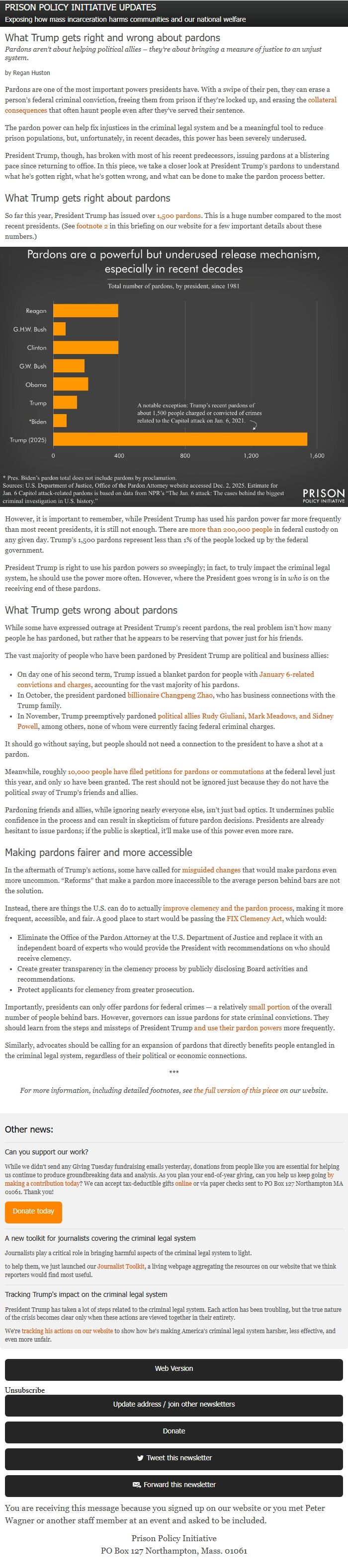
So far this year, President Trump has issued over 1,500 [[link removed]] pardons [[link removed]]. This is a huge number compared to the most recent presidents. (See footnote 2 [[link removed]] in this briefing on our website for a few important details about these numbers.)
However, it is important to remember, while President Trump has used his pardon power far more frequently than most recent presidents, it is still not enough. There are more than 200,000 people [[link removed]] in federal custody on any given day. Trump’s 1,500 pardons represent less than 1% of the people locked up by the federal government.
President Trump is right to use his pardon powers so sweepingly; in fact, to truly impact the criminal legal system, he should use the power more often. However, where the President goes wrong is in who is on the receiving end of these pardons.
What Trump gets wrong about pardons
While some have expressed outrage at President Trump’s recent pardons, the real problem isn’t how many people he has pardoned, but rather that he appears to be reserving that power just for his friends.
The vast majority of people who have been pardoned by President Trump are political and business allies:
On day one of his second term, Trump issued a blanket pardon for people with January 6-related convictions and charges [[link removed]], accounting for the vast majority of his pardons. In October, the president pardoned billionaire Changpeng Zhao [[link removed]], who has business connections with the Trump family. In November, Trump preemptively pardoned political allies Rudy Giuliani, Mark Meadows, and Sidney Powell [[link removed]], among others, none of whom were currently facing federal criminal charges.
It should go without saying, but people should not need a connection to the president to have a shot at a pardon.
Meanwhile, roughly 10,000 people have filed petitions for pardons or commutations [[link removed]] at the federal level just this year, and only 10 have been granted. The rest should not be ignored just because they do not have the political sway of Trump’s friends and allies.
Pardoning friends and allies, while ignoring nearly everyone else, isn’t just bad optics. It undermines public confidence in the process and can result in skepticism of future pardon decisions. Presidents are already hesitant to issue pardons; if the public is skeptical, it’ll make use of this power even more rare.
Making pardons fairer and more accessible
In the aftermath of Trump’s actions, some have called for misguided changes [[link removed]] that would make pardons even more uncommon. “Reforms” that make a pardon more inaccessible to the average person behind bars are not the solution.
Instead, there are things the U.S. can do to actually improve clemency and the pardon process [[link removed]], making it more frequent, accessible, and fair. A good place to start would be passing the FIX Clemency Act [[link removed]], which would:
Eliminate the Office of the Pardon Attorney at the U.S. Department of Justice and replace it with an independent board of experts who would provide the President with recommendations on who should receive clemency. Create greater transparency in the clemency process by publicly disclosing Board activities and recommendations. Protect applicants for clemency from greater prosecution.
Importantly, presidents can only offer pardons for federal crimes — a relatively small portion [[link removed]] of the overall number of people behind bars. However, governors can issue pardons for state criminal convictions. They should learn from the steps and missteps of President Trump and use their pardon powers [[link removed]] more frequently.
Similarly, advocates should be calling for an expansion of pardons that directly benefits people entangled in the criminal legal system, regardless of their political or economic connections.
***
For more information, including detailed footnotes, see the full version of this piece [[link removed]] on our website.
Please support our work in your end-of-year giving [[link removed]]
While we didn't send any Giving Tuesday fundraising emails, our work is only possible because of private donations from people like you. As you plan your end-of-year giving, can you help us keep going? We can accept tax-deductible gifts online [[link removed]] or via paper checks sent to PO Box 127 Northampton MA 01061. Thank you!
Other news: Can you support our work? [[link removed]]
While we didn't send any Giving Tuesday fundraising emails yesterday, donations from people like you are essential for helping us continue to produce groundbreaking data and analysis. As you plan your end-of-year giving, can you help us keep going by making a contribution today [[link removed]]? We can accept tax-deductible gifts online [[link removed]] or via paper checks sent to PO Box 127 Northampton MA 01061. Thank you!
Donate today [[link removed]] A new toolkit for journalists covering the criminal legal system [[link removed]]
Journalists play a critical role in bringing harmful aspects of the criminal legal system to light.
to help them, we just launched our Journalist Toolkit [[link removed]], a living webpage aggregating the resources on our website that we think reporters would find most useful.
Tracking Trump's impact on the criminal legal system [[link removed]]
President Trump has taken a lot of steps related to the criminal legal system. Each action has been troubling, but the true nature of the crisis becomes clear only when these actions are viewed together in their entirety.
We're tracking his actions on our website [[link removed]] to show how he's making America's criminal legal system harsher, less effective, and even more unfair.
Please support our work [[link removed]]
Our work is made possible by private donations. Can you help us keep going? We can accept tax-deductible gifts online [[link removed]] or via paper checks sent to PO Box 127 Northampton MA 01061. Thank you!
Our other newsletters Ending prison gerrymandering ( archives [[link removed]]) Criminal justice research library ( archives [[link removed]])
Update your newsletter subscriptions [link removed].
You are receiving this message because you signed up on our website [[link removed]] or you met Peter Wagner or another staff member at an event and asked to be included.
Prison Policy Initiative [[link removed]]
PO Box 127
Northampton, Mass. 01061
Web Version [link removed] Unsubscribe [link removed] Update address / join other newsletters [link removed] Donate [[link removed]] Tweet this newsletter [link removed] Forward this newsletter [link removed]
You are receiving this message because you signed up on our website or you met Peter Wagner or another staff member at an event and asked to be included.
Prison Policy Initiative
PO Box 127 Northampton, Mass. 01061
Did someone forward this to you? If you enjoyed reading, please subscribe! [[link removed]] Web Version [link removed] | Update address [link removed] | Unsubscribe [link removed] | Share via: Twitter [link removed] Facebook [[link removed] Email [link removed]
Prison Policy Initiative updates for December 3, 2025 Exposing how mass incarceration harms communities and our national welfare
What Trump gets right and wrong about pardons [[link removed]] Pardons aren’t about helping political allies – they’re about bringing a measure of justice to an unjust system. [[link removed]]
by Regan Huston
Pardons are one of the most important powers presidents have. With a swipe of their pen, they can erase a person’s federal criminal conviction, freeing them from prison if they’re locked up, and erasing the collateral consequences [[link removed]] that often haunt people even after they’ve served their sentence.
The pardon power can help fix injustices in the criminal legal system and be a meaningful tool to reduce prison populations, but, unfortunately, in recent decades, this power has been severely underused.
President Trump, though, has broken with most of his recent predecessors, issuing pardons at a blistering pace since returning to office. In this piece, we take a closer look at President Trump’s pardons to understand what he’s gotten right, what he’s gotten wrong, and what can be done to make the pardon process better.
What Trump gets right about pardons
So far this year, President Trump has issued over 1,500 [[link removed]] pardons [[link removed]]. This is a huge number compared to the most recent presidents. (See footnote 2 [[link removed]] in this briefing on our website for a few important details about these numbers.)
However, it is important to remember, while President Trump has used his pardon power far more frequently than most recent presidents, it is still not enough. There are more than 200,000 people [[link removed]] in federal custody on any given day. Trump’s 1,500 pardons represent less than 1% of the people locked up by the federal government.
President Trump is right to use his pardon powers so sweepingly; in fact, to truly impact the criminal legal system, he should use the power more often. However, where the President goes wrong is in who is on the receiving end of these pardons.
What Trump gets wrong about pardons
While some have expressed outrage at President Trump’s recent pardons, the real problem isn’t how many people he has pardoned, but rather that he appears to be reserving that power just for his friends.
The vast majority of people who have been pardoned by President Trump are political and business allies:
On day one of his second term, Trump issued a blanket pardon for people with January 6-related convictions and charges [[link removed]], accounting for the vast majority of his pardons. In October, the president pardoned billionaire Changpeng Zhao [[link removed]], who has business connections with the Trump family. In November, Trump preemptively pardoned political allies Rudy Giuliani, Mark Meadows, and Sidney Powell [[link removed]], among others, none of whom were currently facing federal criminal charges.
It should go without saying, but people should not need a connection to the president to have a shot at a pardon.
Meanwhile, roughly 10,000 people have filed petitions for pardons or commutations [[link removed]] at the federal level just this year, and only 10 have been granted. The rest should not be ignored just because they do not have the political sway of Trump’s friends and allies.
Pardoning friends and allies, while ignoring nearly everyone else, isn’t just bad optics. It undermines public confidence in the process and can result in skepticism of future pardon decisions. Presidents are already hesitant to issue pardons; if the public is skeptical, it’ll make use of this power even more rare.
Making pardons fairer and more accessible
In the aftermath of Trump’s actions, some have called for misguided changes [[link removed]] that would make pardons even more uncommon. “Reforms” that make a pardon more inaccessible to the average person behind bars are not the solution.
Instead, there are things the U.S. can do to actually improve clemency and the pardon process [[link removed]], making it more frequent, accessible, and fair. A good place to start would be passing the FIX Clemency Act [[link removed]], which would:
Eliminate the Office of the Pardon Attorney at the U.S. Department of Justice and replace it with an independent board of experts who would provide the President with recommendations on who should receive clemency. Create greater transparency in the clemency process by publicly disclosing Board activities and recommendations. Protect applicants for clemency from greater prosecution.
Importantly, presidents can only offer pardons for federal crimes — a relatively small portion [[link removed]] of the overall number of people behind bars. However, governors can issue pardons for state criminal convictions. They should learn from the steps and missteps of President Trump and use their pardon powers [[link removed]] more frequently.
Similarly, advocates should be calling for an expansion of pardons that directly benefits people entangled in the criminal legal system, regardless of their political or economic connections.
***
For more information, including detailed footnotes, see the full version of this piece [[link removed]] on our website.
Please support our work in your end-of-year giving [[link removed]]
While we didn't send any Giving Tuesday fundraising emails, our work is only possible because of private donations from people like you. As you plan your end-of-year giving, can you help us keep going? We can accept tax-deductible gifts online [[link removed]] or via paper checks sent to PO Box 127 Northampton MA 01061. Thank you!
Other news: Can you support our work? [[link removed]]
While we didn't send any Giving Tuesday fundraising emails yesterday, donations from people like you are essential for helping us continue to produce groundbreaking data and analysis. As you plan your end-of-year giving, can you help us keep going by making a contribution today [[link removed]]? We can accept tax-deductible gifts online [[link removed]] or via paper checks sent to PO Box 127 Northampton MA 01061. Thank you!
Donate today [[link removed]] A new toolkit for journalists covering the criminal legal system [[link removed]]
Journalists play a critical role in bringing harmful aspects of the criminal legal system to light.
to help them, we just launched our Journalist Toolkit [[link removed]], a living webpage aggregating the resources on our website that we think reporters would find most useful.
Tracking Trump's impact on the criminal legal system [[link removed]]
President Trump has taken a lot of steps related to the criminal legal system. Each action has been troubling, but the true nature of the crisis becomes clear only when these actions are viewed together in their entirety.
We're tracking his actions on our website [[link removed]] to show how he's making America's criminal legal system harsher, less effective, and even more unfair.
Please support our work [[link removed]]
Our work is made possible by private donations. Can you help us keep going? We can accept tax-deductible gifts online [[link removed]] or via paper checks sent to PO Box 127 Northampton MA 01061. Thank you!
Our other newsletters Ending prison gerrymandering ( archives [[link removed]]) Criminal justice research library ( archives [[link removed]])
Update your newsletter subscriptions [link removed].
You are receiving this message because you signed up on our website [[link removed]] or you met Peter Wagner or another staff member at an event and asked to be included.
Prison Policy Initiative [[link removed]]
PO Box 127
Northampton, Mass. 01061
Web Version [link removed] Unsubscribe [link removed] Update address / join other newsletters [link removed] Donate [[link removed]] Tweet this newsletter [link removed] Forward this newsletter [link removed]
You are receiving this message because you signed up on our website or you met Peter Wagner or another staff member at an event and asked to be included.
Prison Policy Initiative
PO Box 127 Northampton, Mass. 01061
Did someone forward this to you? If you enjoyed reading, please subscribe! [[link removed]] Web Version [link removed] | Update address [link removed] | Unsubscribe [link removed] | Share via: Twitter [link removed] Facebook [[link removed] Email [link removed]
Message Analysis
- Sender: Prison Policy Initiative
- Political Party: n/a
- Country: United States
- State/Locality: n/a
- Office: n/a
-
Email Providers:
- Campaign Monitor