|
It's (predatory) gamblin' time!
As of two days ago, sports gambling is legal in Missouri. That's bad for everyone—especially our military.
|

| |||||||||||||||


Something I’ve written about often: online sports gambling is very bad.¹ But because Missouri voters passed Amendment 2 last year, as of this past Monday, it’s now legal across the state.

Ads for FanDuel, DraftKings, and other gambling platforms are inescapable everywhere these days, but that’s been especially true in Missouri over the last few months leading up to legalization.
I’ve argued for a long time that this will be bad for everyone. But it’s especially dangerous for our Armed Forces. Active-duty military personnel are already far more likely to have gambling addictions than the rest of the population.
Now, we’ve given them unfettered access to sports gambling whenever they want. This is bad for our active-duty military, bad for our veterans, and bad for our national defense.

Article summary:
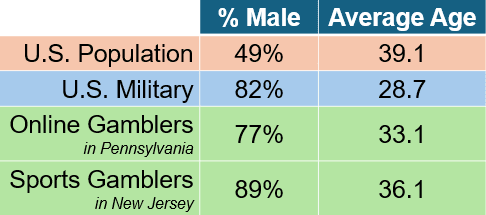
The military is predominantly young and predominantly male—exactly the demographics of people most vulnerable to predatory gambling apps.
“Investing” in cryptocurrencies is highly correlated with problem gambling, and our service members trade crypto at a much higher rate than the rest of the U.S.
Active-duty military (and veterans) are alarmingly at risk for gambling addiction. We must ban online gambling from military bases before the problem gets worse.
The inescapable barrage of gambling ads
A few weeks ago, KMOV ran a good segment on the barrage of ads flooding Missouri’s airwaves in the lead-up to legalization earlier this week:

DraftKings, FanDuel, BetMGM, Caesars, bet365, Fanatics Sportsbook, theScore Bet, and Circa are all running ads and offering promos to new customers. Not a dime has been gambled yet, and already they’ve spent a lot of money on this:
Sports gambling advocates spent $46 million to pass Amendment 2.
The companies above are spending tens of millions in ads to encourage new users in the state to sign up.²
They’re offering all sorts of promotions: DraftKings and FanDuel are offering bet $5, get $300 promos; the other platforms are offering something similar. To paraphrase a friend, there’s not a drug dealer in the world offering a buy-one-get-60-free promo, which tells you just how addicting this stuff is.
Just for good measure, they’re not just paying for ads on TV and social media. On Monday, I got an email from Marriott—yes, the hotel brand—encouraging me to sign up for BetMGM, which you can see in the footnotes if you’re curious.³
Men and young people are the most susceptible to gambling problems; young men are the most vulnerable of all. And basically no one makes money on this stuff: a study that looked at over 700,000 sports gamblers found that fewer than 5% made any money.
To state the obvious: the gambling platforms are spending all of this money because they expect to fleece Missourians, just like they’ve fleeced Americans everywhere else in the country. And that includes our military.
The military is alarmingly vulnerable to gambling addiction
There have been a bunch of articles lately talking about the risks that gambling, online or otherwise, creates for our Armed Forces:
Wired: “The Big Money and High Cost of the US Military’s On-Base Slot Machines”
The Wall Street Journal: “Top Gun Traders: Stock Bets and Crypto Culture Take Over the Military”
The Guardian: “‘Gambling addiction on steroids’: fears of betting crisis at heart of US military”
Task & Purpose: “Gambling addiction in the military may be going unnoticed, advocates warn”
It’s worth noting that our military, demographically, doesn’t look that much like the United States.⁴ You know who it looks a lot like? Sports gamblers and online gamblers.
Like gamblers, our Armed Forces are younger and more male than the general population—the two groups most vulnerable to the dangers of online gambling.⁵
 |
It’s no surprise then that active-duty service members are 3× likelier than civilians to gamble online, or that service members are 2× likelier than the civilian population to have gambling problems.⁶
This is an enormous, and growing, crisis among our Armed Forces. And that makes it a crisis of national safety and defense.
Our Armed Forces are being exploited by these apps
As tough as this may be, set aside for a moment the risks of bankruptcy, addiction, domestic violence, and suicide—all of which are correlated with gambling online. Online gambling is eating up a lot of time that our service members should be spending on their work.
What proof do I have? As I noted above, online gambling platforms release very little data (obviously) about how much money and time people are throwing away. But we can look at how people are gambling on cryptocurrencies.
I’ve argued before that cryptocurrencies, and get-rich-quick investing generally, aren’t any different from gambling:
 |
|
Here’s a quick look at the data to back up that claim:
People who gamble are more likely to trade cryptocurrencies.
Cryptocurrencies appeal far more to problem gamblers than to the general public.
Crypto traders are—surprise!—generally young and generally male.
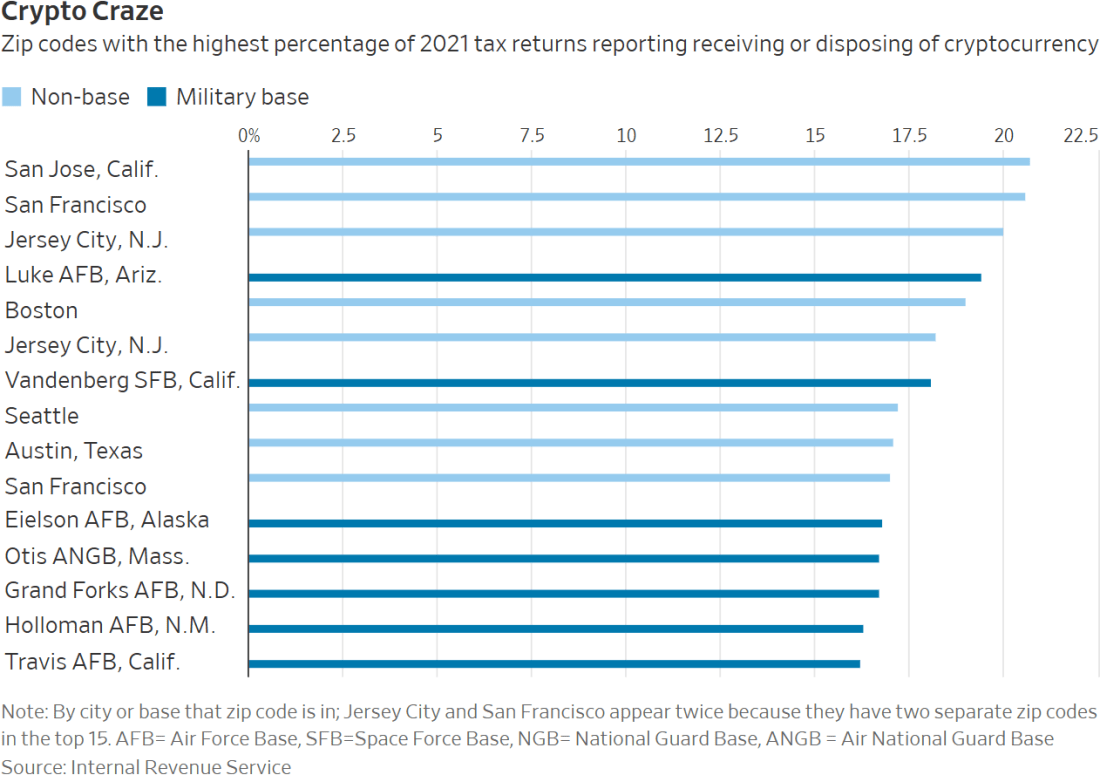
I bring this up because while most of what we know about online gambling on military bases is anecdotal, there’s growing data around how much cryptocurrency trading there is.
A recent WSJ article said that service members are, “trading tips on obscure cryptocurrencies from the decks of aircraft carriers.” Military bases have some of the highest rates of crypto trading anywhere in the country:
 |
Given everything we know—that service members are far likelier to be problem gamblers and that cryptocurrency traders are far likelier to engage in problem gambling—it’s a safe bet that they aren’t just trading crypto tips from the decks of aircraft carriers. They’re almost certainly gambling too.
Gambling is a violation of Section 2-501 of the Joint Ethics Regulation (JER), which prohibits “gambling activities with Government equipment, on Government property, or while on duty.”
And even when they aren’t working, 30% of active-duty military personnel live on a base, and another 13% live in government-leased housing. By the letter of the JER, they shouldn’t ever be allowed to gamble at home.
But the new status quo, one that allows online gambling on base, leaves them more vulnerable to addiction than ever before.
Ban online gambling from military bases
People can see the impact that sports gambling is having on their friends and family, so it’s no surprise that a growing percentage of Americans agree that it’s bad for society.⁷
The sports gambling lobby has become incredibly powerful, and it won’t be easy to roll back sports gambling legalization efforts that have taken hold all over the country.
But one thing we can push for: a ban on online gambling and on sports gambling on military bases.
Of service members stationed in the U.S., 48% are in states where online sports gambling is legal.⁸ By gambling on base, they’re violating military policy. But much more importantly, it’s an activity to which they’re uniquely vulnerable.
That doesn’t just hurt our military. It hurts all of us.
By banning their apps from Fort Leonard Wood, Whiteman Air Force Base, and other installations around the state, voters and lawmakers in Missouri can protect our military, our service members, and our national security.
Feel free to share this post with someone who will find this interesting. If you’re reading this email because someone sent it to you, please consider subscribing.
My argument here is that things get measurably worse in states after gambling is legalized.
Bankruptcy filings increase by 25-30% in the 3-4 years after legalization. A different study finds “a substantial increase in average bankruptcy rates, debt sent to collections, use of debt consolidation loans, and auto loan delinquencies” after states legalize sports gambling.
Problem gambling leads to higher rates of domestic violence and higher rates of suicide, and rates of problem gambling go way up after states legalize online gambling. That’s no surprise—everyone has a casino in their pocket—but online gambling is leading to more domestic violence and more suicide.
Driving down I-64 yesterday, I saw at least a half-dozen sports gambling billboards, including this one right before the Tower Grove Ave. exit:
 |
Sorry for the blurry image; it comes from my dash cam. It’s a DraftKings ad that reads “Provel and parlays that hit the spot.”
Can someone explain what on earth that means? Does DraftKings serve Provel somewhere? I get that Provel is a St. Louis thing, but does that have anything to do with parlays? As far as I know, Imo’s isn’t into sports gambling (yet?).
This seems like some AI-generated nonsense where someone in DraftKings marketing plugged “generate a billboard ad that combines sports gambling and St. Louis culture” into ChatGPT.
Here’s the ad, if you’re curious:
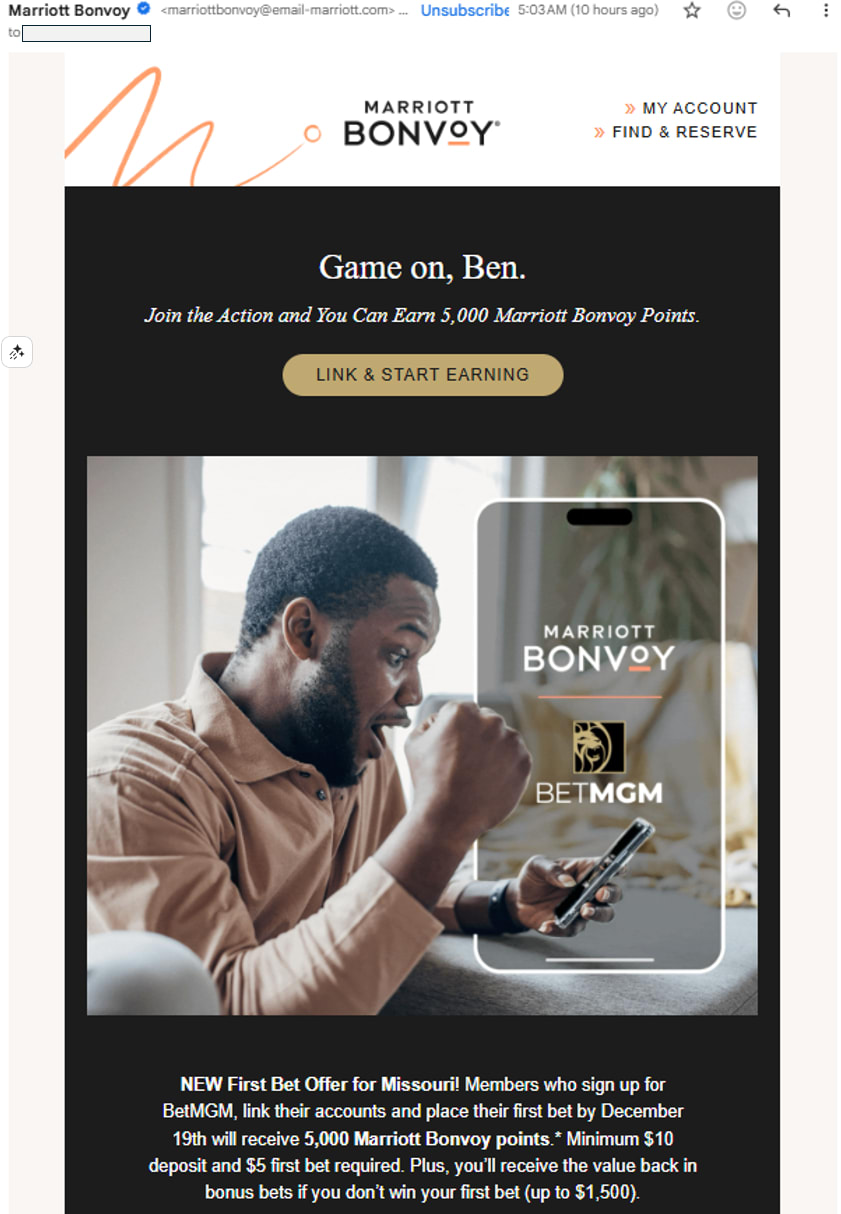 |
Marriott points in the U.S. are worth about 0.69¢ each, so this promo is worth about $34.50. (All you have to do is make a $5 bet!) So once again, it tells you how much they’re expecting to make off of you over time.
Everyone’s selling their soul on this issue.
Julie Roland and I wrote about women in the military last year:
 |
|
Here’s where I’m pulling all of this data:
U.S. population data:
% male came from Wikipedia.
Median age came from the Census Bureau. Note that this is the median age and not the average age; I couldn’t find a reliable source for that. But the average age would, almost certainly, be even higher.
U.S. military data:
Online gambler data from Pennsylvania: both % male and average age came from p. 7 of the Pennsylvania Interactive Gaming Assessment done in 2023.
Sports gambler data from New Jersey: both % male and average age came from p. 3 of the Rutgers Center for Gambling Studies’ Sports Betting in New Jersey report from 2019.
I would’ve much preferred to use robust national data here, but it really doesn’t exist. There’s survey and polling data, but that had some pretty inconsistent answers on both gender breakdown and age. (On the age question especially, it was often broken into segments—say, 18-29 or 55+—that made it impossible to get an average or a median.)
Furthermore, what Pennsylvania is measuring isn’t exactly the same as what New Jersey is measuring. In Pennsylvania, the data is looking at online gambling, not just sports gambling—their online gambling extends beyond sports and includes online slots, among other things, which is frightening. In New Jersey, the data only looks at sports gambling and doesn’t break down online vs. in person by the demographic data I needed here.
So this is as good as we’re going to do. I’m sure the data varies a little from state to state, but I doubt it varies by that much. In any event, this tells us what we’ve already known: that young people, men, and young men are by far the most likely to be gambling online and gambling on sports.
And that’s before you get to any issues specific to our Armed Forces and veterans. I would not be surprised if the same traits that lead people to join the military are correlated with problem gambling, nor would I be surprised if the experiences that people face in the military lead to more problem gambling. Substance abuse, after all, is more common among veterans than in the general population.
It’s unusual that sports gambling is becoming less popular as it’s becoming more legal. Contrast this with marijuana: support for legalization has steadily grown as it’s become legal in more states.
The reason this figure is below 50%: more members of our military are stationed in California than anywhere else, and online gambling isn’t legal in California.
| ||||||||||

