|
 |
Thirteen House Republicans preview what to expect in 2026, Rep. Andy Barr praises Trump’s travel ban, and more!
Department of the Interior bringing America First pricing to our National Parks, Rep. Troy Nehls on securing America’s AI future, and more!
|

| |||||||||||||||


For advertising opportunities to reach our audience of center-right policymakers, contact [email protected]
December 2nd, 2025
Let’s dive in.
INTERVIEW: Thirteen House Republicans on what to expect in 2026, their biggest 2025 accomplishments, and the leadership of President Trump and Speaker Johnson
Heard on the Hill
SCOOP: DNI, CIA fire back at Reuters “shouting match” smear
SCOOP: Interior Department announces America First pricing for National Parks
SCOOP: Rep. Andy Barr praises Trump’s travel ban: “if we can’t vet them, they don’t belong here”
SCOOP: Small Business Committee Chairman Roger Williams’s Black Friday Weekend message
OPINIONATED: Rep. Troy Nehls on how to secure America’s AI future
 |
 |
Novartis is breaking ground on new manufacturing and R&D facilities across the US. Its $23 billion investment over the next five years will generate thousands of American jobs and deliver end-to-end production of key innovative medicines in the US. Learn More
If you have a tip you would like to anonymously submit, please use our tip form — your anonymity is guaranteed!
 |
INTERVIEW: Thirteen House Republicans on what to expect in 2026, their biggest 2025 accomplishments, and the leadership of President Trump and Speaker Johnson
by Matthew Foldi
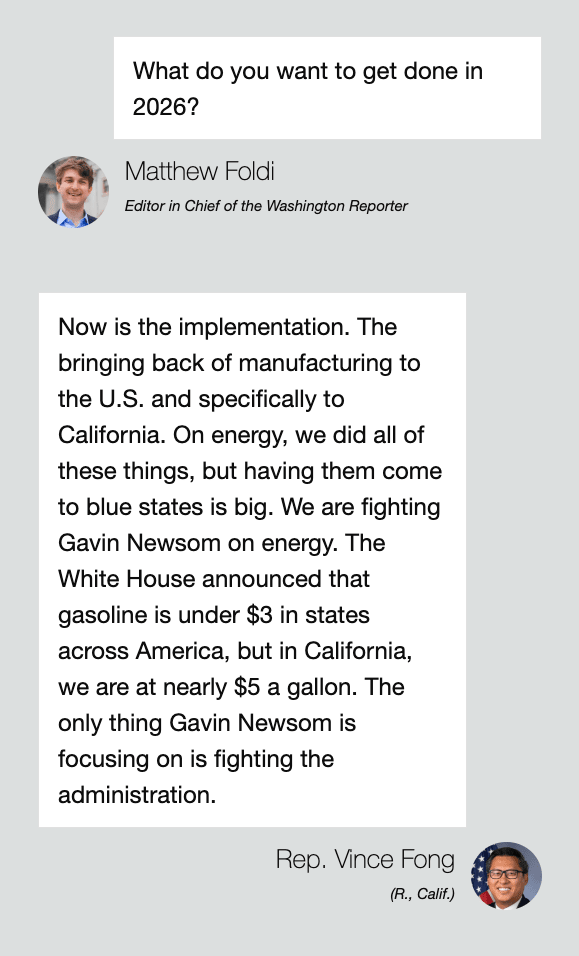
House Republicans are proud of a historically successful 2025, and are eager to tackle a number of policy issues in 2026, thirteen of them told the Washington Reporter during a media row on Tuesday.
Rep. Ben Cline (R., Va.) described the differences between Congress under President Joe Biden and under President Donald Trump as “a sea change in an approach to government.”
“Without question, the country is a lot better off than when 2025 started,” Rep. Tracey Mann (R., Kansas) said. “The border is secure thanks to President Trump and House Republicans. Getting the One Big, Beautiful Bill passed and signed into law was important not just for now but for the future.”
Most Republicans named the One Big, Beautiful Bill (OBBB) as what they were most proud of accomplishing this year, with wins like no taxes on tips, overtime, and Social Security mentioned in multiple interviews. Rep. Mark Harris (R., N.C.) said that he appreciated what Sen. Ted Cruz (R., Texas) told him at a recent event, that “‘if you ever get discouraged, just remember that there were more conservative victories than folks can even imagine in the One Big, Beautiful Bill.’”
Other lawmakers, like Rep. Mark Alford (R., Mo.), said that he is proudest of “the work that our constituent services team has done, returning more than $8 million to taxpayers that the federal government was holding on to.”
Heard on the Hill
AI MORATORIUM CHANCES: House and Senate Republican leadership are furiously debating whether to include a moratorium on state-based AI laws in the NDAA. One source is optimistic it will be included, as the measure has the support of most leadership and the White House. Another source was bearish, pointing out the political risks. More to come from the Washington Reporter!
DEFENDING SACKS: Multiple Republicans spoke out in support of David Sacks following a New York Times article that claimed Sacks’s AI work for the White House was “benefitting himself and his friends.” Marc Andreessen posted: “@DavidSacks is a throwback to the era of American greatness in which the most capable private sector citizens selflessly volunteered for government service in moments of peril for a dollar a day. He is a credit to our nation, and we need more like him, not fewer.”
TEMU AND SHEIN: Senator Tom Cotton sent a letter to the Department of Justice requesting an investigation into Temu and Shein for their widespread use of counterfeit products.
A message from our sponsor.
 |
Americans want clear, transparent information, expert guidance, and real access – not government-restricted options.
Cut through the noise and listen to the overwhelming majority.
America is stronger with the freedom to protect our health.
Learn more: fightinfectiousdisease.org
SCOOP: DNI, CIA fire back at Reuters “shouting match” smear
by Matthew Foldi
The CIA and Office of Director of National Intelligence (ODNI) are jointly pushing back on a Reuters story alleging discord between the two agencies spilled over when officials from the DNI arrived at a CIA warehouse to seize files related to the assassination of Robert F. Kennedy.
Reuters, an outlet that employed a Hamas terrorist, alleged a “shouting” match ensued during the incident, which the DNI’s office denied to the Washington Reporter.
50 U.S. Code § 3023 section B notes that “the Director of National Intelligence shall have access to all national intelligence and intelligence related to the national security which is collected by any Federal department, agency, or other entity, except as otherwise provided by law or, as appropriate, under guidelines agreed upon by the Attorney General and the Director of National Intelligence.”
Given President Donald Trump’s adamance that Gabbard and her agency run point on the mass declassifications that the administration has undertaken, the DNI likely has jurisdiction in the matter at hand.
Pursuant to Trump’s executive order demanding the declassification of massive tranches of documents relating to RFK’s assassination, DNI officials took boxes of documents from a Washington-area CIA site to move for their declassification.
SCOOP: Interior Department announces America First pricing for National Parks
by Matthew Foldi
Secretary of Interior Doug Burgum and the Department of Interior (DOI) gave Americans a Thanksgiving present with new “America First pricing” at American national parks, DOI announced.
The move is “the most significant modernization of national park access in decades,” the Interior Department said — and it will kick off on the first day of 2026, during which Americans will be celebrating the 250th birthday of the United States.
Under the new policies, Americans will pay significantly less to visit national parks, while foreign visitors will pick up an increased portion of the tab. The Interior Department’s “America the Beautiful” passes will be available for purchase. The passes will cost $80 for U.S. residents and $250 for nonresidents. This ensures “that American taxpayers who already support the National Park System receive the greatest benefit,” the department noted.
“President Trump’s leadership always puts American families first,” Burgum said following the announcement. “These policies ensure that U.S. taxpayers, who already support the National Park System, continue to enjoy affordable access, while international visitors contribute their fair share to maintaining and improving our parks for future generations.”
SCOOP: Rep. Andy Barr praises Trump’s travel ban: “if we can’t vet them, they don’t belong here”
by Matthew Foldi
President Donald Trump’s move to “permanently pause migration from all Third World Countries” won quick praise from Rep. Andy Barr (R., Ky.), who said that the administration’s move — made in the wake of the murder of a National Guardswoman blocks from the White House — is necessary.
“I join all Kentuckians and Americans in mourning the murder of Army Specialist Sarah Beckstrom,” Barr explained. “Our troops deserve support — not reckless Democrat claims that they’re following ‘illegal orders,’ putting a target on their backs.”
Weeks after President Joe Biden’s failed withdrawal from Afghanistan, Barr voted against a measure Biden subsequently signed that provided billions of dollars of emergency funds to unvetted refugees from Afghanistan. Several top members of the Trump administration, including then-Sen. Marco Rubio and then-Reps. Mike Waltz and Lee Zeldin, sided with Barr in the vote.
“President Trump is right to pause immigration from countries we can’t vet,” Barr added. “As I’ve said repeatedly, ‘if we can’t vet them, they don’t belong here.’ That’s why I voted against Biden’s $6 billion Afghan resettlement package that rushed unvetted arrivals into the country. President Trump is cleaning up Biden’s mess and I fully support him.”
A message from our sponsor.
 |
The App Store “Freedom” Act creates new cybersecurity risks for children. It:
● Forces sideloading, exposing smartphones to cyberattacks;
● Breaks parental controls;
● Threatens to flood the market with insecure apps; and
● Denies parents the choice of a secure smartphone for their family.
Tell Congress to protect kids. Vote NO.
SCOOP: Small Business Committee Chairman Roger Williams’s Black Friday Weekend message
by Matthew Foldi
The Trump administration is eagerly celebrating historic Black Friday Weekend shopping across America, giving President Donald Trump a bump when it comes to his handling of the economy.
In Congress, Rep. Roger Williams (R., Texas) — the chairman of the House Committee on Small Business — added his voice to the chorus of Republicans who urged Americans to “support your local small businesses and shop on Main Street.”
Williams, who has run a small business himself as a car dealer for almost 60 years, previously told the Washington Reporter in an interview ahead of Small Business Week that “everything Trump is doing is geared towards small business.”
Now, Williams added that “small businesses are the heartbeat of the American economy, making up over 99 percent of all businesses in America. From corner stores to coffee shops, I am honored to be a voice for the over 36 million small businesses that create jobs and drive economic growth.”
OPINIONATED
Op-Ed: Rep. Troy Nehls: To win the global AI race, we must secure our optical transceivers and prioritize American-made components
by Rep. Troy Nehls
Protecting our AI infrastructure is critical to winning the global AI race. While switches, routers, and other components that make up our data centers have received attention for their potential security vulnerabilities, a smaller, just as powerful component has been overlooked — and it leaves our country vulnerable.
Optical transceivers are small gateway devices that directly interface with core systems in data centers and cloud infrastructures. Virtually all information that passes through a switch and router in an AI data center flows through one or more transceivers, meaning that transceivers have access to all information — sensitive or otherwise — that supports artificial intelligence, cloud services, and advanced analytics.
Transceivers’ access to information makes them an attractive target for foreign adversaries, presenting an immense national security risk. Foreign adversaries, such as China, can insert malicious firmware or hidden surveillance tools into transceivers, potentially corrupting our networks. They can intercept, record, or reroute sensitive information, putting our most important state secrets within the reach of our enemies. In theory, they could even inject false data into our AI models through compromised transceivers, resulting in false answers or hallucinations from those models.
 |
About the Washington Reporter
We created the Washington Reporter to give Republicans in Congress an outlet for insights to help you succeed, and to cover the toughest policy fights that don't get the attention they deserve.
| ||||||||||

