
Email
December Weed of the Month: An Invasive Plant Success Story
| From | Minnesota Department of Agriculture <[email protected]> |
| Subject | December Weed of the Month: An Invasive Plant Success Story |
| Date | December 1, 2025 3:02 PM |
Links have been removed from this email. Learn more in the FAQ.
Links have been removed from this email. Learn more in the FAQ.
Advice for those beginning invasive plant removal projects
department of agriculture
Having trouble viewing this email? View it as a Web page [ [link removed] ].
December 1, 2025
December Weed of the Month: An Invasive Plant Success Story
Advice for those beginning invasive plant removal projects
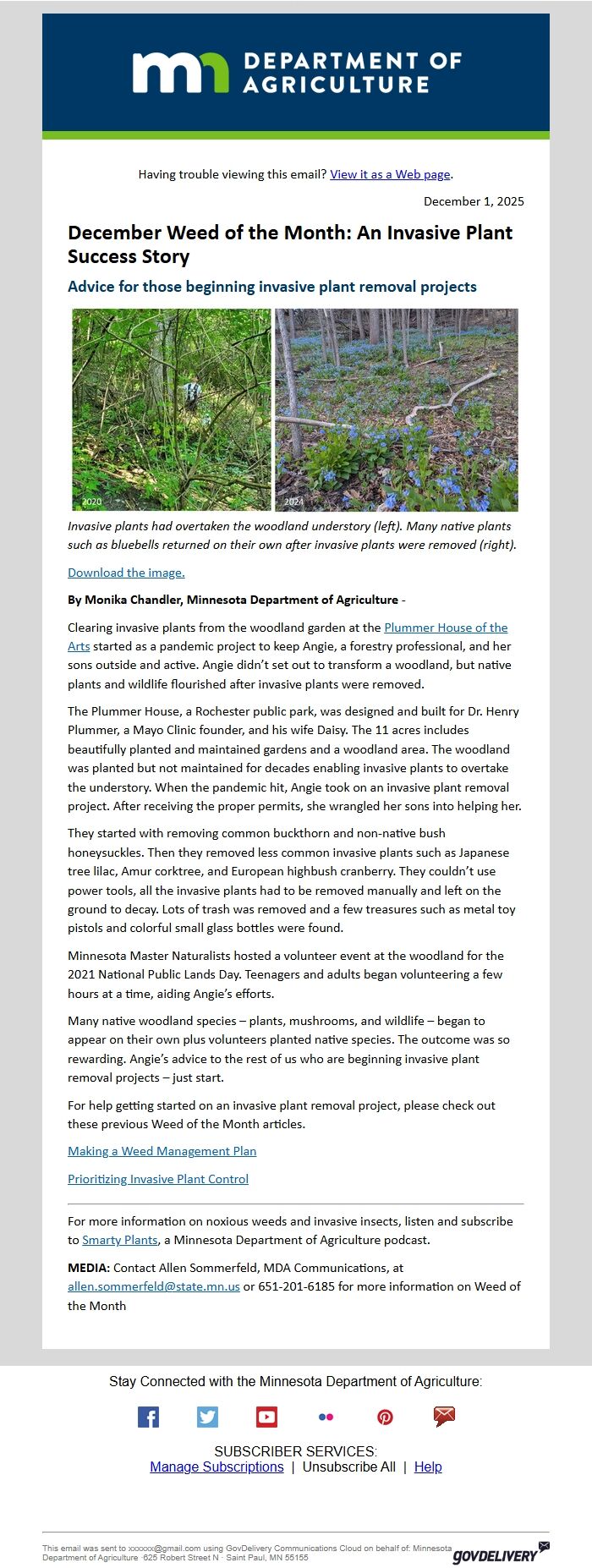
In 2020 the woodland understory was dominated by invasive plants. By 2024, invasive plants were removed and native plants rebounded. [ [link removed] ]
"Invasive plants had overtaken the woodland understory (left). Many native plants such as bluebells returned on their own after invasive plants were removed (right)."
Download the image. [ [link removed] ]
*By Monika Chandler, Minnesota Department of Agriculture* -
Clearing invasive plants from the woodland garden at the Plummer House of the Arts [ [link removed] ] started as a pandemic project to keep Angie, a forestry professional, and her sons outside and active. Angie didn’t set out to transform a woodland, but native plants and wildlife flourished after invasive plants were removed.
The Plummer House, a Rochester public park, was designed and built for Dr. Henry Plummer, a Mayo Clinic founder, and his wife Daisy. The 11 acres includes beautifully planted and maintained gardens and a woodland area. The woodland was planted but not maintained for decades enabling invasive plants to overtake the understory. When the pandemic hit, Angie took on an invasive plant removal project. After receiving the proper permits, she wrangled her sons into helping her.
They started with removing common buckthorn and non-native bush honeysuckles. Then they removed less common invasive plants such as Japanese tree lilac, Amur corktree, and European highbush cranberry. They couldn’t use power tools, all the invasive plants had to be removed manually and left on the ground to decay. Lots of trash was removed and a few treasures such as metal toy pistols and colorful small glass bottles were found.
Minnesota Master Naturalists hosted a volunteer event at the woodland for the 2021 National Public Lands Day. Teenagers and adults began volunteering a few hours at a time, aiding Angie’s efforts.
Many native woodland species – plants, mushrooms, and wildlife – began to appear on their own plus volunteers planted native species. The outcome was so rewarding. Angie’s advice to the rest of us who are beginning invasive plant removal projects – just start.
For help getting started on an invasive plant removal project, please check out these previous Weed of the Month articles.
Making a Weed Management Plan [ [link removed] ]
Prioritizing Invasive Plant Control [ [link removed] ]
________________________________________________________________________
For more information on noxious weeds and invasive insects, listen and subscribe to Smarty Plants [ [link removed] ], a Minnesota Department of Agriculture podcast.
*MEDIA: *Contact Allen Sommerfeld, MDA Communications, at [email protected] or 651-201-6185 for more information on Weed of the Month
Stay Connected with the Minnesota Department of Agriculture: Facebook [ [link removed] ] Twitter [ [link removed] ] Youtube [ [link removed] ] Flickr [ [link removed] ] Flickr [ [link removed] ] Govdelivery [ [link removed] ]
SUBSCRIBER SERVICES:
Manage Subscriptions [ [link removed] ] | Unsubscribe All [ [link removed] ] | Help [ [link removed] ]
________________________________________________________________________
This email was sent to [email protected] using GovDelivery Communications Cloud on behalf of: Minnesota Department of Agriculture ·625 Robert Street N · Saint Paul, MN 55155 GovDelivery logo [ [link removed] ]
body .abe-column-block {min-height: 5px;} table.gd_combo_table img {margin-left:7px; margin-right:7px;} table.gd_combo_table div.govd_image_display img, table.gd_combo_table td.gd_combo_image_cell img {margin-left:0px; margin-right:0px;}
department of agriculture
Having trouble viewing this email? View it as a Web page [ [link removed] ].
December 1, 2025
December Weed of the Month: An Invasive Plant Success Story
Advice for those beginning invasive plant removal projects
In 2020 the woodland understory was dominated by invasive plants. By 2024, invasive plants were removed and native plants rebounded. [ [link removed] ]
"Invasive plants had overtaken the woodland understory (left). Many native plants such as bluebells returned on their own after invasive plants were removed (right)."
Download the image. [ [link removed] ]
*By Monika Chandler, Minnesota Department of Agriculture* -
Clearing invasive plants from the woodland garden at the Plummer House of the Arts [ [link removed] ] started as a pandemic project to keep Angie, a forestry professional, and her sons outside and active. Angie didn’t set out to transform a woodland, but native plants and wildlife flourished after invasive plants were removed.
The Plummer House, a Rochester public park, was designed and built for Dr. Henry Plummer, a Mayo Clinic founder, and his wife Daisy. The 11 acres includes beautifully planted and maintained gardens and a woodland area. The woodland was planted but not maintained for decades enabling invasive plants to overtake the understory. When the pandemic hit, Angie took on an invasive plant removal project. After receiving the proper permits, she wrangled her sons into helping her.
They started with removing common buckthorn and non-native bush honeysuckles. Then they removed less common invasive plants such as Japanese tree lilac, Amur corktree, and European highbush cranberry. They couldn’t use power tools, all the invasive plants had to be removed manually and left on the ground to decay. Lots of trash was removed and a few treasures such as metal toy pistols and colorful small glass bottles were found.
Minnesota Master Naturalists hosted a volunteer event at the woodland for the 2021 National Public Lands Day. Teenagers and adults began volunteering a few hours at a time, aiding Angie’s efforts.
Many native woodland species – plants, mushrooms, and wildlife – began to appear on their own plus volunteers planted native species. The outcome was so rewarding. Angie’s advice to the rest of us who are beginning invasive plant removal projects – just start.
For help getting started on an invasive plant removal project, please check out these previous Weed of the Month articles.
Making a Weed Management Plan [ [link removed] ]
Prioritizing Invasive Plant Control [ [link removed] ]
________________________________________________________________________
For more information on noxious weeds and invasive insects, listen and subscribe to Smarty Plants [ [link removed] ], a Minnesota Department of Agriculture podcast.
*MEDIA: *Contact Allen Sommerfeld, MDA Communications, at [email protected] or 651-201-6185 for more information on Weed of the Month
Stay Connected with the Minnesota Department of Agriculture: Facebook [ [link removed] ] Twitter [ [link removed] ] Youtube [ [link removed] ] Flickr [ [link removed] ] Flickr [ [link removed] ] Govdelivery [ [link removed] ]
SUBSCRIBER SERVICES:
Manage Subscriptions [ [link removed] ] | Unsubscribe All [ [link removed] ] | Help [ [link removed] ]
________________________________________________________________________
This email was sent to [email protected] using GovDelivery Communications Cloud on behalf of: Minnesota Department of Agriculture ·625 Robert Street N · Saint Paul, MN 55155 GovDelivery logo [ [link removed] ]
body .abe-column-block {min-height: 5px;} table.gd_combo_table img {margin-left:7px; margin-right:7px;} table.gd_combo_table div.govd_image_display img, table.gd_combo_table td.gd_combo_image_cell img {margin-left:0px; margin-right:0px;}
Message Analysis
- Sender: Minnesota Department of Agriculture
- Political Party: n/a
- Country: n/a
- State/Locality: n/a
- Office: n/a
-
Email Providers:
- govDelivery