
| From | The American Prospect <[email protected]> |
| Subject | Selling the poor on spending like they’re rich |
| Date | December 1, 2025 11:02 AM |
Links have been removed from this email. Learn more in the FAQ.
Links have been removed from this email. Learn more in the FAQ.
How "premiumization" squeezes the middle class.Was this email forwarded to you? Sign up here to get The Daily Prospect Monday through Friday. [link removed]
[link removed]
**DECEMBER 1, 2025**
Click to read this email in your browser. [link removed]
In this article [link removed], I write about the often vague idea of cultural affordability—how we pay for the social non-necessities in our lives, like weddings, sporting events, and going out to eat. I argue that these kinds of purchases have become inaccessible to many middle class consumers as the rich continue to get richer and dominate our economy. The availability of credit, especially through “buy now, pay later” platforms, makes it easier than ever for consumers to go into debt to keep up with the lives we are sold through our screens. I don’t think this is a problem of personal spending responsibility. I doubt we could budget our way out of this. Like so many affordability issues, the problem lies with our deeply unequal economy and the corporations that help make it so.
**–Emma Janssen, writing fellow**
[link removed]
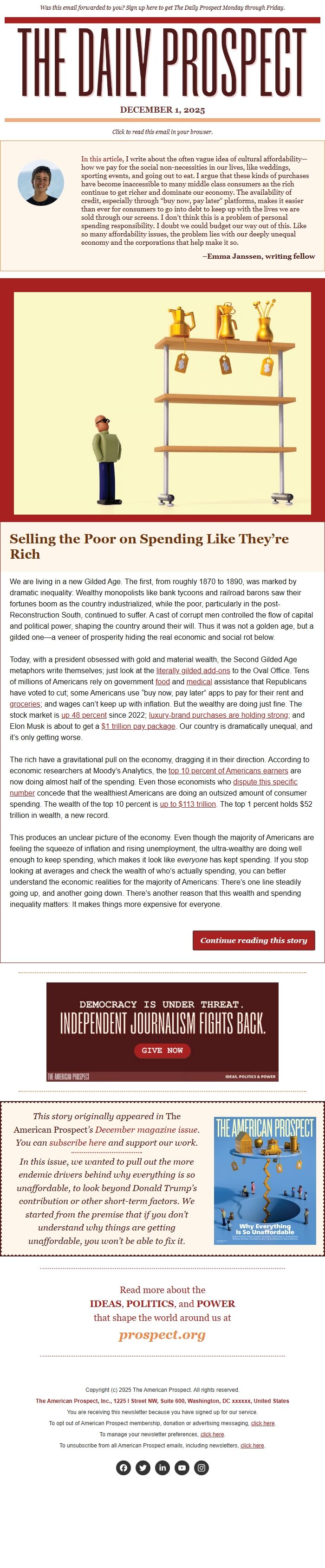
Selling the Poor on Spending Like They’re Rich [link removed]
We are living in a new Gilded Age. The first, from roughly 1870 to 1890, was marked by dramatic inequality: Wealthy monopolists like bank tycoons and railroad barons saw their fortunes boom as the country industrialized, while the poor, particularly in the post-Reconstruction South, continued to suffer. A cast of corrupt men controlled the flow of capital and political power, shaping the country around their will. Thus it was not a golden age, but a gilded one—a veneer of prosperity hiding the real economic and social rot below.
Today, with a president obsessed with gold and material wealth, the Second Gilded Age metaphors write themselves; just look at the literally gilded add-ons [link removed] to the Oval Office. Tens of millions of Americans rely on government food [link removed] and medical [link removed] assistance that Republicans have voted to cut; some Americans use “buy now, pay later” apps to pay for their rent and groceries [link removed]; and wages can’t keep up with inflation. But the wealthy are doing just fine. The stock market is up [link removed] percent [link removed] since 2022; luxury-brand purchases are holding strong [link removed]; and Elon Musk is about to get a $1 trillion pay package [link removed]. Our country is dramatically unequal, and it’s only getting worse.
The rich have a gravitational pull on the economy, dragging it in their direction. According to economic researchers at Moody’s Analytics, the top 10 percent of Americans earners [link removed] are now doing almost half of the spending. Even those economists who dispute this specific number [link removed] concede that the wealthiest Americans are doing an outsized amount of consumer spending. The wealth of the top 10 percent is up to $113 trillion [link removed]. The top 1 percent holds $52 trillion in wealth, a new record.
This produces an unclear picture of the economy. Even though the majority of Americans are feeling the squeeze of inflation and rising unemployment, the ultra-wealthy are doing well enough to keep spending, which makes it look like
**everyone** has kept spending. If you stop looking at averages and check the wealth of who’s actually spending, you can better understand the economic realities for the majority of Americans: There’s one line steadily going up, and another going down. There’s another reason that this wealth and spending inequality matters: It makes things more expensive for everyone.
Continue reading this story [link removed]
prospect.org/donate
**This story originally appeared in** The American Prospect’s December magazine issue [link removed]. You can subscribe here [link removed] and support our work.
**In this issue, we wanted to pull out the more endemic drivers behind why everything is so unaffordable, to look beyond Donald Trump’s contribution or other short-term factors. We started from the premise that if you don’t understand why things are getting unaffordable, you won’t be able to fix it.**
Read more about the [link removed]
IDEAS, POLITICS, and POWER [link removed]
that shape the world around us at [link removed]
prospect.org [link removed]
Copyright (c) 2025 The American Prospect. All rights reserved.**The American Prospect, Inc., 1225 I Street NW, Suite 600, Washington, DC xxxxxx, United States**
You are receiving this newsletter because you have signed up for our service.
To opt out of American Prospect membership, donation or advertising messaging, click here [link removed].
To manage your newsletter preferences, click here [link removed].
To unsubscribe from all American Prospect emails, including newsletters, click here [link removed].
[link removed]
[link removed]
[link removed]
[link removed]
[link removed]
Sent to: [email protected]
Unsubscribe [link removed]
The American Prospect, Inc., 1225 I Street NW, Suite 600, Washington, DC xxxxxx, United States
[link removed]
**DECEMBER 1, 2025**
Click to read this email in your browser. [link removed]
In this article [link removed], I write about the often vague idea of cultural affordability—how we pay for the social non-necessities in our lives, like weddings, sporting events, and going out to eat. I argue that these kinds of purchases have become inaccessible to many middle class consumers as the rich continue to get richer and dominate our economy. The availability of credit, especially through “buy now, pay later” platforms, makes it easier than ever for consumers to go into debt to keep up with the lives we are sold through our screens. I don’t think this is a problem of personal spending responsibility. I doubt we could budget our way out of this. Like so many affordability issues, the problem lies with our deeply unequal economy and the corporations that help make it so.
**–Emma Janssen, writing fellow**
[link removed]
Selling the Poor on Spending Like They’re Rich [link removed]
We are living in a new Gilded Age. The first, from roughly 1870 to 1890, was marked by dramatic inequality: Wealthy monopolists like bank tycoons and railroad barons saw their fortunes boom as the country industrialized, while the poor, particularly in the post-Reconstruction South, continued to suffer. A cast of corrupt men controlled the flow of capital and political power, shaping the country around their will. Thus it was not a golden age, but a gilded one—a veneer of prosperity hiding the real economic and social rot below.
Today, with a president obsessed with gold and material wealth, the Second Gilded Age metaphors write themselves; just look at the literally gilded add-ons [link removed] to the Oval Office. Tens of millions of Americans rely on government food [link removed] and medical [link removed] assistance that Republicans have voted to cut; some Americans use “buy now, pay later” apps to pay for their rent and groceries [link removed]; and wages can’t keep up with inflation. But the wealthy are doing just fine. The stock market is up [link removed] percent [link removed] since 2022; luxury-brand purchases are holding strong [link removed]; and Elon Musk is about to get a $1 trillion pay package [link removed]. Our country is dramatically unequal, and it’s only getting worse.
The rich have a gravitational pull on the economy, dragging it in their direction. According to economic researchers at Moody’s Analytics, the top 10 percent of Americans earners [link removed] are now doing almost half of the spending. Even those economists who dispute this specific number [link removed] concede that the wealthiest Americans are doing an outsized amount of consumer spending. The wealth of the top 10 percent is up to $113 trillion [link removed]. The top 1 percent holds $52 trillion in wealth, a new record.
This produces an unclear picture of the economy. Even though the majority of Americans are feeling the squeeze of inflation and rising unemployment, the ultra-wealthy are doing well enough to keep spending, which makes it look like
**everyone** has kept spending. If you stop looking at averages and check the wealth of who’s actually spending, you can better understand the economic realities for the majority of Americans: There’s one line steadily going up, and another going down. There’s another reason that this wealth and spending inequality matters: It makes things more expensive for everyone.
Continue reading this story [link removed]
prospect.org/donate
**This story originally appeared in** The American Prospect’s December magazine issue [link removed]. You can subscribe here [link removed] and support our work.
**In this issue, we wanted to pull out the more endemic drivers behind why everything is so unaffordable, to look beyond Donald Trump’s contribution or other short-term factors. We started from the premise that if you don’t understand why things are getting unaffordable, you won’t be able to fix it.**
Read more about the [link removed]
IDEAS, POLITICS, and POWER [link removed]
that shape the world around us at [link removed]
prospect.org [link removed]
Copyright (c) 2025 The American Prospect. All rights reserved.**The American Prospect, Inc., 1225 I Street NW, Suite 600, Washington, DC xxxxxx, United States**
You are receiving this newsletter because you have signed up for our service.
To opt out of American Prospect membership, donation or advertising messaging, click here [link removed].
To manage your newsletter preferences, click here [link removed].
To unsubscribe from all American Prospect emails, including newsletters, click here [link removed].
[link removed]
[link removed]
[link removed]
[link removed]
[link removed]
Sent to: [email protected]
Unsubscribe [link removed]
The American Prospect, Inc., 1225 I Street NW, Suite 600, Washington, DC xxxxxx, United States
Message Analysis
- Sender: American Prospect
- Political Party: n/a
- Country: United States
- State/Locality: n/a
- Office: n/a