|
Critical State: JD Vance’s Missteps on Abrego Garcia Case
If you read just one thing this week … read about the US vice president’s follies on a high-profile deportation.
|

| |||||||||||||||


 |
At The New Republic, Greg Sargent breaks down US Vice President JD Vance’s repeated missteps when it comes to the case of Kilmar Abrego Garcia, whom the Trump administration has refused to return from an El Salvador prison even after admitting that his deportation was an “administrative error.”
Once a Never Trump, Vance is now the second-in-command — and he’s proven himself loyal to Donald Trump even in the most controversial cases. As of late, he has tweeted himself into a frenzy to defend the Trump administration’s insistence that it won’t return Abrego Garcia to the US. The deportation, of course, happened without Abrego Garcia receiving due process. Vance has argued otherwise, insisting that Abrego Garcia is a “terrorist.”
“When Vance claims that Abrego Garcia is validly subject to deportation, he’s effectively admitting that the administration does have those alternative options,” Sargent wrote. “Remember, the Supreme Court declared Abrego Garcia’s current removal ‘illegal.’ Trump has the option of moving to deport him in a way that is not illegal. Why not bring him back and do this the lawful way? The question remains unanswered.”
The way Sargent sees it, Vance already knows that the Trump administration could return Abrego Garcia and then try to lawfully deport him. Instead, the vice president is content to simply forget Abrego Garcia in a foreign prison.
“Does Vance really think that outcome would be a more proportional punishment for his transgression of entering the country illegally at the age of 16, as Abrego Garcia did, than removing him more conventionally would be?” Sargent concluded.
If You Read One More Thing: The Kahane Effect
In The Guardian’s long reads section, Joshua Leifer explored the legacy of the far-right American Israeli settler leader Meir Kahane:
Kahane immigrated to present-day Israel in 1971. He founded the hardline, ultra-nationalist Kach party, became an influential advocate of extreme violence against the Palestinians, and advocated for their expulsion from their historic homeland. An Egyptian-born American man named El Sayyid Nosair assassinated Kahane in New York in 1990.
“Kahane’s political career was marked by failure,” wrote Leifer. “Throughout his life he appeared to most Israelis to be a grotesque US import. His relentless demagogic campaign to expel the Palestinians won him notoriety and a small cadre of fanatical followers.”
Kahanism, the ideology he left behind, has outlived him and has now found broad currency in Israeli society. “Thirty years ago, Kahane was the name of a man who most thought would be forgotten,” he went on. “Today, Kahanism is the governing coalition’s operational ideology.”
American Journalism in Exile?
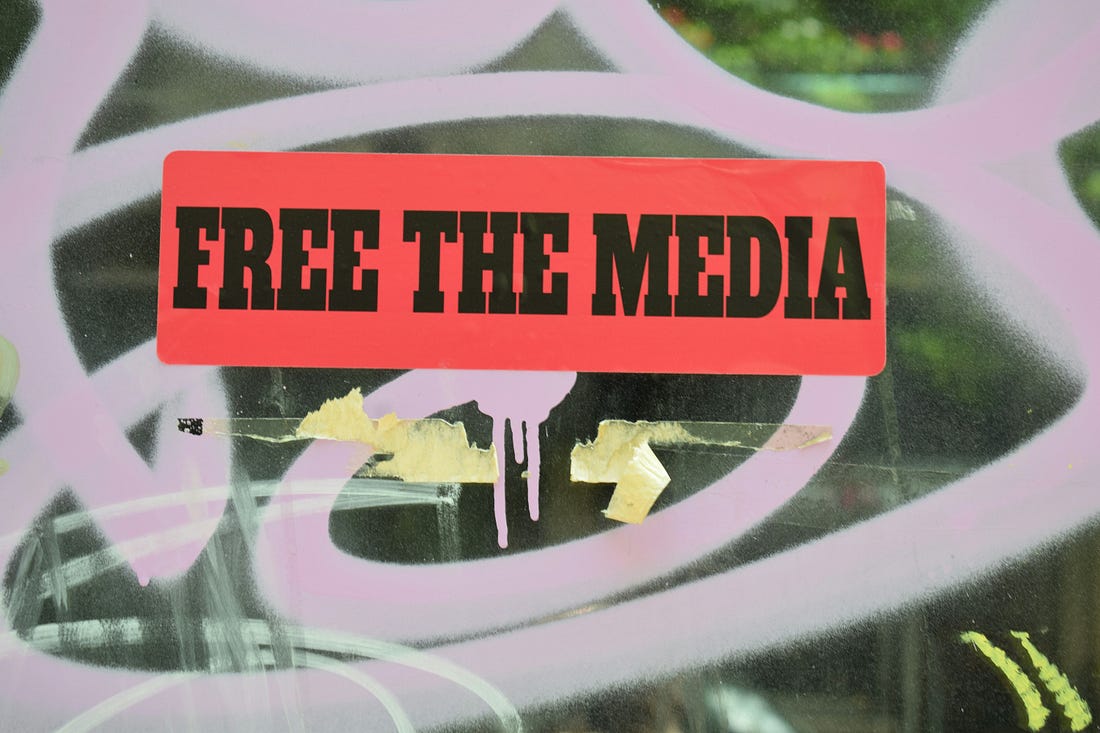 |
At the American Prospect, Robert Kuttner examined the growing number of signs of the Trump administration’s coming war on the free press.
While some legacy media have already started to cave to the Trump administration through self-censorship, the president has made a point of lashing out at the media at large. Now, nonprofit newsrooms — including Inkstick — could be at detrimental risk if Trump follows through on his promises to attack their tax-exempt statuses.
“Trump’s abrupt efforts to summarily remove the tax exemptions of institutions such as Harvard University were flatly illegal,” Kuttner explained. “The law explicitly prohibits a president from instructing the IRS to target a particular institution. Due process is required before an exemption can be lifted. And the rationale cannot be simply political.”
The American Prospect, among others, has already begun to move toward a funding model that relies far more heavily on readers. Kuttner also pointed out that American press could set up shop abroad to continue critical reporting: “Some of the best English-language journalism comes from overseas. … During World War II, London-based media penetrated Nazi censorship. One could imagine an American free press publishing or broadcasting in exile.”
Deep Dive: Border Walls Are Bad for Wildlife
Walls, fences, razor wire, and other physical barriers all make crossing a border a much more dangerous undertaking. In some cases, people on the move fall off walls, injuring themselves or even dying, and in others, the barriers force them into riskier — and potentially more fatal — journeys through rougher terrain.
But that’s not the only way that border walls and other physical barriers pose serious threats to the world. A recent study in the journal Biological Conservation dug deep into the dangers these border barriers impose on wildlife.
Authors Carol L. Chambers and Cole Sennett found that walls and fences take a drastic toll on wildlife species and “fragment habitat, reduce gene flow, and access to important resources.” For east-west borders, climate change will only make the risks more severe.
Although the “construction of barriers to enforce borders dates back thousands of years,” border walls and fences have been on the rise since 2001, the paper explained.
Border walls often prevent migratory paths for wildlife, destroy their habitats, and leave them at greater danger of injury at the hands of poachers or even “fence entanglement,” among other consequences.
Take the US-Mexico border, which the authors described as a “prominent example.” In 1993, US authorities began constructing sections of the border wall between San Diego and its Mexican counterpart, Tijuana. As politicians have time and again expanded and fortified that wall, including in other southwestern states, it has resulted in considerable damage for both wildlife and “binational conservation” between Mexico and the US.
Yet, it’s not just the US-Mexico border that has proven detrimental to wildlife species. A fence spans around 70% of the India-Bangladesh border, and much of it includes razor wire. India built the barrier to stop people on the move from entering the country.
Both elephants and residents of rural communities bore the brunt of it. That fence has “interrupted historical migration routes of Asian elephants,” Chambers and Sennett wrote, and “trapped animals in populated rural areas,” which led the elephants to change routes and destroy “agricultural land and homes.”
Despite harms like these, the paper noted, “the construction of international border walls has intensified globally with the refugee crises in Europe and Asia and after the terrorist attacks on the United States” on Sept. 11, 2001.
In fact, some scholars have estimated that there are at least 30,000 kilometers (18,641 miles) of fencing and walls on borders in Eurasia, the paper added, and as of 2012, some “13.2 % of the world's borders [had] a physical barrier.”
In other words, governments and politicians might advocate for border barriers as a way to make it more difficult for refugees and migrants to cross boundaries, but it’s wildlife that has to often shoulder the consequences.
What should governments do about that? According to Chambers and Sennett, they might want to consider “cross-border collaboration, creation of peace parks, use of technologically advanced surveillance instead of physical barriers, placing fences in areas that would not disrupt wildlife migration routes, creating wildlife-friendly openings in fences, and wildlife-friendly fencing.”
Show Us the Receipts
Here at Inkstick, we recently published an excerpt from Palestinian journalist and author Mohammed Omer Almoghayer’s upcoming book, The Pleasures of Living in Gaza (courtesy of OR Books). The excerpt tells the story of two men, Adli and Mansour, who became inseparable best friends after each lost a leg during Israeli strikes on the Strip. They even pool their money to buy a single pair of shoes – they wear the same size – whenever they want new kicks.
Meanwhile, Johannes Streeck reported on the “necropolitics” of US border policy in the country’s southwest. Since the US began using the policy of deterrence to push people on the move into more dangerous routes, Streeck wrote, Border Patrol has tallied at least 10,000 deaths. Still, he explained, “local rights groups at the border believe the number could be up to 80,000, with thousands more disappeared.”
At The World, Daniel Ofman took a hard look at the complications of polling Russian public opinion during authoritarian rule and wartime. “It’s hard to know what exactly Russians think about Putin’s comments [about Ukraine], or even about the war in Ukraine,” Ofman explained, “as one of the hallmarks of this kind of autocratic government is making it harder to gauge public opinion, especially with limited access to data that’s not generated by the government.”
We’re Asking for Your Help
Listen, things are grim. Inkstick is a nonprofit newsroom, and the Trump administration has plans to ramp up its attacks on the free press. I wrote about all this in a Substack last week here. Point is, we’re asking for your support to help us prepare for the fight ahead. Here’s how you can have Inkstick’s back: Donate, become a paid subscriber on Substack, and share our reporting.
 |
Critical State is written by Inkstick Media in collaboration with The World.
The World is a weekday public radio show and podcast on global issues, news, and insights from PRX and GBH.
With an online magazine and podcast featuring a diversity of expert voices, Inkstick Media is “foreign policy for the rest of us.”
Critical State is made possible in part by the Carnegie Corporation of New York.
You're currently a free subscriber to Inkstick’s Substack. For the full experience, upgrade your subscription.
| ||||||||||