Legislative Update
Dear Neighbor,
Monday was a big day in the House Fraud Prevention and State Agency Oversight Committee because it provided our first opportunity to have Attorney General Keith Ellison testify regarding a December 11, 2021 meeting he attended with business owners connected to the $250 million Feeding Our Future scandal.
In particular, we wanted to dig deeper into a 54-minute recording that was exhibit #710 in the Feed Our Future trial and ask him to explain why he offered to help the fraudsters fight against the state agencies. We pressed Ellison on why he met with the group and what he said to individuals who were already under investigation.
During the meeting, we played three key portions of the audio recording (Clip 1, Clip 2, Clip 3), which captured the business owners expressing frustration to Ellison over the state’s decision to withhold federal reimbursements related to the Feeding Our Future program earlier that year. It is clear Ellison appeared to be more concerned about the business owners than ensuring that services were actually delivered to those in need.
Unfortunately, Ellison sidestepped addressing the substance of his remarks during the meeting with people who were later indicted. He failed to explain why, when speaking with constituents linked to Feeding Our Future, he stressed — in his own words — the need to “keep business going” and "keep the business running.”
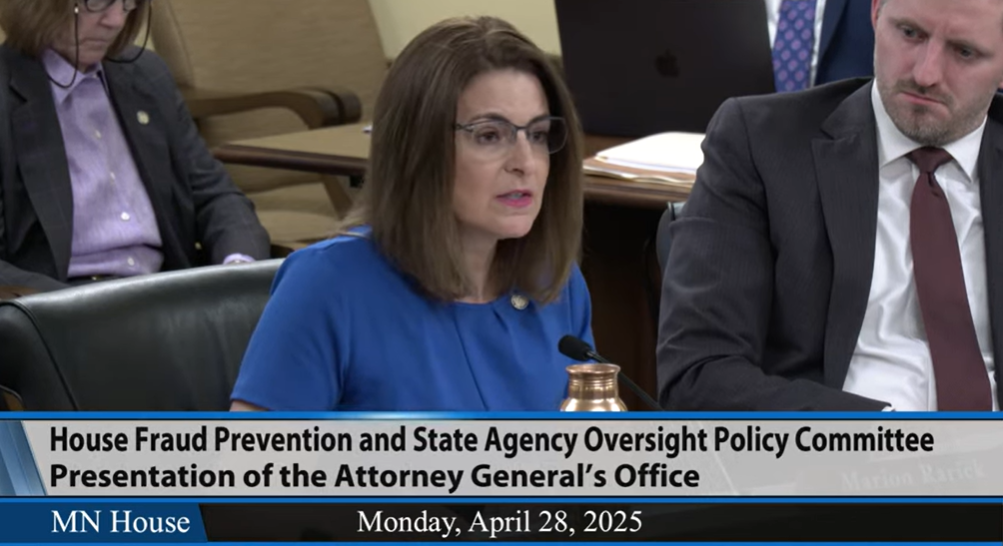 One article covering the meeting quoted me pushing for more from Ellison:
“The fraudsters literally go through step by step, the how they do it, the who's involved. At the very beginning of the tape, they spell their names,” Rep. Marion Rarick, R-Maple Lake, said. “They go through and talk about specifically the program that was being defrauded. And then you said, ‘Hey, tell me more about that.’”
Instead of providing answers Minnesotans deserve, Ellison’s testimony only raises more serious questions.
My takeaway is he either is inept and truly had no idea what was happening in his own Constitutional Office, or he knew exactly who they were and still offered to help them “battle against” the Department of Human Services and the Minnesota Department of Education (who are his clients).
Ellison claims he didn't know who they were, but they told him exactly who they were. One was the owner of Safari Restaurant, who was just convicted alongside Amy Bock, of 21 federal felonies. He was the ringleader. On the tape, they tell Ellison how the “system” works, how they used it, and that they had to sue MDE to try to get their money. The owner of Safari tells him he sued MDE.
Ellison had just defended MDE against “the vendors” as he repeatedly said. These were THOSE vendors, and they made it quite clear. They didn't hide who they were.
Ellison, at the end of the tape, can be heard offering to help them, by calling the DHS and MDE commissioners into his office, demanding answers as to why they are going after East African businesses.
The FBI raided Feeding Our Future one month later, January 2022. In Ellison's own press release from September 2022 (less than one year after this meeting) he brags that he had worked extremely closely with the FBI for the 2 years prior, which was a full year before this meeting.
This story is far from over, so stay tuned. Click here for the full committee hearing video.
Higher Ed bill
The Minnesota House on Monday approved an omnibus higher education package (H.F. 2431) which takes steps toward closing a major State Grant Program shortfall without increasing state spending.
As chair of the House Higher Education Committee, I led a top-down, inside-out examination of our state’s higher education budget to determine exactly what is happening with the tax dollars our state is providing so adjustments could be made as necessary.
The result is bipartisan agreement on a $3.98 billion plan which holds that part of the state’s budget flat the next two years as the state faces a $6 billion shortfall. It makes policy changes and cuts to significantly close a $239 million State Grant shortfall, which is equivalent to one entire years’ worth of grants. This greatly reduces the gap – a $62 million hole remains – without immediately impacting students.
With a 67- 67 tie in the House, bipartisanship is essential for bills to pass this session. My objective with this bill is to tighten up unnecessary or inefficient state spending while holding students harmless. We asked the tough questions, made difficult decisions and ultimately crafted a bill that accomplishes those goals
The bill delivers cuts of $36.4 million for 2026-27 and another $38.282 million in the two-year cycle to follow, reappropriating the savings to the State Grant Program deficit. This includes reducing and then eliminating the Student Parent Support Initiative, a program that was just put into place by the trifecta two years ago, saving $10 million over four years. In addition, Mayo Clinic funding is eliminated from the Office of Higher Education’s budget, a $3.6 million reduction. The cut is a drop in the bucket compared with Mayo’s 2024 gross revenue of around $18.8 billion.
The bill also cuts $500,000 in cannabis dual training funds because. That appropriation is unnecessary since the market is not up and running. It also eliminates funding that was going to Lutheran Social Services, which has 10 employees making more than the governor and a CEO making $420,000. A student loan counseling program also is stripped of funding in the bill, saving taxpayers $400,000 per biennium.
Republicans stood firm on closing that massive State Grant Program deficit through cuts to other areas of the budget, then applying those savings to the state grant and dialing back the overly generous parameters that sent money flowing out like a high-pressure fire hose. To my knowledge, nobody has gone to the depths we’ve gone by pouring over data and asking tough questions this session. After initial reluctance, Democrats finally agreed to the spending cuts we identified, and we were able to bring forward a bill worthy of bipartisan support from the full body.
One area of new spending I do support is $3 million for base funding of the U of M & CentraCare medical school in St. Cloud to train doctors as there is a shortage in Greater Minnesota.
The bill passed 120-14. A conference committee soon will work to reconcile differences between the bill approved by the House and a separate higher education package that is moving through the Senate so votes on final approval can take place.
Public safety bill
The House approved a Public Safety omnibus finance bill (H.F. 2432) on Friday. It focuses on core safety needs, smart corrections policy, and expanded officer training while eliminating waste and making targeted investments that will have a real impact.
Legislation I co-authored (H.F. 1082) to establish a Minnesota Victims of Crime Account is included in the bill. This measure addresses a wild inconsistency in funding to support the rising number of crime victims in our state. It is the result of bipartisan efforts between Rep. Kelly Moller and me seeking solutions to stabilize this important issue. Here is an article with more background. Other key wins in the bill include:
- Tougher penalties for sex traffickers who prey on minors, inmates who assault correctional officers, and individuals who expose children to deadly fentanyl.
- Over $8 million per year to help departments across Minnesota with officer training, use-of-force education, and reimbursement for local public safety efforts.
- Meaningful justice reform that extends the statute of limitations for first-degree arson, pauses the expiration of probation fees, and sets up a bipartisan working group on transparency.
- Redirected $23 million from past DFL overspending into essential, one-time upgrades for cybersecurity and court technology without growing the size of government.
- Increased transparency at the Met Council by classifying certain members as “public officials” under state data practices laws.
One major disappointment regarding this bill is House Democrats defeated an amendment that would strengthen immigration enforcement. This initiative complements the Laken Riley Act, which has been seen at the national level and signed by President Trump. It mandates reporting to ICE when people in our state illegally are arrested for violent crimes, including murder, assault, carjacking, and kidnapping. It also prevents local governments from obstructing immigration enforcement by banning sanctuary city policies that protect criminals from deportation.
This initiative reflects House Republicans’ commitment to ensuring the safety of communities across Minnesota. It is unfortunate ALL 67 House Democrats voted against this amendment, siding with people who are in our country illegally instead of protecting the rest of us.
|