
Email
Road warriors, stealthy plants and stressed trees: Indulge your curiosity with NotMISpecies webinars
| From | Michigan DNR <[email protected]> |
| Subject | Road warriors, stealthy plants and stressed trees: Indulge your curiosity with NotMISpecies webinars |
| Date | December 4, 2024 6:31 PM |
Links have been removed from this email. Learn more in the FAQ.
Links have been removed from this email. Learn more in the FAQ.
Register now for 2025 webinars!
Share or view as webpage [ [link removed] ] | Update preferences [ [link removed] ]
Michigan Invasive Species Program banner [ [link removed] ]
"News Release"
Dec. 4, 2024
Contact: Joanne Foreman <[email protected]>, 517-284-5814
Road warriors, stealthy plants and stressed trees: Indulge your curiosity with NotMISpecies webinars
Did you know that road rights-of-way can be hot spots of invasive species infestation? Were you aware that that some retailers in Michigan will take back aquarium pets if you have too many? Have you heard about lesser celandine, Michigan’s newest watch list plant? Have you thought about the impacts of climate change on Michigan’s forests?
If you are curious about these or other invasive species issues, check out the NotMISpecies webinar series.
Supported by the Michigan Invasive Species program, the monthly, hourlong webinars are designed to keep people informed about available programs, current research and emerging issues in the state and the Great Lakes region. Question and answer sessions and links to resources help attendees get the most out of each presentation.
Pesky pets and plants
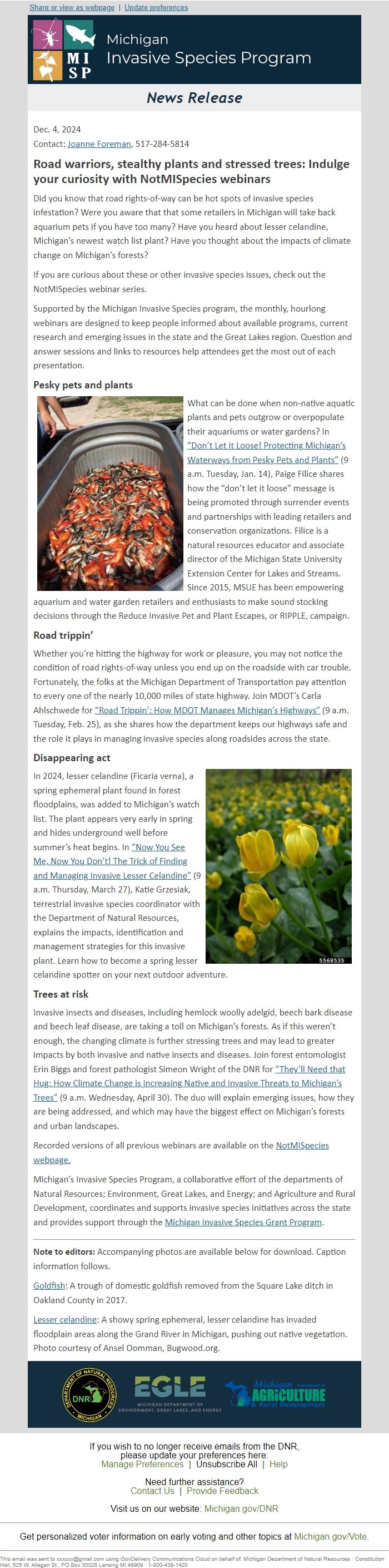
A stock tank of orange and black goldfish removed from a ditch in Oakland County, MI.
What can be done when non-native aquatic plants and pets outgrow or overpopulate their aquariums or water gardens? In “Don’t Let it Loose! Protecting Michigan’s Waterways from Pesky Pets and Plants” [ [link removed] ] (9 a.m. Tuesday, Jan. 14), Paige Filice shares how the “don’t let it loose” message is being promoted through surrender events and partnerships with leading retailers and conservation organizations. Filice is a natural resources educator and associate director of the Michigan State University Extension Center for Lakes and Streams. Since 2015, MSUE has been empowering aquarium and water garden retailers and enthusiasts to make sound stocking decisions through the Reduce Invasive Pet and Plant Escapes, or RIPPLE, campaign.
Road trippin’
Whether you’re hitting the highway for work or pleasure, you may not notice the condition of road rights-of-way unless you end up on the roadside with car trouble. Fortunately, the folks at the Michigan Department of Transportation pay attention to every one of the nearly 10,000 miles of state highway. Join MDOT’s Carla Ahlschwede for “Road Trippin’: How MDOT Manages Michigan’s Highways” [ [link removed] ] (9 a.m. Tuesday, Feb. 25), as she shares how the department keeps our highways safe and the role it plays in managing invasive species along roadsides across the state.
Disappearing act
An infestation of lesser celandine, here with petals closed, along a floodplain.
In 2024, lesser celandine (Ficaria verna), a spring ephemeral plant found in forest floodplains, was added to Michigan’s watch list. The plant appears very early in spring and hides underground well before summer’s heat begins. In “Now You See Me, Now You Don’t! The Trick of Finding and Managing Invasive Lesser Celandine” [ [link removed] ] (9 a.m. Thursday, March 27), Katie Grzesiak, terrestrial invasive species coordinator with the Department of Natural Resources, explains the impacts, identification and management strategies for this invasive plant. Learn how to become a spring lesser celandine spotter on your next outdoor adventure.
Trees at risk
Invasive insects and diseases, including hemlock woolly adelgid, beech bark disease and beech leaf disease, are taking a toll on Michigan’s forests. As if this weren’t enough, the changing climate is further stressing trees and may lead to greater impacts by both invasive and native insects and diseases. Join forest entomologist Erin Biggs and forest pathologist Simeon Wright of the DNR for “They’ll Need that Hug: How Climate Change is Increasing Native and Invasive Threats to Michigan’s Trees” [ [link removed] ] (9 a.m. Wednesday, April 30). The duo will explain emerging issues, how they are being addressed, and which may have the biggest effect on Michigan’s forests and urban landscapes.
Recorded versions of all previous webinars are available on the NotMISpecies webpage. [ [link removed] ]
Michigan’s Invasive Species Program, a collaborative effort of the departments of Natural Resources; Environment, Great Lakes, and Energy; and Agriculture and Rural Development, coordinates and supports invasive species initiatives across the state and provides support through the Michigan Invasive Species Grant Program [ [link removed] ].
________________________________________________________________________
*Note to editors:* Accompanying photos are available below for download. Caption information follows.
Goldfish [ [link removed] ]: A trough of domestic goldfish removed from the Square Lake ditch in Oakland County in 2017.
Lesser celandine [ [link removed] ]: A showy spring ephemeral, lesser celandine has invaded floodplain areas along the Grand River in Michigan, pushing out native vegetation. Photo courtesy of Ansel Oomman, Bugwood.org.
DNR Logo 24 bit PNGDept of Environment, Great Lakes and Energy logoMDARD Logo
If you wish to no longer receive emails from the DNR,
please update your preferences here:
Manage Preferences [ [link removed]? ] | Unsubscribe All [ [link removed] ] | Help [ [link removed] ]
Need further assistance?
Contact Us [ [link removed] ] | Provide Feedback <[email protected]>
Visit us on our website: Michigan.gov/DNR [ [link removed] ]
________________________________________________________________________
Get personalized voter information on early voting and other topics at Michigan.gov/Vote [ [link removed] ].
________________________________________________________________________
This email was sent to [email protected] using GovDelivery Communications Cloud on behalf of: Michigan Department of Natural Resources · Constitution Hall, 525 W. Allegan St., PO Box 30028 Lansing MI 48909 · 1-800-439-1420
Share or view as webpage [ [link removed] ] | Update preferences [ [link removed] ]
Michigan Invasive Species Program banner [ [link removed] ]
"News Release"
Dec. 4, 2024
Contact: Joanne Foreman <[email protected]>, 517-284-5814
Road warriors, stealthy plants and stressed trees: Indulge your curiosity with NotMISpecies webinars
Did you know that road rights-of-way can be hot spots of invasive species infestation? Were you aware that that some retailers in Michigan will take back aquarium pets if you have too many? Have you heard about lesser celandine, Michigan’s newest watch list plant? Have you thought about the impacts of climate change on Michigan’s forests?
If you are curious about these or other invasive species issues, check out the NotMISpecies webinar series.
Supported by the Michigan Invasive Species program, the monthly, hourlong webinars are designed to keep people informed about available programs, current research and emerging issues in the state and the Great Lakes region. Question and answer sessions and links to resources help attendees get the most out of each presentation.
Pesky pets and plants
A stock tank of orange and black goldfish removed from a ditch in Oakland County, MI.
What can be done when non-native aquatic plants and pets outgrow or overpopulate their aquariums or water gardens? In “Don’t Let it Loose! Protecting Michigan’s Waterways from Pesky Pets and Plants” [ [link removed] ] (9 a.m. Tuesday, Jan. 14), Paige Filice shares how the “don’t let it loose” message is being promoted through surrender events and partnerships with leading retailers and conservation organizations. Filice is a natural resources educator and associate director of the Michigan State University Extension Center for Lakes and Streams. Since 2015, MSUE has been empowering aquarium and water garden retailers and enthusiasts to make sound stocking decisions through the Reduce Invasive Pet and Plant Escapes, or RIPPLE, campaign.
Road trippin’
Whether you’re hitting the highway for work or pleasure, you may not notice the condition of road rights-of-way unless you end up on the roadside with car trouble. Fortunately, the folks at the Michigan Department of Transportation pay attention to every one of the nearly 10,000 miles of state highway. Join MDOT’s Carla Ahlschwede for “Road Trippin’: How MDOT Manages Michigan’s Highways” [ [link removed] ] (9 a.m. Tuesday, Feb. 25), as she shares how the department keeps our highways safe and the role it plays in managing invasive species along roadsides across the state.
Disappearing act
An infestation of lesser celandine, here with petals closed, along a floodplain.
In 2024, lesser celandine (Ficaria verna), a spring ephemeral plant found in forest floodplains, was added to Michigan’s watch list. The plant appears very early in spring and hides underground well before summer’s heat begins. In “Now You See Me, Now You Don’t! The Trick of Finding and Managing Invasive Lesser Celandine” [ [link removed] ] (9 a.m. Thursday, March 27), Katie Grzesiak, terrestrial invasive species coordinator with the Department of Natural Resources, explains the impacts, identification and management strategies for this invasive plant. Learn how to become a spring lesser celandine spotter on your next outdoor adventure.
Trees at risk
Invasive insects and diseases, including hemlock woolly adelgid, beech bark disease and beech leaf disease, are taking a toll on Michigan’s forests. As if this weren’t enough, the changing climate is further stressing trees and may lead to greater impacts by both invasive and native insects and diseases. Join forest entomologist Erin Biggs and forest pathologist Simeon Wright of the DNR for “They’ll Need that Hug: How Climate Change is Increasing Native and Invasive Threats to Michigan’s Trees” [ [link removed] ] (9 a.m. Wednesday, April 30). The duo will explain emerging issues, how they are being addressed, and which may have the biggest effect on Michigan’s forests and urban landscapes.
Recorded versions of all previous webinars are available on the NotMISpecies webpage. [ [link removed] ]
Michigan’s Invasive Species Program, a collaborative effort of the departments of Natural Resources; Environment, Great Lakes, and Energy; and Agriculture and Rural Development, coordinates and supports invasive species initiatives across the state and provides support through the Michigan Invasive Species Grant Program [ [link removed] ].
________________________________________________________________________
*Note to editors:* Accompanying photos are available below for download. Caption information follows.
Goldfish [ [link removed] ]: A trough of domestic goldfish removed from the Square Lake ditch in Oakland County in 2017.
Lesser celandine [ [link removed] ]: A showy spring ephemeral, lesser celandine has invaded floodplain areas along the Grand River in Michigan, pushing out native vegetation. Photo courtesy of Ansel Oomman, Bugwood.org.
DNR Logo 24 bit PNGDept of Environment, Great Lakes and Energy logoMDARD Logo
If you wish to no longer receive emails from the DNR,
please update your preferences here:
Manage Preferences [ [link removed]? ] | Unsubscribe All [ [link removed] ] | Help [ [link removed] ]
Need further assistance?
Contact Us [ [link removed] ] | Provide Feedback <[email protected]>
Visit us on our website: Michigan.gov/DNR [ [link removed] ]
________________________________________________________________________
Get personalized voter information on early voting and other topics at Michigan.gov/Vote [ [link removed] ].
________________________________________________________________________
This email was sent to [email protected] using GovDelivery Communications Cloud on behalf of: Michigan Department of Natural Resources · Constitution Hall, 525 W. Allegan St., PO Box 30028 Lansing MI 48909 · 1-800-439-1420
Message Analysis
- Sender: State of Michigan
- Political Party: n/a
- Country: United States
- State/Locality: MIchigan
- Office: n/a
-
Email Providers:
- govDelivery