IN THE DISTRICT
Virginia Delegation Receives an Update on Postal Service Issues
As you may recall, for over a year, I have worked with Senators Warner and Kaine to address significant delays in mail delivery through the US Postal Service Richmond Distribution Center. These efforts have included constituent casework, letters to regional and national USPS leadership, and the Office of the Inspector General, a meeting with Postmaster DeJoy, and a tour of the Richmond Distribution Center itself.
Last week, I joined Senators Kaine and Warner and Rep. Spanberger for a briefing from Postmaster Louis DeJoy and regional USPS officials on their progress addressing mail delays. We also heard about the efforts they are taking to ensure the timely delivery of election mail, including ballots. You can learn more about our meeting in the Richmond Times-Dispatch or CBS6-WTVR.
I am encouraged by USPS’s progress to improve mail delivery and steps to prioritize and ensure the timely delivery of ballots. However, I encourage voters to not wait until the last minute to request or mail in your absentee ballot. Remember, the deadline to request an absentee ballot is October 25th. Ballots must be postmarked by November 5th and received by November 8th at 12:00pm ET. You can also vote in person now until November 2nd. You can find more information here.
VCU Symposium on Improving Black Maternal Health Outcomes
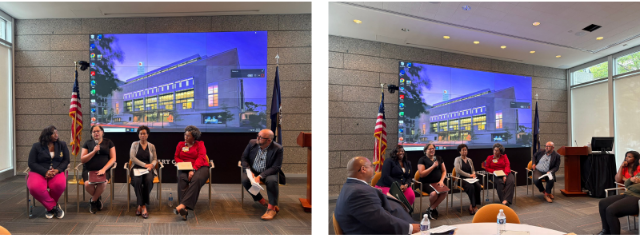
The United States faces severe maternal and infant health crises, as women here are three times more likely to die during childbirth or postpartum than any other high-income nation in the world. Those rates are even worse for Black mothers, who are three times more likely than white mothers to die during childbirth. I know the risks firsthand, as I nearly died giving birth to my daughter, who was born 9 weeks prematurely and had to spend six weeks in the NICU. To discuss my work as a policymaker to address the maternal health crisis, I joined Virginia Commonwealth University’s Symposium on Improving Birth Outcomes for the Black Community.
Countless factors contribute to our maternal health crisis and its disproportionate impact on Black women, including:
- Lack of access to quality, affordable, culturally competent health care, including comprehensive reproductive health care;
- Health disparities in cardiovascular disease or
- Environmental injustices like air pollution, PFAS, and other toxic chemicals;
- Lack of education and support systems surrounding pregnancy, birth, and the postpartum period;
- The exorbitant cost of child care; and
- The lingering impacts of 300 years of slavery and Jim Crow.
I’m fighting every day in Congress to advance policies that address these intersectional crises and improve health outcomes for every American. I’ve worked to address these disparities through public policy since my days as a state legislator, when I championed passage of the Pregnant Worker Fairness Act and extending Medicaid coverage for new mothers from 60 days to 12 months. Now in Congress, I am working as a member of the Black Maternal Health Caucus to pass the Momnibus Act.
Virginia Tribal Education Consortium Annual Conference Commemorates the 100th Anniversary of the Racial Integrity Act and the Indian Citizenship Act
Long before Europeans arrived on the shores of Virginia, several tribes of Algonquian, Iroquoian, and Siouan speaking people had lived here for thousands of years. Today, eleven state-recognized tribes remain, seven of which have gained federal recognition. Gaining federal recognition was not easy, however, due to a dark stain on Virginia history that occurred 100 years ago.
In 1924, the Virginia General Assembly passed The Racial Integrity Act, which was designed to preserve white racial purity by banning interracial marriage and intermingling of races. The law required persons to be categorized as "white," "colored," or "mixed," and defined a white person as one “with no trace of the blood of another race,” except “persons who have one-sixteenth or less of the blood of the American Indian." One of the Act’s main proponents, Dr. Walter Ashby Plecker, enforced it as head of Virginia’s Bureau of Vital Statistics from 1912-1946. His racist belief that “there are no native born Virginia Indians free from negro intermixture,” and his authority to determine racial identity by physical features and family names led to the erasure of Virginia Indian identity. As a result, Virginia tribes had difficulty proving an unbroken lineage, one of the requirements for federal recognition as a sovereign nation.
The Supreme Court struck down the Racial Integrity Act in its 1967 Loving v. Virginia decision. However, the law remained on Virginia’s books until I carried legislation in 2020 repealing it. Learn more about how this odious law impacted Virginia Tribes here.
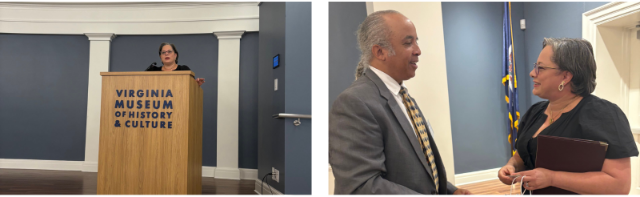
Today, the seven federally recognized tribes collaborate through the Virginia Tribal Education Consortium to build the leadership capacity to support academic excellence, cultural awareness, and historical accuracy. I was honored to join VTEC for its annual conference to discuss the profound impact of the Virginia Racial Integrity Act of 1924, as well as the Indian Citizenship Act of 1924, which declared Indigenous persons born within the United States to be U.S. citizens. The conference focused on the resiliency of the Virginia Tribes as they reclaim their identity 100 years after Walter Plecker sought to erase it.
|